
From Data to Wisdom: Scaling Intelligent Agents via Knowledge Mining
From data mining to knowledge mining: Application to intelligent agents
This paper introduces a "Knowledge Mining" paradigm that applies data mining techniques—specifically clustering and classification—directly to induction rules rather than raw data. It proposes the Miner Intelligent Agent (MIA), which utilizes K-means-IR and K-NN-IR algorithms to manage large-scale knowledge bases, achieving significantly faster reasoning in cognitive agents.
TL;DR
As data explodes, the knowledge bases of AI agents become bottlenecks. This paper proposes a paradigm shift from mining raw data to mining induction rules. By introducing "Knowledge Mining" via adapted K-means and K-NN algorithms, the authors created the Miner Intelligent Agent (MIA)—an architecture that clusters rules into "meta-knowledge" to accelerate reasoning by focusing only on relevant rule subsets.
The Scalability Wall in Cognitive Agents
Traditional cognitive agents rely on inference engines to traverse a Knowledge Base (KB). However, when a KB contains tens of thousands of induction rules (e.g., IF temperature=hot AND humidity=low THEN play_tennis=yes), the agent slows down significantly. Every new fact from the environment forces the agent to evaluate the entire rule set.
The authors argue that we shouldn't just mine data to find rules; we need to mine the rules themselves to find patterns—essentially creating "meta-rules" that organize the agent's brain into specialized clusters.
Methodology: High-Dimensional Rule Geometry
To apply clustering to symbolic logic, the authors had to redefine the basic "physics" of the rule space:
1. The Dist_clauses Metric
They proposed a similarity measure based on shared symbolic components: This formula treats rules as sets of logical clauses, measuring how much "information overlap" exists between two distinct pieces of knowledge.
2. Centroid Computation (The Gravity of Knowledge)
In a standard K-means algorithm, the "mean" of data points is easy to calculate. But what is the "average" of three logical rules? The paper explores three strategies:
- UCI (Union Over Intersection): Complex but thorough.
- IUC (Intersection Union Center): Fast but less accurate.
- UIC (Union Intersection Center): The "sweet spot" that performs a logical union of rules followed by an intersection with the previous centroid.
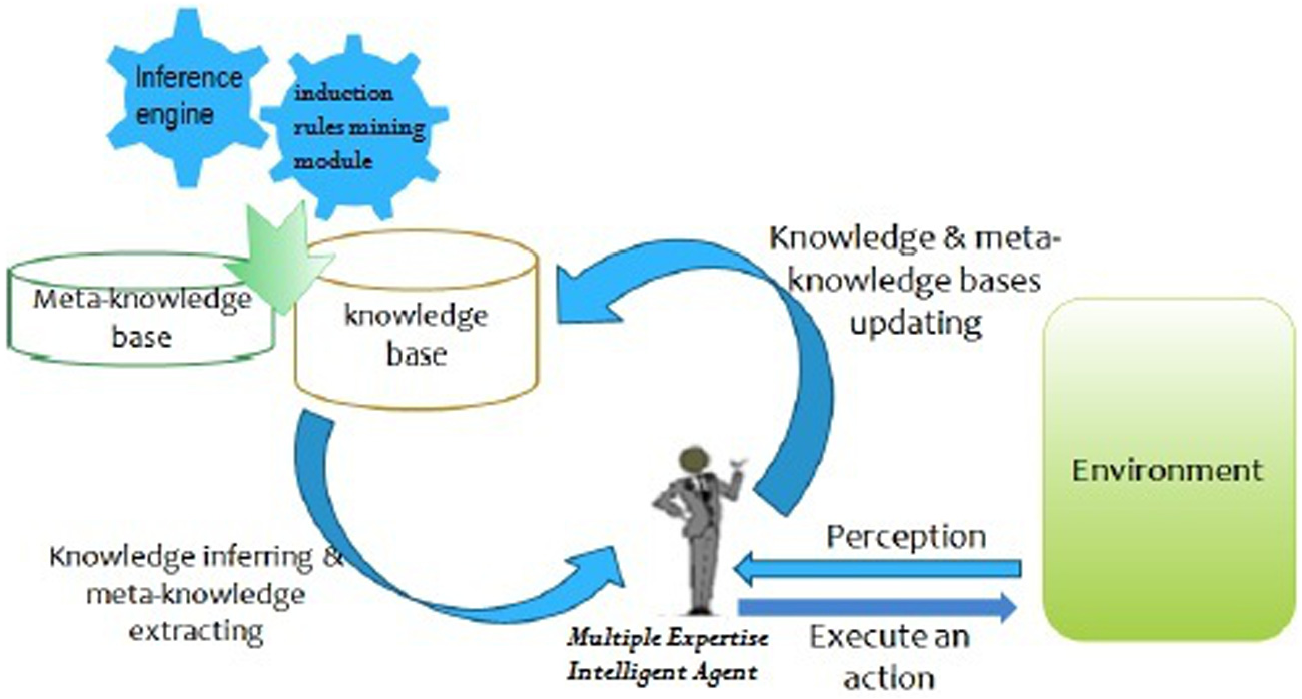 The Miner Intelligent Agent (MIA) architecture uses a specialized mining module to bridge the gap between a huge Knowledge Base and the Inference Engine.
Experiments: When Knowledge Mining Wins
The team tested their approach on 25,000 rules derived from UCI benchmarks (Chess, Abalone, Car Evaluation).
The "Cross-Over" Efficiency
One of the most profound findings is the relationship between KB size and reasoning speed. When the KB is small (<7,500 rules), a classic agent is faster because the MIA's "clustering overhead" isn't worth it. However, once the KB crosses the 7,500-rule threshold, the MIA's pre-organized meta-knowledge allows it to outpace traditional agents significantly.
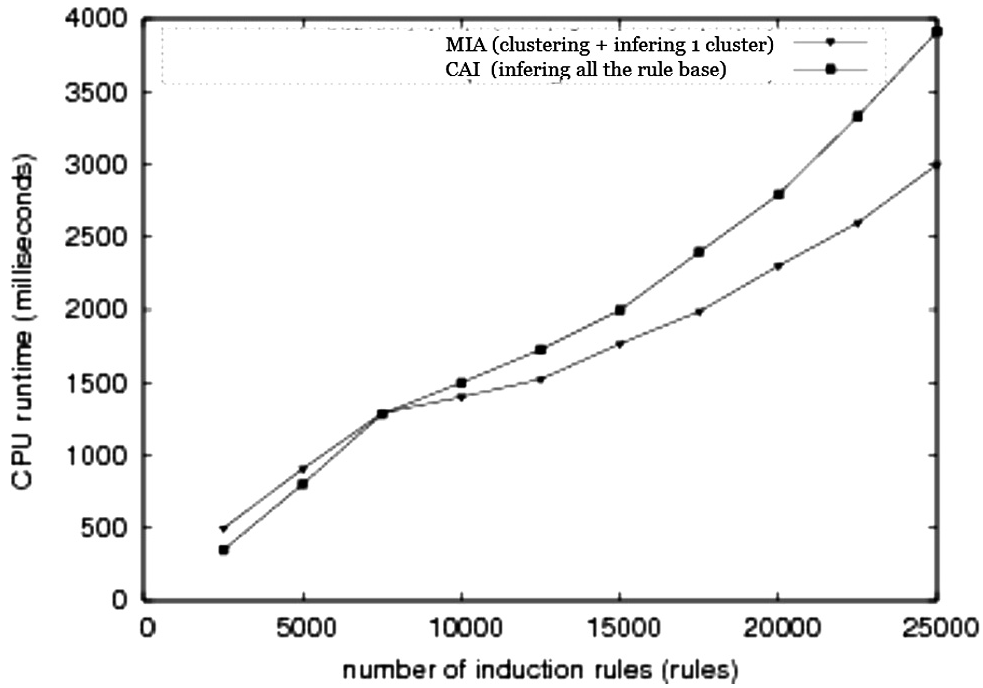 CPU time comparison: Notice how the MIA (blue) maintains a much flatter growth curve compared to the classical agent (red) as rules increase.
Success Rate and Robustness
The UIC method maintained a success rate of over 84% even as the scale increased to 25,000 rules, proving that logical clusters correctly capture the underlying domain expertise.
Critical Analysis & Future Outlook
Takeaway: This work proves that symbolic AI can be scaled using the very same statistical methods (clustering/classification) used in data-driven AI. The transition from "Data Mining" to "Knowledge Mining" mirrors how human experts organize information—not as a flat list of facts, but as a hierarchical structure of related concepts.
Limitations: The current method relies on propositional logic. Extending this to First-Order Logic (FOL) with variables and predicates would be significantly more complex but necessary for modern semantic web applications.
Future Prospect: We are likely heading toward "Super Intelligent Agents" that don't just communicate data, but share pre-clustered "Meta-Knowledge," drastically reducing the bandwidth required for collaborative AI systems.