
Optimized Data Modeling: Pushing Bank Telemarketing Prediction to 100% Accuracy
A data modeling approach for classification problems: application to bank telemarketing prediction
The paper introduces a specialized data modeling approach for bank telemarketing prediction, focusing on optimizing the Portuguese bank retail dataset. By implementing a granular preprocessing pipeline tailored to numerical, categorical, and nominal features, the authors significantly enhance the performance of five standard classifiers: NB, LR, DT, ANN, and SVM, achieving up to 100% accuracy with Decision Trees.
TL;DR
In the high-stakes world of retail banking, identifying which customer will subscribe to a long-term deposit is the difference between a successful campaign and wasted resources. This paper presents a refined data modeling framework that re-engineered the preprocessing of the famous Portuguese Bank dataset. By treating nominal, ordinal, and numerical features with distinct mathematical strategies, the authors achieved an unprecedented 100% accuracy with Decision Trees, shattering previous SOTA records that hovered around 93%.
Background: The Shift to Target Marketing
The financial crisis of 2008-2013 reshaped consumer behavior. Mass marketing is no longer viable; the modern bank relies on "Target Marketing." While the UCI Bank Marketing dataset has been a playground for researchers for a decade, many previous attempts failed to reach near-perfect precision due to improper feature handling—specifically regarding how nominal variables like "job" or "marital status" are encoded.
The Core Insight: Precision Preprocessing
The authors argue that the bottleneck in prediction isn't the choice of the algorithm (SVM vs. ANN), but how the data is prepared for those algorithms. Their approach bifurcates the data pipeline:
- Ordinal Scaling: Factors like
EducationorDay of Weekare converted to ordered integers. - Frequency-Based Nominal Encoding: Instead of simple One-Hot encoding, nominal features (e.g., Job) are associated with a decision function based on their maximum class frequency within the training set. This directly links the feature value to its predictive "weight" for a specific class.
- Class-Aware Imputation: Missing values ("unknown") are replaced by the Mean (for numerical) or Mode (for categorical) calculated within that specific class, rather than the global dataset average.
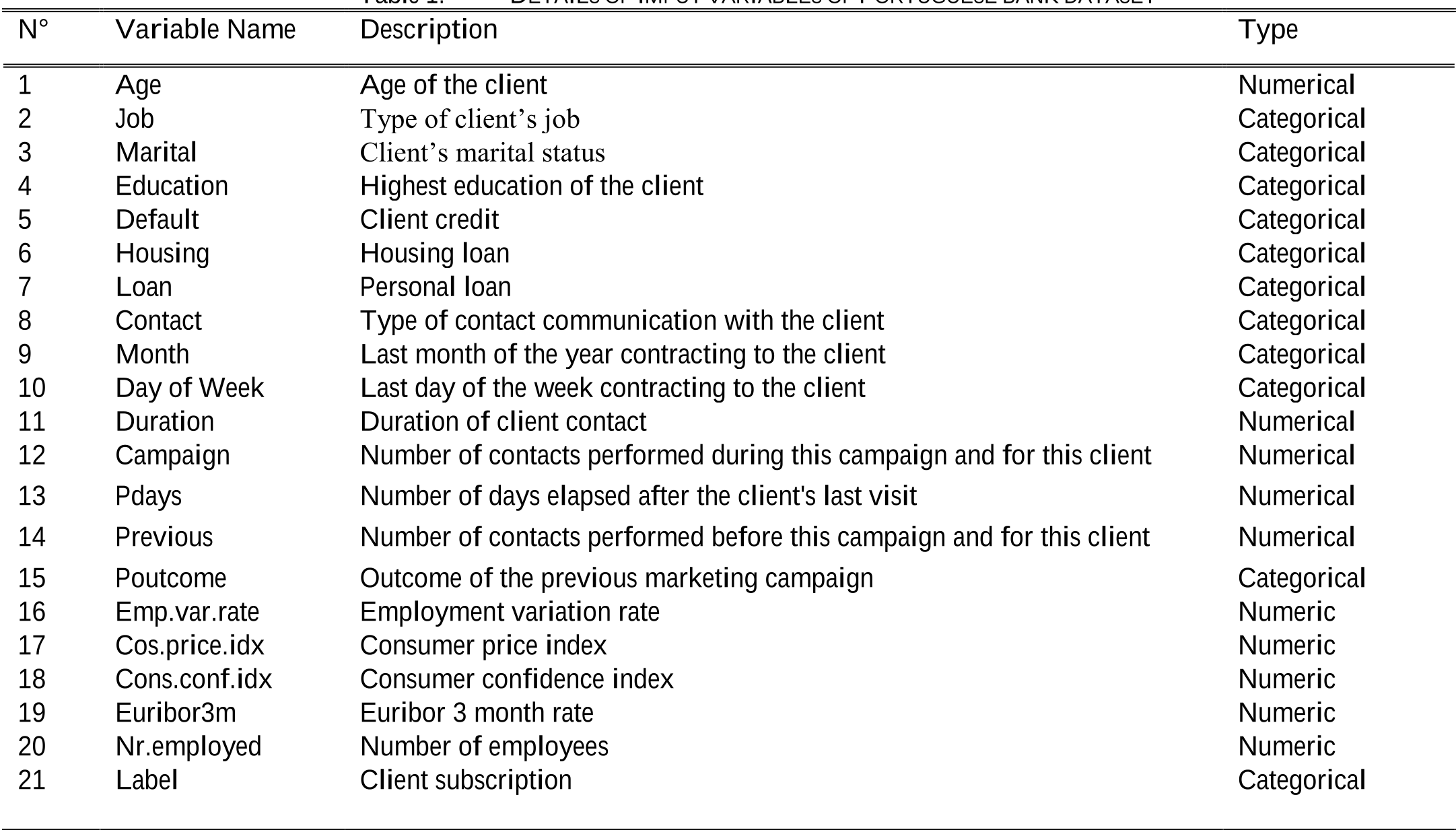 Table 1: The 21 variables used in the optimized feature set, including socio-economic indicators like Euribor 3-month rates.
Methodology: To Normalize or Not?
The paper explores a critical trade-off in machine learning: the impact of Min-Max Normalization.
The authors demonstrate through Euclidean distance calculations (e.g., instance ) that without normalization, features with larger magnitudes dominate the decision boundary. After normalization, the "closeness" of a data point to a class center ( or ) shifts significantly, often leading to more accurate group assignments for distance-based models like SVM and ANN.
Experimental Results: Breaking the 93% Ceiling
The researchers compared five major algorithms: Naïve Bayes (NB), Logistic Regression (LR), Decision Trees (DT), Artificial Neural Networks (ANN), and Support Vector Machines (SVM).
Key Findings:
- Decision Tree Supremacy: The DT (C5.0) reached 100% Accuracy and F1-Score without normalization. This suggests that the hierarchical nature of trees perfectly captured the logic of the authors' preprocessing.
- The Power of Normalization: For the ANN, normalization was the "silver bullet," driving accuracy up to 99.07%.
- SOTA Comparison: Compared to previous benchmarks from Migue (93.5%) and Elsalamony (93.23%), this approach represents a massive leap in reliability.
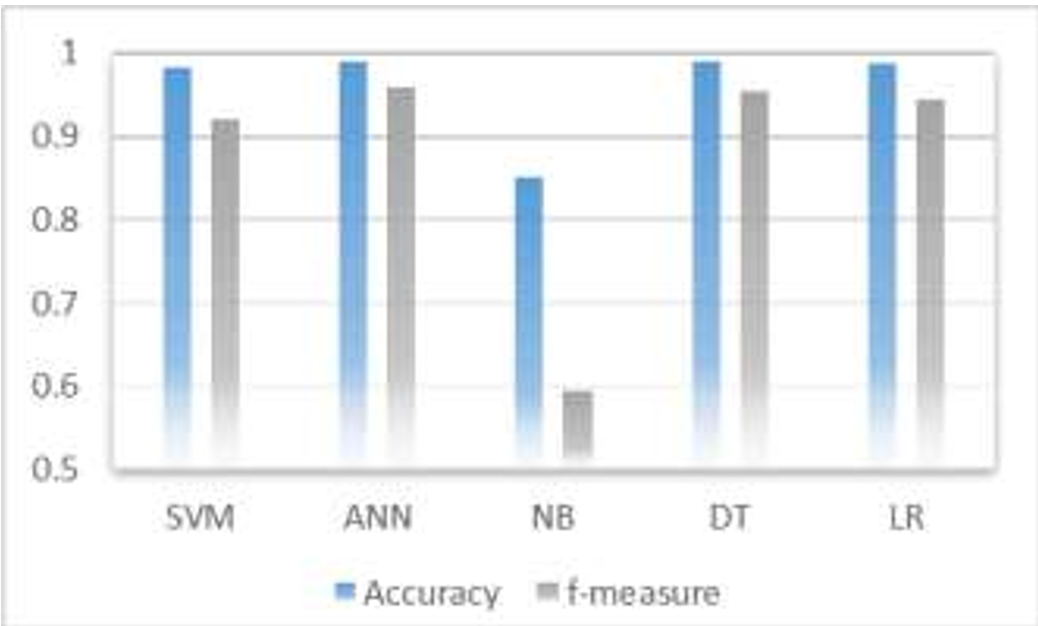 Figure 1: Performance metrics showing the dominance of Decision Trees and Logistic Regression in the proposed framework.
Critical Insight & Conclusion
This work highlights a fundamental truth in applied Data Science: Data modeling trumps algorithmic complexity. By meticulously defining how each data type contributes to the class probability, the authors made it nearly impossible for the models to fail.
Limitations: Achieving 100% accuracy often raises the specter of Overfitting or Data Leakage (particularly with the duration attribute in telemarketing datasets, which is only known after a call is made). Future research should validate if this performance holds on live, streaming data where the call duration is unknown at the start of the prediction.
Takeaway: For Fintech practitioners, the lesson is clear—invest your time in class-specific imputation and frequency-based encoding of nominal variables before tuning your neural network hyperparameters.