
BGPA: Bridging the Gap Between Cost-Efficiency and Load Balancing in Social Clouds
Data Placement Cost Optimization and Load Balancing for Online Social Networks
This paper introduces the Balanced Graph-Partitioning Algorithm (BGPA), a data placement strategy designed for Online Social Networks (OSNs). BGPA optimizes the total cost of data storage and inter-datacenter transfers while strictly adhering to user data access latency constraints and maintaining load balancing across geo-distributed cloud datacenters.
TL;DR
Online Social Networks (OSNs) face a trilemma: reducing storage/transfer costs, maintaining low latency for global users, and preventing server bottlenecks. This paper proposes the Balanced Graph-Partitioning Algorithm (BGPA), which treats data placement as a constrained optimization problem. By using graph partitioning, it reduces operational costs by ~20% while significantly improving load distribution compared to standard Genetic Algorithms and random placement.
The Social Locality Challenge
As OSN data grows exponentially, storing data near users is no longer enough. The "friends of friends" problem creates a massive web of inter-datacenter traffic. If you store data to minimize storage costs (the "GA" approach), you might end up with massive data transfer fees when friends from different regions interact. Conversely, if you force all related data into one center, you create a "hotspot" that destroys system performance.
The authors identify a crucial insight: Social Locality—the tendency of connected users to access each other's data—is the key to minimizing the "transfer" portion of the bill without breaking the bank on storage.
Methodology: Graph Partitioning with Constraints
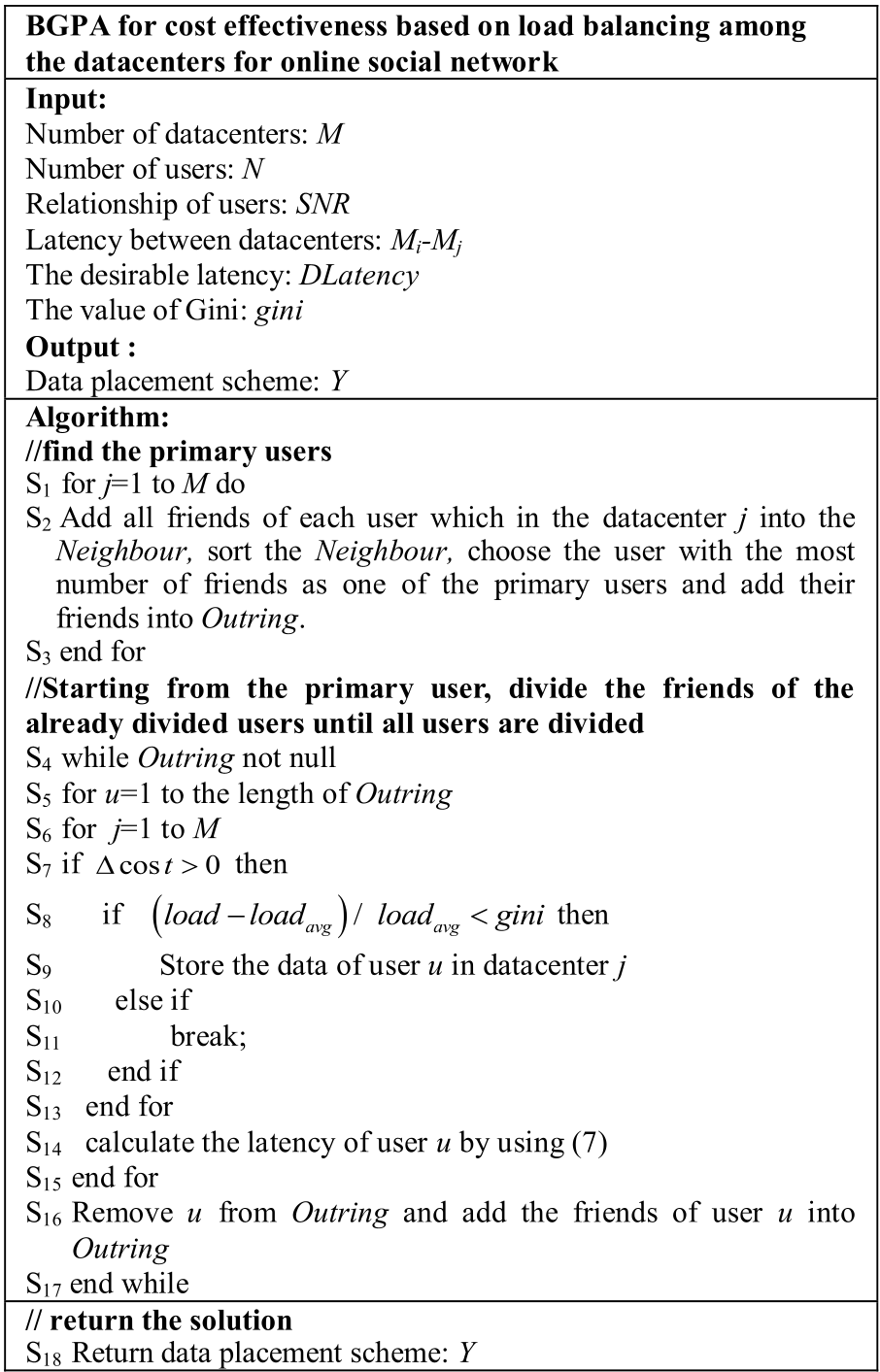
The core of the paper is the BGPA algorithm. Unlike previous works that treat latency as an objective to be minimized, BGPA treats it as a strict p-percentile constraint (e.g., 99% of requests must be < 150ms).
1. Cost Modeling
The total cost is defined as the sum of storage () and transfer ():
- Storage: Calculated per GB/month per datacenter.
- Transfer: Calculated based on the read rate () between friends located in different datacenters.
2. The Gini Coefficient for Balance
To measure "fairness" in load, the authors use the Gini coefficient—a metric usually found in economics. A value of 0 indicates perfect balance (equal data in all datacenters), while 1 indicates a total bottleneck. BGPA ensures the Gini coefficient stays within a reasonable range (0.1 - 0.4) to prevent system congestion.
Experimental Insights
The researchers tested BGPA against Genetic Algorithms (GA), standard Graph Partitioning (GP), and Random strategies using Facebook's social graph data.
Performance Highlights:
- Cost Reduction: BGPA consistently outperformed GA, with savings ranging from 13.9% to 22.1% depending on the latency requirements.
- Load Stability: The standard deviation of load for BGPA remained remarkably low (under 200), whereas GP results fluctuated wildly, reaching over 1000. This proves that "pure" graph partitioning without load-balancing constraints is dangerous for production environments.
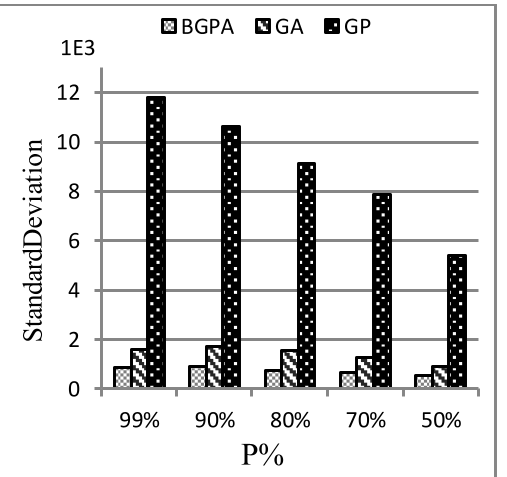 Fig: The impact of varying the Gini coefficient on total cost. Notice how cost decreases as we allow more imbalance, but plateaus after 0.4.
Critical Analysis & Conclusion
The true value of this work lies in its holistic view of OSN infrastructure. By moving away from "optimizing for one thing" and moving toward "optimizing under constraints," it provides a blueprint for more resilient cloud architectures.
Limitations: The current model is static. In the real world, social graphs are dynamic—people add friends and move locations every second. Re-running a graph partition for millions of users in real-time remains a significant computational hurdle.
Future Outlook: The next frontier is extending BGPA to dynamic environments and applying "server-level" balancing within the datacenters themselves. As distributed ledger technologies and edge computing grow, these graph-based placement strategies will be vital for minimizing the carbon footprint and financial cost of our digital social lives.