
Specialized Data Preparation: Slashing Preprocessing Time in Epidemiological Data Mining
A Data Preparation Methodology in Data Mining Applied to Mortality Population Databases
This paper introduces a specialized Data Preparation Methodology oriented to the epidemiological domain, structured into General Data Preparation (GDP) and Specific Data Preparation (SDP). Built upon the CRISP-DM framework, the methodology streamlines the processing of large-scale mortality databases, achieving significant reductions in manual processing time and revealing localized public health patterns.
TL;DR
Data preparation usually swallows 80% of a data scientist's time. This paper presents a methodology tailored for epidemiology that splits tasks into "General" and "Specific" categories. By automating the specific calculation and integration steps, the researchers achieved up to a 99% reduction in processing time while uncovering critical mortality clusters in Mexico.
The Bottleneck: Why General Methodologies Fail Epidemiology
In the world of Data Mining, the CRISP-DM (Cross-Industry Standard Process for Data Mining) is the "gold standard." However, its high-level abstraction is also its weakness. It tells you to prepare data but doesn't explain how to handle the unique nuances of mortality records, which involve complex geographical mapping, demographic normalization, and intricate ICD-10 disease coding.
The authors argue that without domain-specific "Specific Data Preparation" (SDP), experts are forced to repeat manual, error-prone calculations (like mortality rates per 100,000 inhabitants) for every single disease category—a monumental task given there are over 2,000 causes of death.
Methodology: The GDP vs. SDP Split
The core innovation lies in the classification of 14 specialized tasks into two distinct sets:
1. General Data Preparation (GDP)
These are the "hygiene" factors tasks:
- Cleaning: Deleting headlines, fixing displaced records.
- Selection: Vertical (choosing attributes like Age/Location) and Horizontal (filtering by population thresholds).
2. Specific Data Preparation (SDP)
This is where the domain expertise resides. This layer focuses on transformation and logic required for epidemiological insight:
- Data Construction: Automatically calculating Mortality Incidence (count) and Mortality Rate (normalized by population).
- Data Integration: Merging Mortality, Geographic, and Population databases into a Star Schema Data Warehouse.
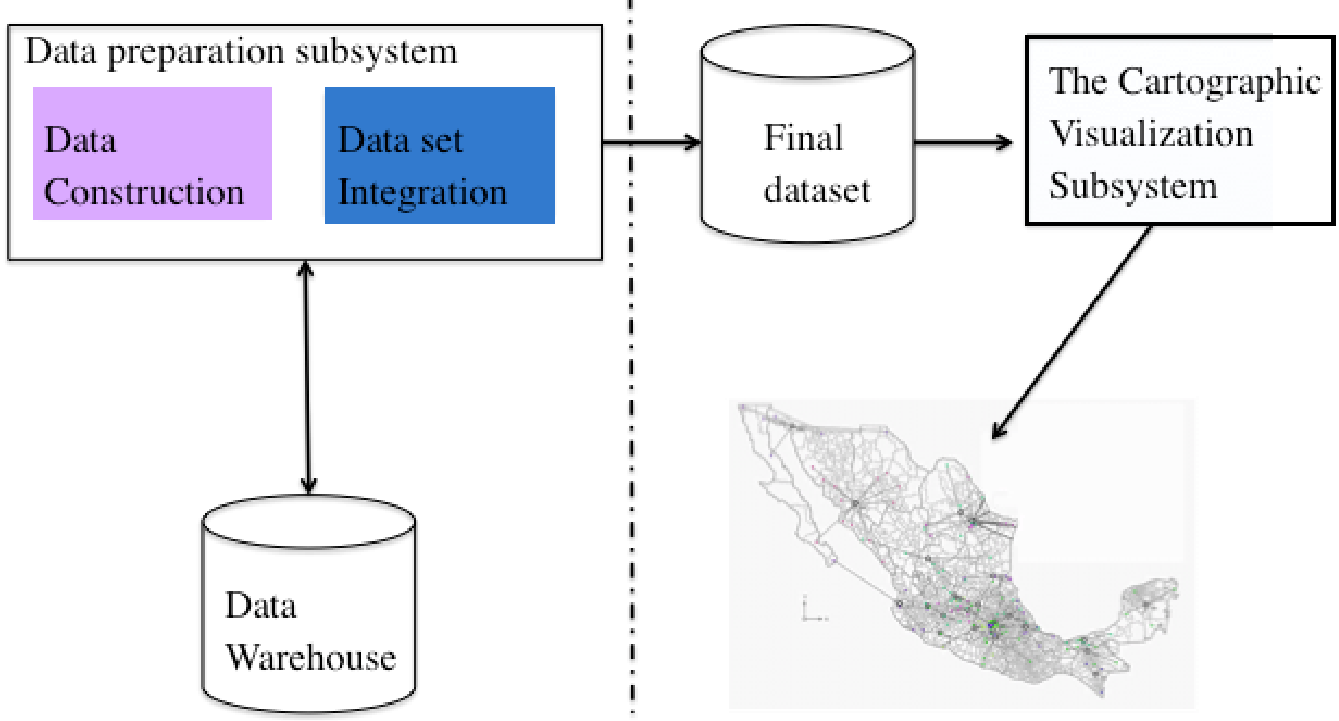 The interaction between the Data Preparation Subsystem and the Cartographic Visualization Subsystem.
From Raw Data to Spatial Intelligence
To validate the methodology, the authors processed the Mexican mortality database from the year 2000.
The Automation Payoff
The results from the automated SDP subsystem were staggering. By shifting from manual spreadsheet-style calculations to a Java-based automated SQL connection, the time required for key tasks plummeted:
- Incidence Calculation: From 33 minutes to 0.05 seconds (99.83% faster).
- Rate Calculation: From 5 minutes to 0.33 seconds (93.61% faster).
Research Finding: The C16 (Gastric Cancer) Cluster
Beyond efficiency, the methodology proved its clinical value. By applying k-means clustering to the prepared data, the system identified a significant mortality cluster in the Chiapas highlands (Southeast Mexico). This finding isn't just a number; it correlates with medical research regarding Helicobacter pylori prevalence in that specific region, proving the system can find "potentially useful and previously unknown information."
 Table showing the monumental time reduction achieved through the specialized automation methodology.
Critical Insight & Future Outlook
The primary contribution of this work isn't just a faster way to do math; it's a structural blueprint for domain-informed data engineering.
Key Takeaways:
- Reusability: GDP tasks can be ported to any population-based study, while SDP tasks are reusable across any disease study within the epidemiological field.
- Decision Support: Such systems allow public health officials to shift focus from "crunching numbers" to "designing campaigns" for high-risk regions.
Limitations: The methodology still requires significant manual intervention in the "Selection" phase, as deciding which attributes are "irrelevant" still requires a high degree of domain expertise. Future work involving LLMs or automated feature importance could potentially bridge this final manual gap.
Conclusion
By formalizing the data preparation phase into 14 distinct tasks, this research proves that specificity—rather than generality—is the key to unlocking the true power of Data Mining in public health.