
Graph Privacy Unlocked: P-Stability and the Geometry of Social Networks
Data Protection for Online Social Networks and $ P$ -Stability for Graphs
This paper investigates the relationship between P-stability in graphs and data privacy for Online Social Networks (OSNs). It demonstrates that any given graph can be embedded into a P-stable class, enabling the use of fully polynomial randomized approximation schemes (FPRAS) for unbiased graph masking and sampling.
TL;DR
Protecting privacy in Online Social Networks (OSNs) often requires generating a random graph that "looks" like the original but masks individual identities. This paper bridges the gap between theoretical P-stability—a condition ensuring we can sample graphs efficiently and uniformly—and real-world social networks that often fail these strict mathematical tests. The authors prove that any graph can be part of a P-stable class, providing a mathematical green light for efficient privacy-preserving data masking.
The Friction Between Theory and Reality
In the realm of Statistical Disclosure Control (SDC), if you want to share a graph without revealing who is connected to whom, you might keep the degree sequence (how many friends each person has) but shuffle the connections.
For this shuffle to be "safe" and "unbiased," we need a Fully Polynomial Randomized Approximation Scheme (FPRAS). However, an FPRAS only exists if the degree sequence belongs to a P-stable class.
The problem? Most famous social network datasets—from the Jazz musicians network to the massive CAIDA internet topology—fail the classic conditions for P-stability (see Table 1).
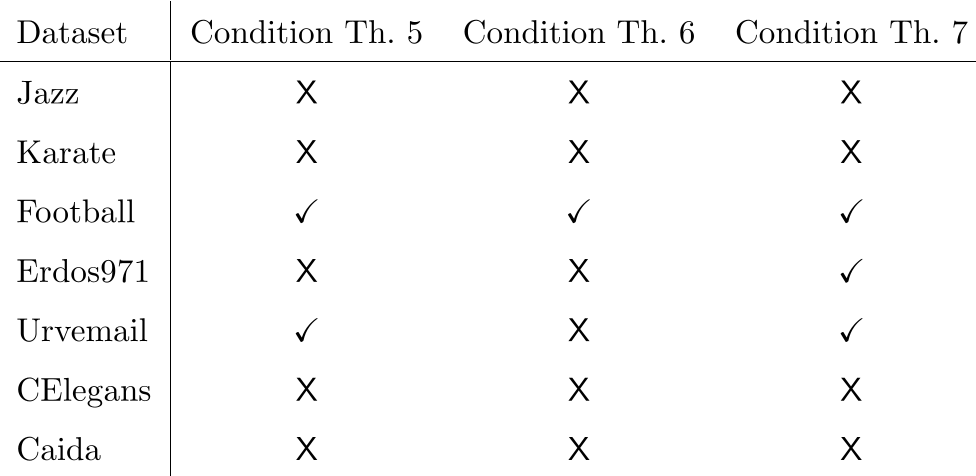 Table 1: Benchmark datasets failing the three primary conditions of P-stability.
The Breakthrough: Universal Embedding
The core contribution of Torra et al. is a proof of construction. They argue that if a single graph doesn't satisfy P-stability, we shouldn't give up. Instead, we can "embed" that graph into a larger sequence of graphs that is P-stable.
1. The Power-Law Insight
Most social networks are Scale-Free, meaning their degree distribution follows a power law . The authors derived how the number of edges () and the maximum degree () scale as the network grows.
They proved that for any scale-free graph with , if you grow the network large enough, it eventually enters a "stable zone" where the number of possible graphs is mathematically well-behaved.
2. The "Natural Class" Concept
To prevent the math from becoming too abstract, the authors introduced the Natural Class. By solving a minimization problem to find the optimal for an existing graph, researchers can map a real-world network to its closest theoretical scale-free cousin.
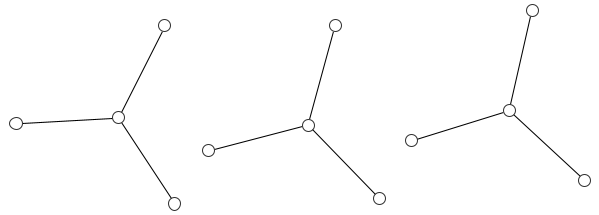 Figure 1: An example of a graph with a specific degree sequence. P-stability ensures we can find all such variations without bias.
Why This Matters for Data Privacy
If an intruder knows the degree of a target node (e.g., "Bob has 50 connections"), and there is only one unique graph that fits that description, Bob's identity is compromised.
P-stability is the mathematical safeguard that guarantees:
- Volume: There are enough graphs with this degree sequence to hide the individual.
- Efficiency: We can actually find and generate these alternative graphs in polynomial time.
- Uniformity: The "masked" graph isn't secretly biased toward the original, which would allow an attacker to make probabilistic guesses.
Critical Analysis
While the paper provides a brilliant theoretical "safety net" by proving that any graph can belong to a P-stable class, there is a practical catch. The polynomial constants () resulting from embedding a very non-compliant graph into a stable class could be enormous.
Future work will need to address the computational overhead of these generators when applied to sparse, extremely high-degree nodes (the "influencers" of the network), where the ratio of remains the tightest bottleneck.
Conclusion
This work transitions P-stability from a restrictive theoretical property to a functional tool for data privacy. By proving that real-world networks can be modeled within "Natural Classes" of scale-free distributions, the authors have provided a rigorous foundation for the next generation of social network anonymization tools.