
EQPD: Turning Data Quality Flaws into Model Robustness
A general approach to incorporate data quality matrices into data mining algorithms
The paper introduces EQPD (Ensembles of Quality-Matrix Perturbed Data), a general-purpose ensemble framework that incorporates documentable but undetectable data errors into the classification process. By leveraging Data Quality Matrices (commonly used in Six-Sigma) to perturb training data, the method creates an ensemble of models that collectively outperform single classifiers and standard Bagging techniques.
TL;DR
Instead of trying to "fix" every error in a database, the EQPD (Ensembles of Quality-Matrix Perturbed Data) approach embraces documentable errors. By using Data Quality Matrices to create multiple "alternative realities" of the training data, this ensemble method significantly reduces prediction variance and outperforms standard Bagging, proving that knowing how your data is broken is as valuable as having clean data.
Background: The "Data as a Manufactured Product" View
In industrial contexts, a database isn't a perfect reflection of reality; it's the output of a "manufacturing process" prone to systemic flaws. While standard ECTL (Extract, Clean, Transform, Load) tools can fix a typo in a zip code, they cannot fix "undocumented" errors—like a clerk consistently misidentifying gender from handwritten forms.
The authors argue that if we have Data Quality Matrices (documented records of how often X is mistaken for Y), we shouldn't just acknowledge them; we should bake them into our machine learning models.
The Core Insight: Stochastic Perturbation
Most practitioners treat their training data as "The Truth." EQPD treats it as "One Flawed Version."
The EQPD Workflow
- Quantify the Flaws: Use existing Six-Sigma or audit matrices that define error probabilities (e.g., a 5% chance that 'Male' is recorded as 'Female').
- Perturb the Reality: Generate new versions of the dataset. For each record, use the Quality Matrix () to "flip" values back into potential alternative states.
- Ensemble Voting: Train a classifier on each perturbed version and use a majority vote for the final prediction.
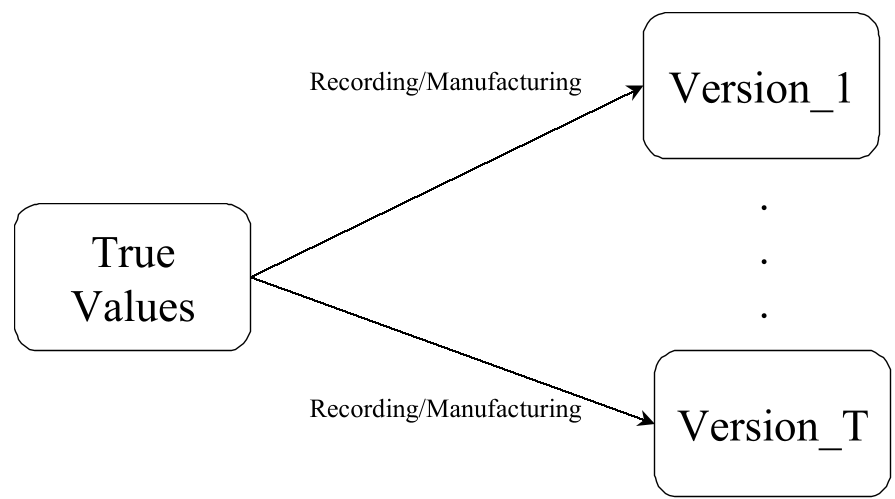 The philosophical shift: The Database is just one realization of a stochastic process.
Why It Outperforms Bagging
While Bagging (Bootstrap Aggregating) reduces variance by sampling with replacement, EQPD reduces variance by exploring the noise space defined by the Quality Matrices.
In the experiment below, we see that EQPD consistently stays ahead of Bagging in predictive accuracy across various UCI datasets, especially when the quality matrices are accurately defined.
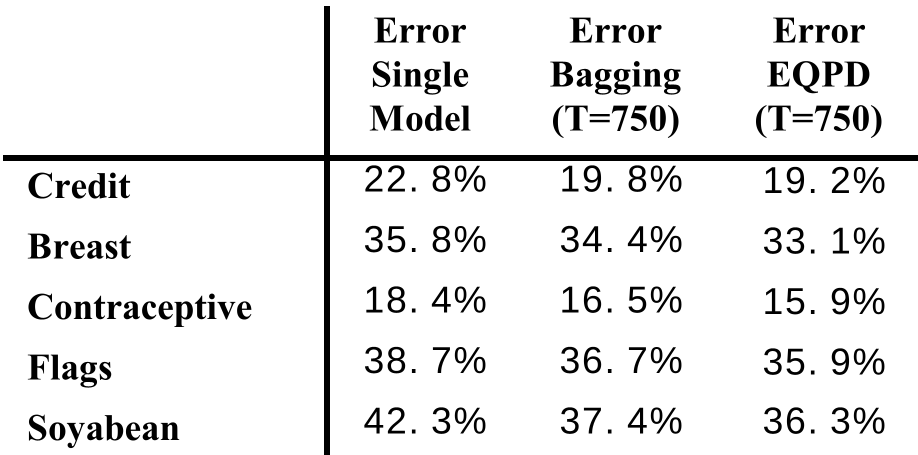 Table: EQPD shows superior error reduction compared to Bagging and Single Models.
Critical Analysis: The Variance Factor
The paper provides a deep dive into the Bias-Variance Decomposition. The primary reason EQPD works is its superior ability to stabilize the learner. By training on different "plausible" versions of the data, the model becomes less sensitive to the specific noise present in the original database.
Key Data Findings:
- Robustness: Even if the Quality Matrix is 25% "wrong," EQPD usually still beats a single model.
- Variance Reduction: In the Credit and Soyabean datasets, EQPD showed the lowest variance scores among all tested methods.
Conclusion & Future Outlook
EQPD bridges the gap between industrial quality control (Six-Sigma) and machine learning. It suggests that the future of robust AI lies not in "perfect" data, but in models that understand the probabilistic nature of their own inputs.
Limitations: The method currently requires humans to provide the Quality Matrices. A logical next step for researchers would be "Automated Quality Matrix Discovery," where the model learns the noise distribution directly from the data without manual audit logs.