
The Data-Reachability Model: Seeing the Invisible Threads of OSN Privacy Risks
A Data-Reachability Model for Elucidating Privacy and Security Risks Related to the Use of Online Social Networks
This paper introduces a novel Data-Reachability Model designed to quantify and visualize privacy risks in Online Social Networks (OSNs). It utilizes a data-reachability matrix to map how seemingly benign public information (e.g., names, friends lists) can be chained together using existing extraction tools to infer sensitive personal data like home addresses, employers, and facial biometrics.
TL;DR
Researchers from the University of Oxford have developed a Data-Reachability Model to make cyber risks tangible for social media users. By mapping out a matrix of data points and their derivations, the paper demonstrates how an attacker can move from a simple public profile to a person's physical location, employer, and even facial biometric data through a series of logical "hops."
Strategic Positioning: This work bridges the gap between technical "attack-centric" research and user-facing privacy awareness, providing a structured framework to calculate the transitive closure of information leakage.
Problem & Motivation: The Intangibility of Risk
In the physical world, "locking the front door" is an intuitive security measure. In Online Social Networks (OSNs), however, users often feel safe if they haven't explicitly posted their home address.
The authors argue that this is a dangerous illusion. The real risk lies in heterogeneous data extraction: the ability of a malicious entity to combine various tools and research-backed methods to correlate disparate data points. The problem isn't just what you share, but what can be derived from what you share.
Methodology: The Reachability Matrix
The core of the paper is the Data-Reachability Matrix. This tool treats personal attributes (usernames, photos, friends) as "currency" in a reachability task.
1. Structure of the Matrix
The model identifies "starting points" (Initial Data) and "targets" (Inferred Data). Each row represents a specific derivation rule:
- Accuracy: Rated Green (>70%), Yellow (35-70%), or Red (<35%).
- Ease: Rated by the technical skill required (High, Medium, Low).
- Justification: Every link is backed by either published research (numbers) or expert brainstorming (letters).
2. Multi-Step Inference (Chaining)
The true power of the model lies in its ability to handle transitive closures. If A allows you to reach B, and B allows you to reach C, the model calculates the risk of reaching C from A.
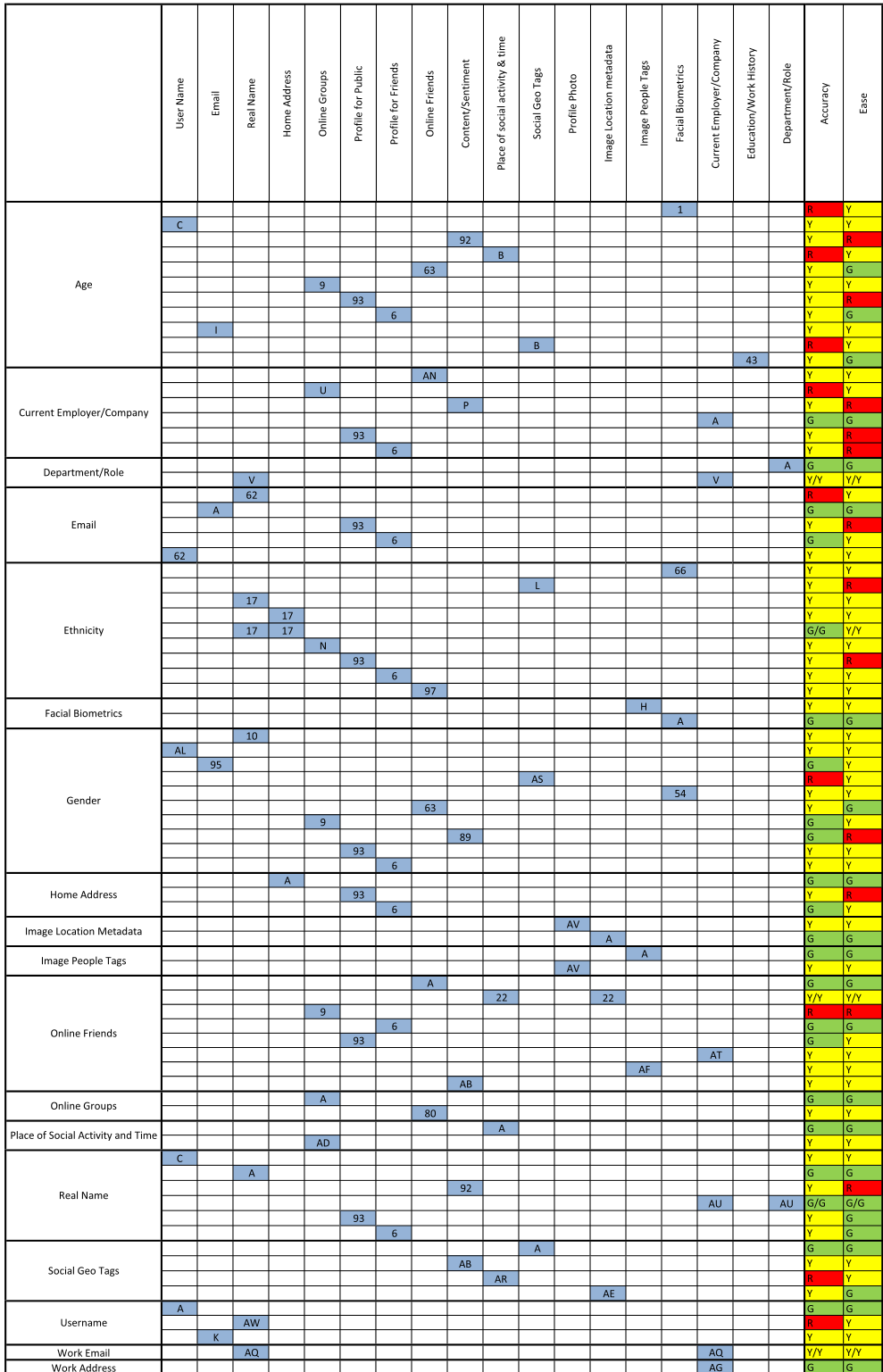 Figure 1: An excerpt of the matrix showing how targets like Age and Gender are derived from Friends and Education data.
A Chilling Scenario: 3 Rounds to Total Disclosure
The authors apply their model to a common scenario: a user who shares only their Real Name, Online Friends, and a Profile Photo.
- Round 1 (Immediate Reach): Attackers can immediately infer Age and Gender (via name and friends), and extract Image Metadata (GPS coordinates if available).
- Round 2 (Secondary Reach): Using the Name + Geocoding, they can hit Ethnicity. By combining Name + Employer (inferred from friends' networks), they can generate a Work Email Address with high accuracy.
- Round 3 (Identity Completion): Using usernames and emails, attackers use tools like
Namechkto link identities across other platforms (LinkedIn, Twitter), building a complete "Social Footprint."
Experimental Analysis & Insights
The paper highlights that many inferences are not just possible but accurate and easy.
- Social Graphs are Traitors: Even if you hide your profile, if your friends share their data, your age and gender can be predicted with moderate to high accuracy just by looking at the "peers" you associate with.
- Metadata is a Goldmine: Profile photos are often ignored by users as "safe," but they provide the biometrics and GPS history required for physical stalking.
Figure 2: [Placeholder for the Chained Inference Flow Diagram]
Critical Analysis & Conclusion
Takeaway
The Data-Reachability Model proves that perfect privacy is a myth in a connected graph. The primary value here is the method—the matrix serves as a "living document" that can be updated as new AI-driven extraction tools emerge.
Limitations
- The "Average Case" Assumption: The model assumes "average" data quality. In reality, some users are much easier to track than others.
- Error Propagation: In a chain of inferences (A -> B -> C), the "noise" or inaccuracy at step A propagates. The authors acknowledge that a systematic way to calculate "confidence decay" in long chains is needed.
Future Outlook
The move toward "targeted paranoia" is a fascinating suggestion. The authors envision a user-friendly tool where a person could input their public visibility settings and see a "Heat Map" of their reachability, effectively visualizing their vulnerability before an attacker does.