
OpenThoughts-Agent: Cracking the Data Recipe for Generalist AI Agents
Data Recipes for Agentic Models
OpenThoughts-Agent introduces a systematic, fully open data curation pipeline for training agentic language models. By fine-tuning Qwen3-32B on a curated 100K SFT dataset, the resulting model (OT-Agent-32B) achieves state-of-the-art performance (44.8% average accuracy) across seven agentic benchmarks, outperforming Nemotron-Terminal-32B by 3.9 percentage points.
TL;DR
The OpenThoughts-Agent (OT-Agent) project provides a long-awaited "cookbook" for training agentic LLMs. By systematically ablating every stage of the data pipeline, the researchers developed OpenThinker-Agent-32B, which now stands as the strongest open-data model in its class, excelling in everything from GitHub issue resolution to complex terminal-based system administration.
The "Secret Sauce" Problem
In the race to build autonomous agents, the industry has become increasingly secretive about training data. While model weights are often shared, the composition of the data remains a black box. The central challenge is generalization: a model trained solely on coding tasks often fails at general terminal use, and vice versa. OT-Agent solves this by treating data curation as a rigorous science rather than an art.
Methodology: The Six-Stage Pipeline
The authors didn't just guess which data worked; they ran over 100 controlled experiments to optimize a six-stage SFT (Supervised Fine-Tuning) pipeline.
1. The Teacher Paradox
One of the most counter-intuitive findings was that the strongest model does not make the best teacher. Despite GPT-5.3-Codex being more capable, GLM-4.7 proved to be a superior teacher for agentic rollouts. This suggests that the "step-by-step" reasoning style of certain models is more effectively distilled into smaller student models than the "leap-to-conclusion" style of frontier models.
2. Architecture of the SFT Pipeline
The pipeline systematically filters tasks and trajectories to ensure the student learns how to "think" through a problem rather than just memorizing a solution.

3. The Power of "Long-Turn" Filtering
The team found that filtering for trajectories with at least 5 turns significantly boosted performance. Even when controlling for the total number of tokens, these "hard-won" solutions provided much richer supervision for the model's ability to self-correct and persist through errors.
Reinforcement Learning: Exploration vs. Exploitation
The study also explored Reinforcement Learning (RL), specifically focusing on which data sources provide the best "reward signal."
- Pymethods2test: This competitive programming source emerged as the champion. Because these tasks are difficult but have clear verifiers, they forced the model to explore more aggressively—doubling its internal "thinking tokens" to find correct solutions.
- Behavioral Shift: Post-RL models didn't just get luckier; they became more "stubborn," using more tool calls and self-correction phrases to navigate complex environments.
Experimental Results: Scaling to SOTA
The results show a clear monotonic improvement as the dataset size increases, especially when using synthetic task augmentation to keep the "task diversity" high.
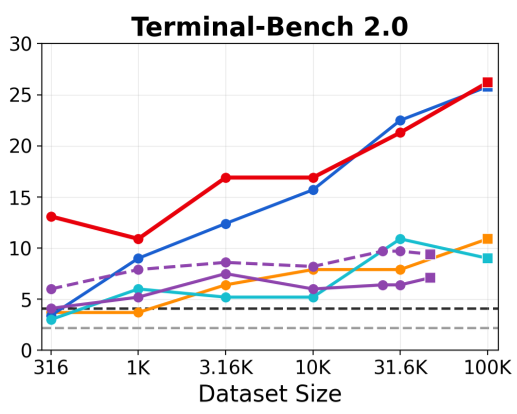
As shown in the table below, OT-Agent-32B sets a new benchmark for open-data models across diverse evaluations:
| Benchmark | OT-Agent-32B | Nemotron-Terminal-32B | Qwen3-32B (Base) |
|---|---|---|---|
| SWE-Bench Verified | 54.0% | 41.9% | 29.1% |
| Terminal-Bench 2.0 | 26.2% | 25.1% | 7.5% |
| BFCL (Tool Use) | 85.9% | 69.1% | 68.3% |
Critical Insight & Future Outlook
OT-Agent proves that the path to better agents isn't just "more data," but "more diverse tasks with complex traces." However, the authors note a limitation: the RL experiments were only conducted at the 8B scale due to compute costs. The next frontier will be determining if these same RL recipes scale linearly to 70B+ models.
By releasing the full pipeline and dataset, the OpenThoughts team has lowered the barrier for the community to build agents that don't just "chat," but actually "do."
Takeaway for Practitioners
If you are building an agent, focus on synthetic instruction rewriting and min-turn filtering. It is better to have 10,000 multi-turn, complex trajectories than 100,000 single-turn "easy" tasks.