
SocialRank: Boosting P2P Replication Through Common Interests and Smart Rolling-Back
Data Replication Based on Common Interests in P2P Social Networks
The paper introduces SocialRank, a content replication protocol for P2P social networks that extends the EasyRank protocol. By incorporating common interests between nodes and introducing a multi-hop neighbor expansion mechanism, it achieves significantly higher replication success rates in resource-constrained environments.
TL;DR
Replicating data in Peer-to-Peer (P2P) social networks is a balancing act between reliability and storage efficiency. This paper presents SocialRank, an evolution of the EasyRank protocol. By analyzing nodes' "common interests" and allowing data to hop beyond immediate social circles, SocialRank achieves a near-perfect replication success rate (98%) where traditional methods stall at 65%.
The Problem: The "Passive Node" Trap
In decentralized social networks, we rely on our "friends" (1-hop neighbors) to store copies of our data. However, two major bottlenecks frequently occur:
- Neighborhood Exhaustion: If your direct friends run out of disk space, replication fails, even if their friends have plenty of room.
- Storage Pollution: Many protocols start replicating data but fail to reach the required "Replication Factor" (e.g., 3 copies). They leave these "orphan" copies on nodes, consuming space while providing no reliability guarantees.
Methodology: Beyond Connectivity
The core of SocialRank lies in its redefined ranking model. While EasyRank focused on network position (Centrality) and available space, SocialRank adds a "Social Layer."
1. The SocialRank Formula
The protocol ranks potential storage peers using a weighted sum: By favoring nodes with common interests, the system naturally places data where it is most likely to be consumed, theoretically reducing future network traffic and access time.
2. Neighbor Expansion (The 2-Hop Strategy)
When 1-hop neighbors are full, SocialRank looks to "friends of friends." This expansion significantly increases the pool of available storage without requiring a global view of the network.
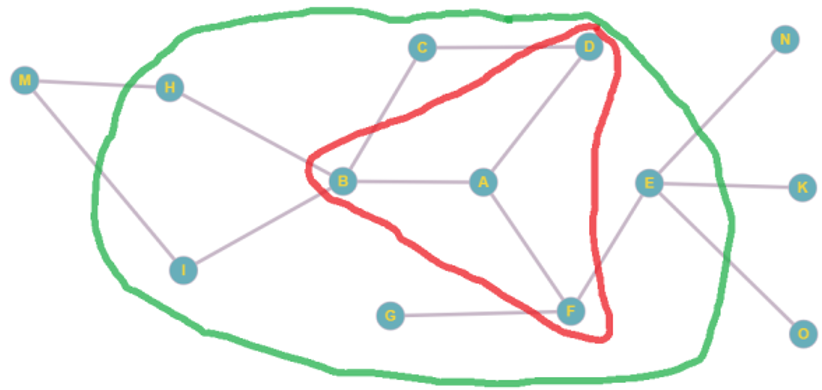 Fig 1: Node A expanding its replication reach to 2-hop connections (C, E, G, H, I) when immediate neighbors (B, D, F) are saturated.
3. The "Unstore" Mechanism
SocialRank introduces a strict cleanup policy. If a replication attempt fails to reach the target factor, all partial copies are deleted. This "all-or-nothing" approach ensures that disk space is only occupied by useful, fully redundant data.
Experimental Results: A Massive Leap in Efficiency
The authors tested the protocol on a massive scale—100,000 nodes using the PEERSIM simulator.
Performance Comparison
The most striking result is the comparison against the baseline EasyRank. As shown in the table below, SocialRank effectively utilized the network to complete nearly all requested replications.
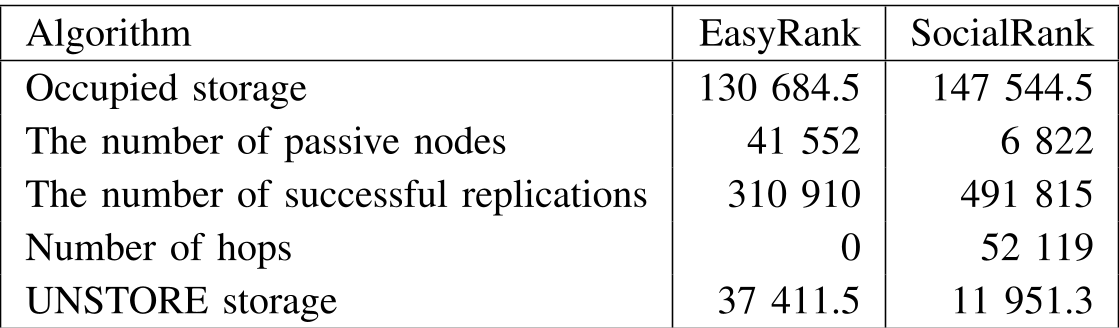 Table 1: SocialRank vs. EasyRank. Note the massive increase in "Successful Replications" from ~310k to ~491k.
Key Insights from Ablation:
- Low-Density Advantage: The improvements were most pronounced in "sparse" networks (where nodes have few connections).
- Space Recovery: The "Unstore" mechanism reclaimed over 11,000 GB of space that would have otherwise been wasted on useless partial replicas.
Deep Insight & Conclusion
The genius of SocialRank isn't just in "adding social data," but in its pragmatism. By acknowledging that 1-hop connections are a bottleneck and that partial data is a liability, it transforms P2P replication from a best-effort service into a robust protocol.
Takeaway: In any distributed system, the social metadata (what users like) is just as important as the physical metadata (how much RAM they have). Future P2P systems should look at "Interest-Aware" routing as a standard, not an exception.
Future Work: The authors suggest moving toward more dynamic social criteria and testing the protocol in live environments to see how fluctuating node availability (churn) affects the "Unstore" frequency.