
Decoding Humanity: Social Metrics as the Compass for Opportunistic Mobile Social Networks
Data routing strategies in opportunistic mobile social networks: Taxonomy and open challenges
This paper presents a comprehensive taxonomy and performance analysis of data routing strategies in Opportunistic Mobile Social Networks (MSNs). It categorizes methods based on social metrics—encounters, social features, and social properties (centrality, similarity, and community structures)—while identifying the SMART protocol as a top performer in balancing delivery ratio and overhead.
TL;DR
In the world of Opportunistic Mobile Social Networks (MSNs), traditional end-to-end paths are a luxury that rarely exists. This seminal survey explores how researchers use human social behavior—our routines, friendships, and communities—as a "routing table" to deliver data in intermittently connected environments. By moving from simple contact history to complex social graph analysis (like SMART and Bubble Rap), delivery efficiency can be boosted by up to 50% while drastically saving bandwidth.
The Core Challenge: Navigating Disconnection
Unlike cellular or Wi-Fi networks where your phone enjoys a constant handshake with an antenna, Opportunistic MSNs rely on the "Store-Carry-Forward" paradigm. Imagine trying to send a letter in a city with no post office; you give it to a friend, who carries it until they meet someone closer to the recipient.
The technical hurdles are immense:
- Dynamic Topology: Nodes move unpredictably.
- Limited Context: Each device only knows who it has met recently.
- Resource Scarcity: Battery and storage are finite, making "Epidemic" (flooding) routing unsustainable.
Taxonomy of Routing: From Contacts to Communities
The paper meticulously organizes the landscape of MSN routing into three distinct social layers:
1. Encounter-Based (The Low Level)
These protocols look at the frequency and recency of physical meetings. PROPHET is the flagship here, calculating a "delivery predictability" score based on past encounters. If I met the destination five minutes ago, I am a better relay than someone who hasn't seen them in a week.
2. Social Feature-Based (The Identity Level)
This moves beyond when people meet to who they are. Protocols like SANE or Social Greedy match nodes based on attributes like profession, hometown, or hobbies. The intuition is simple: people with similar social features are more likely to encounter each other.
3. Social Property-Based (The Network Level)
This is where the most advanced research lies, utilizing graph theory to analyze the "importance" of a node.
- Centrality: Identifying "popular" nodes that act as hubs.
- Community Structure: Recognizing that people belong to clusters (offices, schools). Routing happens in two phases: first, get the data to the destination's community (Global Centrality), then find the specific person (Local Centrality).
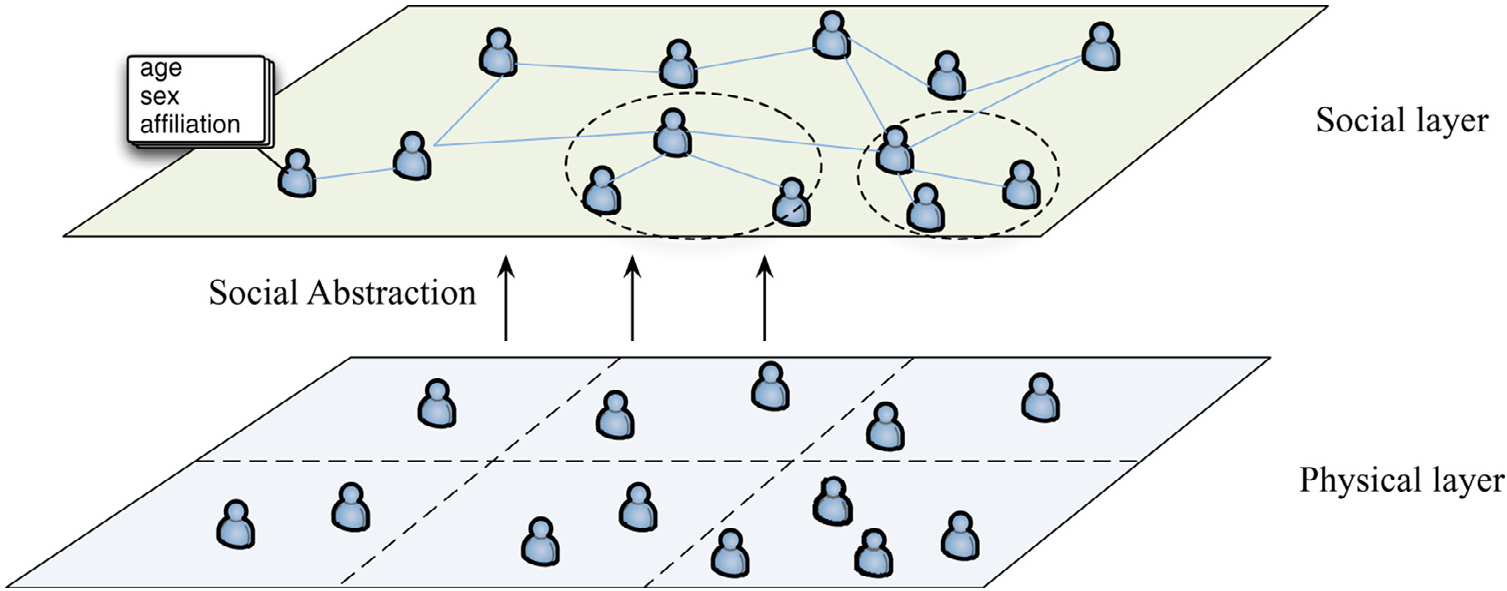 The interaction between physical encounters and abstracted social layers.
Methodology: The Bubble Rap Logic
One of the most influential methods discussed is Bubble Rap. It mimics human social structures by dividing the network into communities.
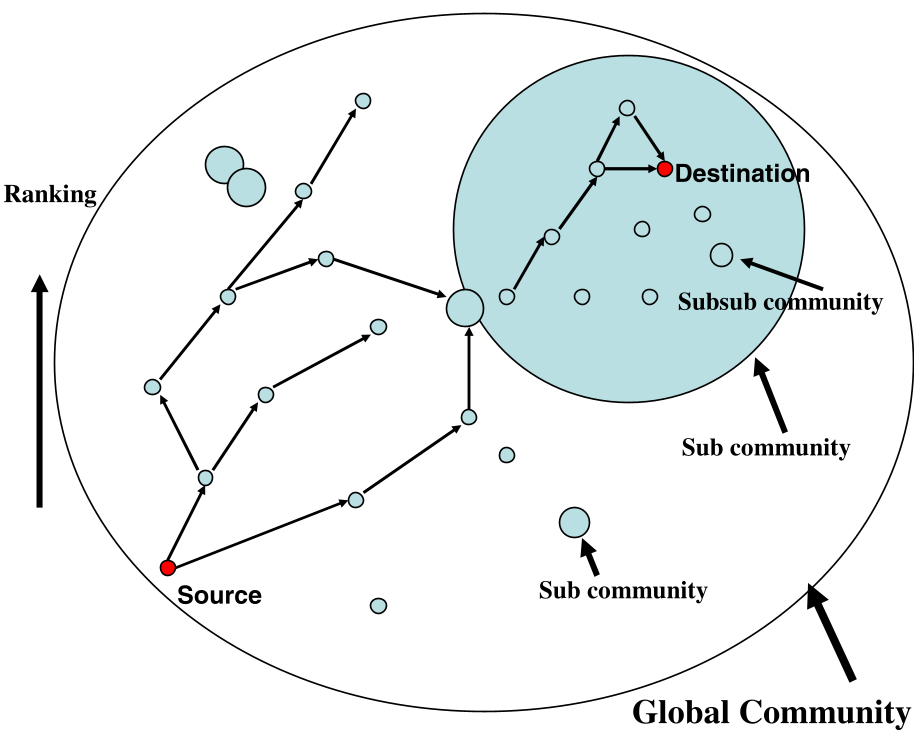
Why it works: It treats the network as a nested hierarchy. If a message is destined for "Alice in the Marketing Dept," the protocol doesn't look for Alice immediately. It first finds someone with high "Global Centrality" (a social butterfly) to move the message toward the Marketing "bubble." Once inside the bubble, it searches for someone with "Local Centrality" to finally hand it to Alice.
Experimental Showdown: Which Strategy Wins?
The authors tested these theories against real-world data traces: MIT Reality Mining (Humans), DieselNet (Buses), and Cabspotting (Taxis).
- Human Networks (MIT): Social property-based routing (SMART) reigned supreme. Because human life is structured around stable communities, social metrics were excellent predictors.
- Vehicular Networks (Taxis): Predictability drops. Taxis are less "social" and more "opportunistic," meaning encounter-based methods like PROPHET remain competitive there.
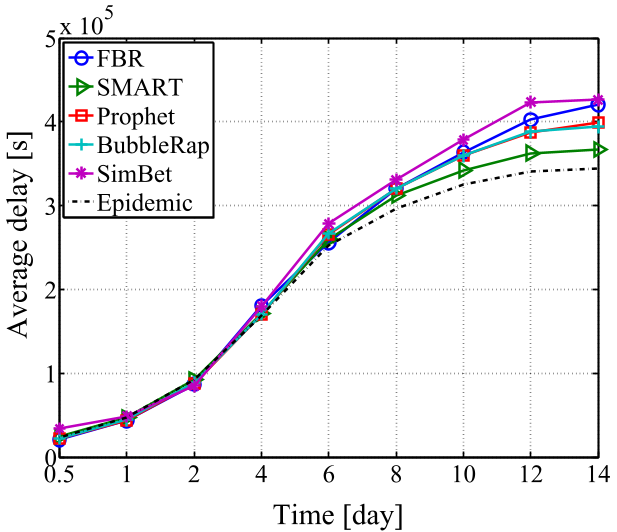 Comparison showing SMART and Bubble Rap achieving higher delivery ratios than traditional history-based methods.
Critical Insight & Future Outlook
While social-aware routing is revolutionary, the authors highlight a massive "Elephant in the Room": Privacy. For these protocols to work, your device must broadcast your social features (age, interests, hometown) or your encounter history to strangers. This creates a friction between routing efficiency and user security.
Future Directions:
- Distributed Computation: How do we calculate "Betweenness Centrality" without a central server?
- Privacy-Preserving Metrics: Using encrypted social ties or Differential Privacy.
- Information-Centric Networking (ICN): Shifting focus from "Where is the host?" to "Where is the data?"
Conclusion
This paper serves as a roadmap for the next generation of mobile communication. By leveraging the Inductive Bias that human mobility is not random but socially driven, we can build robust, "disconnected" networks that thrive in environments where traditional infrastructure fails.