
MAESTRO: Orchestrating QoS for Critical Healthcare Data in Shared Wireless Networks
Assessing Data Traffic Classification to Priority Access for Wireless Healthcare Application
This paper introduces MAESTRO, a device management system that optimizes Quality of Service (QoS) for wireless healthcare applications. By combining a Naive Bayes traffic classifier with an adaptive EDCA prioritization algorithm, it ensures that critical physiological data (e.g., ECG, blood pressure) receives preferential network access over generic traffic in shared wireless environments.
Executive Summary
TL;DR: In the emerging landscape of "Health Parks" and remote patient monitoring, wearable medical devices must compete with Netflix streams and Zoom calls for bandwidth. MAESTRO is a management system that utilizes Machine Learning to recognize vital signs (like ECG or CO2 levels) and automatically grants them "VIP access" on the network. This approach achieves a 91.5% classification accuracy and a staggering 60% improvement in packet delivery reliability.
Context: This work positions itself as a critical bridge between data science and network engineering, moving beyond simple "medical vs. non-medical" binary classification to a nuanced, multi-priority QoS framework.
The Problem: The Congestion of Care
Modern healthcare relies on the continuous transmission of physiological data to the cloud for real-time analysis. However, most wearable devices operate on shared IEEE 802.11 (WiFi) networks. When the network gets crowded, standard QoS mechanisms (EDCA) treat medical data like ordinary "Best Effort" traffic.
The authors identify a crucial insight: not all medical data is equal. Depending on a patient’s condition, an ECG might be life-critical (High Priority), while a respiration rate might be less urgent (Low Priority). Existing systems fail to make this distinction non-intrusively.
Methodology: The MAESTRO Architecture
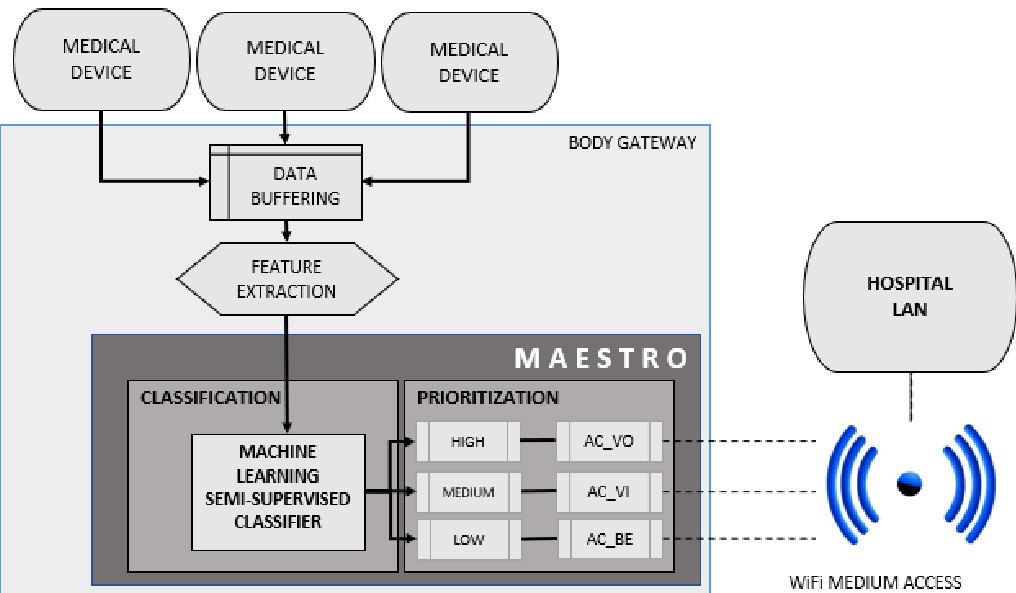
The MAESTRO system (Medical Device Management System) operates via two specialized modules:
1. The Intelligence: Naive Bayes Classification
Instead of relying on port numbers or IP headers (which can be obscured), MAESTRO looks at the morphology of the data stream. By buffering just one second of data, it extracts waveform features from the MGH-MF dataset (containing records from 250 patients). The Naive Bayes algorithm was chosen for its superior performance in healthcare contexts, effectively labeling flows as HIGH, MEDIUM, or LOW priority.
2. The Enforcement: Network Access Prioritization
Once a flow is labeled, the Prioritization Module maps it to specific EDCA (Enhanced Distributed Channel Access) queues:
- High Priority (ECG): Mapped to
AC_VO(Voice Queue). - Medium Priority (Blood Pressure): Mapped to
AC_VI(Video Queue). - Low Priority (Respiration): Mapped to
AC_BE(Best Effort).
Experimental Validation
The authors validated MAESTRO using a two-pronged approach: R-based machine learning evaluation and NS-3 network simulations.
Machine Learning Performance
The probabilistic Naive Bayes model outperformed Decision Trees and K-Nearest Neighbor.
- Accuracy: 91.5%
- Kappa Coefficient: 86.9% (Indicating "Excellent" agreement in healthcare standards).
Network Impact
Under heavy traffic (50% channel capacity taken by background noise), the standard WiFi configuration saw medical packets being dropped as generic traffic prevailed. With MAESTRO enabled:
- Packet Delivery Ratio (PDR) for medical devices increased by 60%.
- Latency: Significantly reduced, satisfying the strict real-time requirements of clinical monitoring.
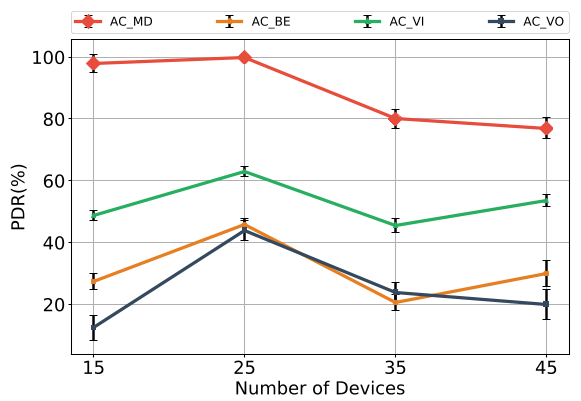 The figure above illustrates how MAESTRO prioritizes medical traffic (PDR improvement) by strategically reducing the airtime of non-critical background traffic.
Critical Analysis & Conclusion
Takeaway
MAESTRO proves that application-aware networking is the future of mHealth. By letting the network "know" what kind of physiological signal it is carrying, we can guarantee reliability without needing a dedicated, expensive medical-only infrastructure.
Limitations & Future Work
While the 91.5% accuracy is impressive, the system currently requires a 1-second buffer which introduces a slight initial delay. Future iterations could explore Zero-shot learning to identify rare medical conditions or adapt to 5G slicing technologies for even lower latency.
Conclusion: This research provides a robust blueprint for how AI can manage the chaos of shared wireless spectrums to save lives in smart healthcare environments.