
SenseFace: Bridging the Gap Between Body Sensors and Social Networks
Data visualization: From body sensor network to social networks
The paper introduces SenseFace, an open-source framework designed to bridge the gap between Body Sensor Networks (BSN) and social networks. It utilizes a four-tier architecture to capture real-time physiological and environmental data, facilitating seamless data visualization and dissemination across diverse social and communication platforms.
TL;DR
SenseFace is an innovative open-source framework that automates the journey of sensory data—from a person’s heartbeat or blood pressure—to their social circle. By integrating Body Sensor Networks (BSN) with a four-tier architecture, it enables real-time data visualization on platforms ranging from legacy Fax and SMS to modern social networks like Facebook and Twitter.
Background Positioning
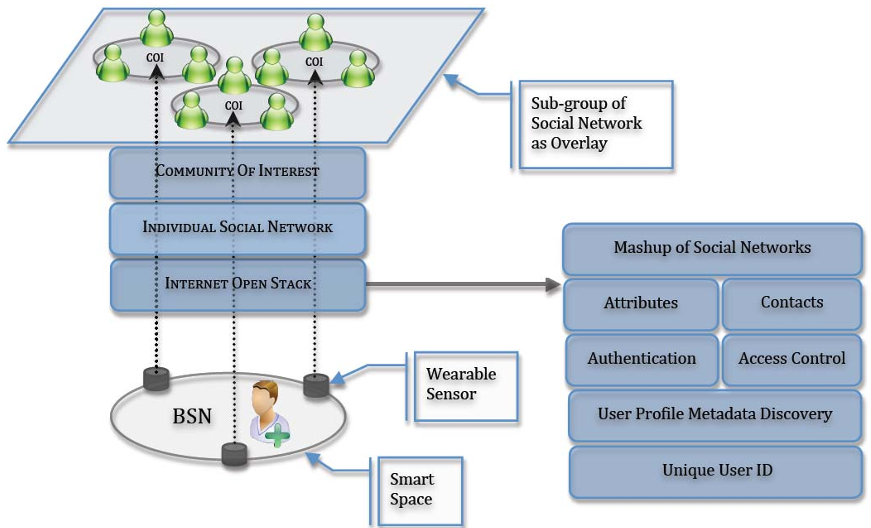
In the landscape of 2009-era pervasive computing, most sensor networks were closed systems. SenseFace positioned itself as an "Overlay" solution, treating social networks not just as websites, but as a holistic communication layer (including Email, IM, and even Amateur Radio).
Problem & Motivation: The "Human Intervention" Barrier
The authors identified a critical bottleneck: Information Silos.
- The Gap: Sensors capture vital data (like a sudden spike in blood pressure), but this data remains trapped on the device unless the user manually shares it.
- The Mobility Challenge: Both the user (BSN side) and the "Community of Interest" (Social side) are often mobile, making reliable data delivery difficult across shifting network conditions.
The insight behind SenseFace is that social networks should intelligently and autonomously receive sensory data to act as a safety net or a real-time awareness tool for friends, family, and medical professionals.
Methodology: The Four-Tier Architecture
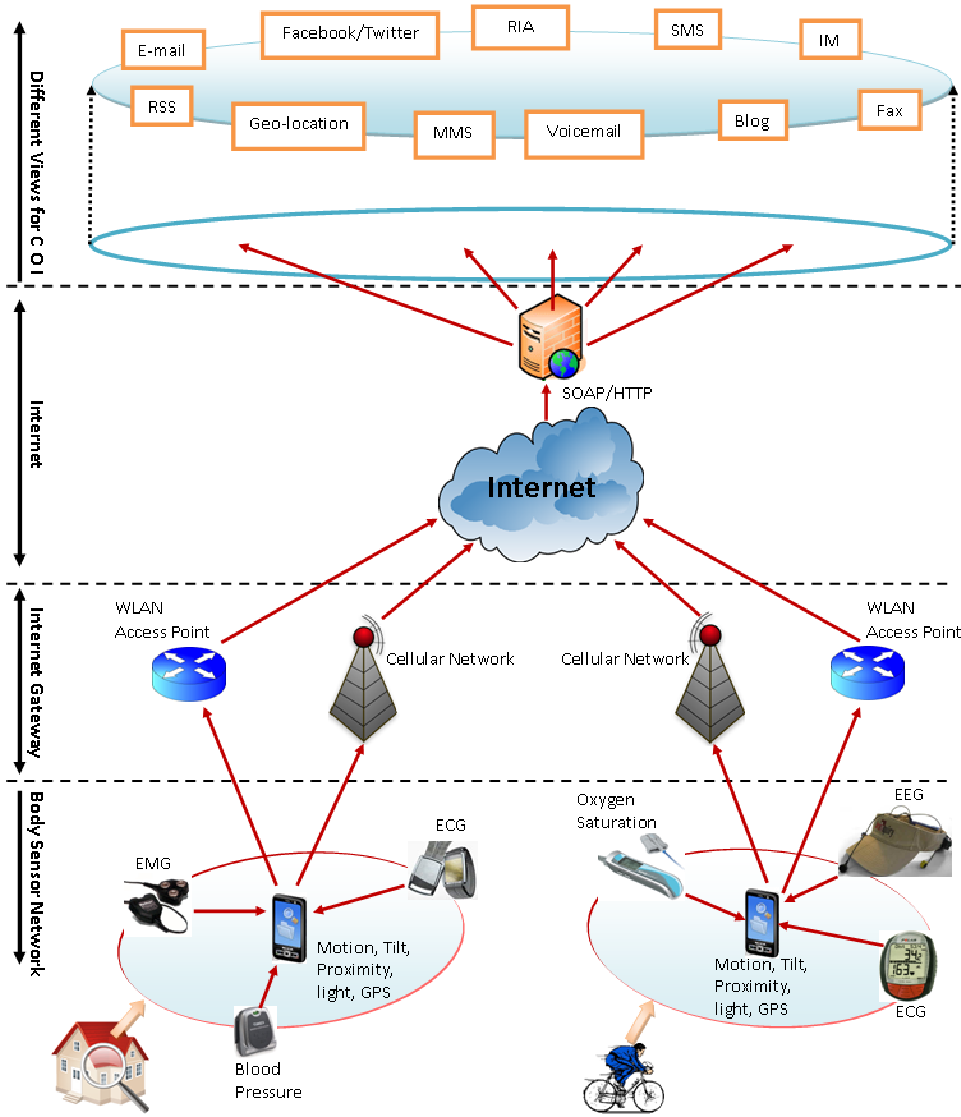
The framework is built on four distinct layers that handle data from its birth to its final visualization:
- BSN Tier (Generation): Wearable sensors (Bluetooth-enabled) capture body phenomena.
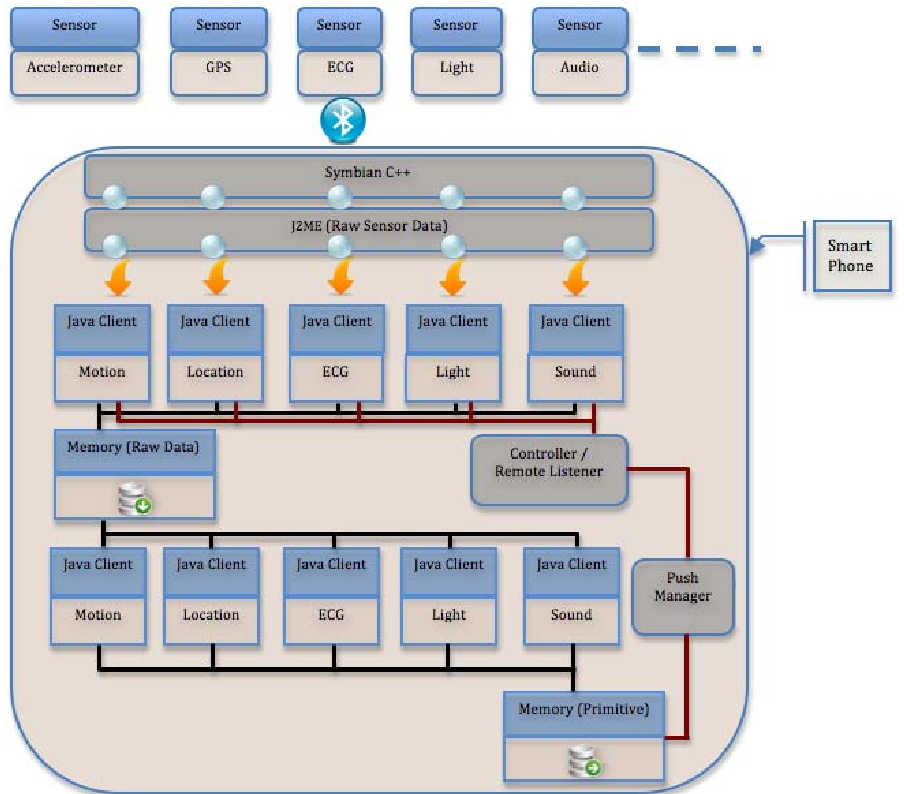
- Gateway Tier (Processing): A smartphone acts as a mobile proxy, running background apps to analyze data for "threshold crossings" (e.g., alarming heart rates) to save bandwidth by only sending critical updates.
- Web Services Tier (Cloud): Servers parse the incoming data, index it against user profiles, and prepare it for the "Content Adaptation" phase.
- Overlay Network Tier (Dissemination): The data is "mashed up" into formats compatible with the recipient’s specific device or preferred social platform.
The Content Adaptation Intelligence
The most technically interesting aspect is how SenseFace handles Format Heterogeneity. If a family member only has a mobile phone, they receive an SMS; if they are a physician, they might receive a Fax or an Email with an Mp3 attachment (Voicemail generated via Text-to-Speech).
Experiments & Results: Real-world Implementation
The authors didn't just propose a theory; they built a prototype using:
- Nokia N-series devices (Symbian OS).
- LEGO MINDSTORM NXT for auxiliary sensing.
- Garmin Forerunner 50 for heart rate tracking.
SOTA Contrast
Unlike previous systems (like BeTelGeuse or BikeNet) which were specialized for specific tasks like data gathering or cycling, SenseFace is agnostic toward the final destination. It successfully demonstrated data updates to a wide array of 2009-era social platforms including:
- Social: Facebook, Twitter, LinkedIn, MySpace.
- Legacy/Utility: Fax (via InterFAX), SMS, MMS.
- Location: Google Maps/Earth via KML files.
Critical Analysis & Conclusion
Takeaway
SenseFace proved that the "Social Web" could be more than just status updates; it could be an Ambient Intelligence platform. By automating the data flow from BSN to Social Networks, it creates a "Health-Aware" social ecosystem.
Limitations
- Privacy & Security: While mentioned, the paper 2009-era focuses more on connectivity than the granular privacy controls needed for sensitive medical data today.
- Energy Consumption: Constant Bluetooth and GPRS/WLAN activity on legacy smartphones (like the N80) posed significant battery challenges, which the authors mitigated with a 5-minute buffering strategy.
Future Outlook
As we look at today's Apple Watch and Fitbit ecosystems, we see the echoes of SenseFace. The next step, as predicted by the authors, involves deeper integration with emergency services and more proactive "Subject" testing for elderly care.