
Unmasking the Like Farms: A Deep Dive into Facebook's Underground Reputation Market
This work was done when the author was with Data61-CSIRO. The first two authors contributed equally. A preliminary version of this article, titled "Paying for Likes? Understanding Facebook Like Fraud Using Honeypots," appeared in Proceedings of the 2014 ACM Internet Measurement Conference (IMC'14). See Section 6 for a summary of the new results presented in this article
This paper presents a comprehensive measurement study of Facebook "like farms"—underground services that artificially inflate page popularity. By deploying 13 honeypot pages, the authors characterize the demographic, temporal, and social graph behaviors of fake likers and introduce a high-precision detection framework based on user timeline features.
Executive Summary
TL;DR: This research exposes the inner workings of Facebook "like farms" through a honeypot-driven measurement study. It reveals that while some farms are "loud" and easily detectable via timing bursts, "stealthy" farms mimic human behavior to evade state-of-the-art graph-based filters. The authors propose a novel detection system using timeline analysis (lexical and non-lexical features) that achieves near-perfect precision (>99%).
Context: Published in ACM Transactions on Privacy and Security, this work bridges the gap between simple bot detection and complex behavioral analysis, shifting the battlefield from "who you know" (graph) to "how you talk" (lexical).
The "Like" Economy: Problem & Motivation
On Facebook, likes are currency. They signal popularity, brand trust, and organic reach. However, this creates a perverse incentive for "Like Farms"—services that sell thousands of likes for a few dollars.
The authors identify a critical gap: Facebook’s official fraud detection (e.g., CopyCatch) is optimized for "lockstep" behaviors—large groups of accounts liking the same thing at the exact same time. Sophisticated farms have evolved. They now:
- Distribute likes over long intervals.
- Like popular "cover" pages (e.g., SpongeBob) to blend in.
- Maintain well-connected social sub-graphs to look like real communities.
Methodology: The Honeypot Strategy
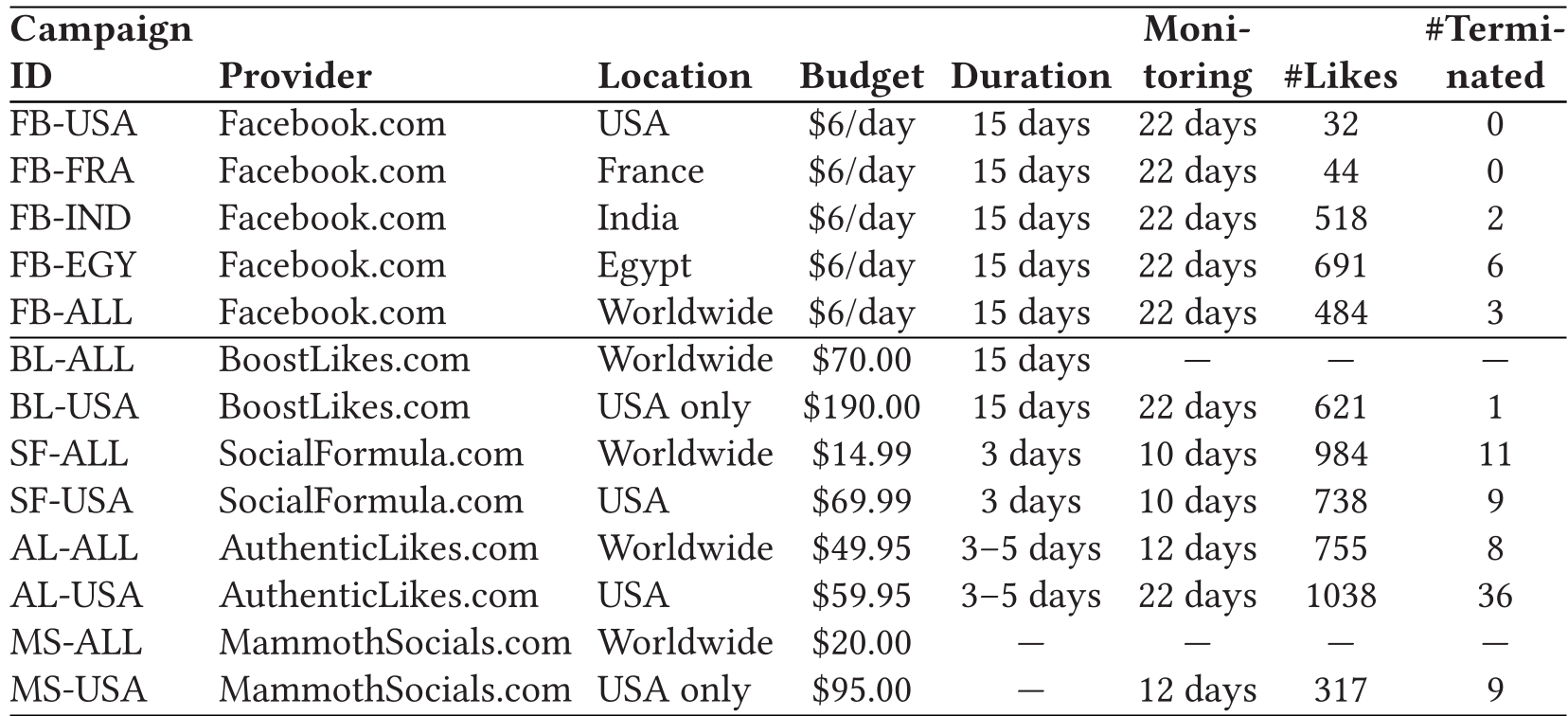
To catch these fraudsters, the researchers created 13 "Virtual Electricity" honeypot pages. The pages were intentionally empty and explicitly stated: "This is not a real page, so please do not like it."
They then "bought" likes from four different farms and ran legitimate Facebook ad campaigns for comparison. This allowed them to isolate 4,179 unique accounts known to be involved in paid reputation manipulation.
Why Graph Co-Clustering Fails
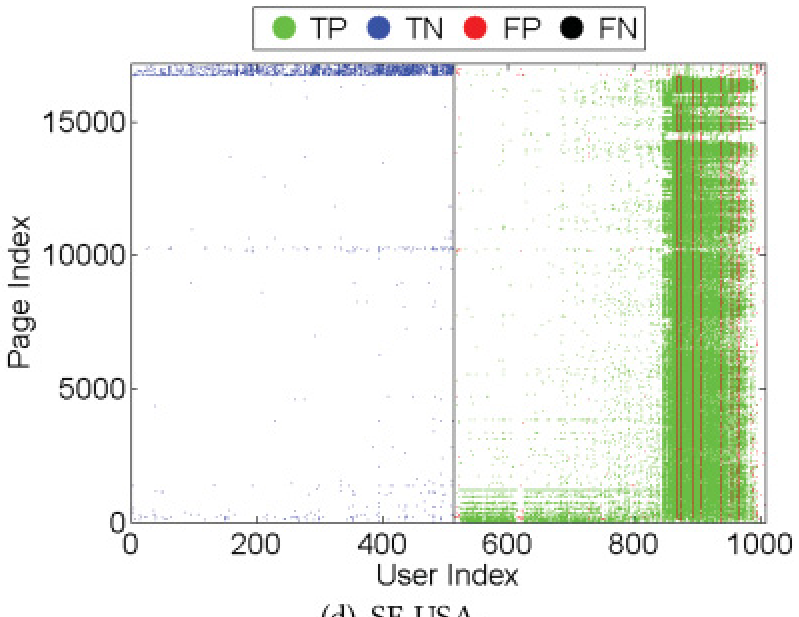
Methods like CopyCatch search for "near-bipartite cores" (groups of users liking the same groups of pages). However, as shown in the visualization below, stealthy farms like BoostLikes (BL-USA) exhibit high overlap with normal user behavior, causing graph-based tools to suffer from high False Positive rates (only 47% precision for BL-USA).
The Core Insight: Timeline "Fingerprinting"
If the graph can be faked, what can't? The authors suggest the Timeline. Writing unique, high-quality posts is expensive. Fake accounts usually:
- Re-share more: They act as "amplifiers" rather than creators.
- Use limited vocabulary: Lower lexical richness and shorter average word lengths.
- Have poor readability: Lower ARI (Automated Readability Index) scores.
Key Comparison (Farm vs. Human):
- Originality: Normal users post original content; farm accounts are 43% more likely to simply "share" external links or other posts.
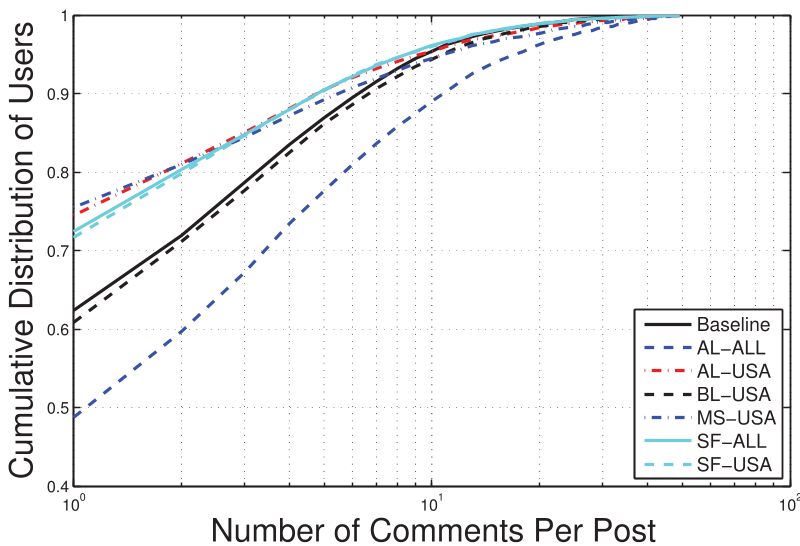
- Engagement Manipulation: Farm posts often have a high number of likes/comments from other farm accounts (forming an "engagement circle") but the text quality is abysmal.
Experimental Results
By training a supervised SVM Classifier on these timeline features (lexical + non-lexical), the researchers achieved:
- Precision: 99% - 100%
- Recall: 93% - 97%
- F1-Score: Consistently above 96% across all farm types.
This represents a massive leap over graph-only methods, especially for "stealthy" farm detection where precision jumped from 47% to 99%.
Critical Analysis & Conclusion
Takeaways
The study proves that the "cost of labor" is the ultimate defense. Automating a social graph is easy; automating human-like linguistic variety at scale is difficult and expensive. For platforms, integrating NLP-based behavioral analysis into security pipelines is no longer optional.
Limitations
- Language Bias: The lexical analysis was focused on English. Non-English farms might require different feature sets.
- Adversarial Evolution: If fraudsters start using LLMs (like GPT-4, though not available at the time of the study) to generate timeline posts, the "lexical richness" gap may close.
Future Work
The next frontier is detecting "Hybrid" accounts—real users who are paid a pittance to use their own active timelines for intermittent "like" jobs. Sophisticated NLP and sentiment consistency checks will be required to catch these "crowdturfing" employees.