
Beyond Big Data: Why Quality Trumps Quantity in Music Emotion Recognition
Analysis of the Effect of Dataset Construction Methodology on Transferability of Music Emotion Recognition Models
This paper investigates the cross-dataset transferability of Music Emotion Recognition (MER) models, specifically focusing on how dataset construction methodology (annotation control and segment selection) affects generalizability. By comparing models across three datasets (PMEmo, DEAM, and the Song, Dixon & Pearce dataset), the authors demonstrate that smaller, high-quality datasets can outperform larger, crowdsourced ones in cross-dataset scenarios.
TL;DR
In the world of AI, "more data" is often the default solution. However, this study reveals a different reality for Music Emotion Recognition (MER): a smaller, meticulously controlled dataset (PMEmo) produces models that generalize better than those trained on a dataset more than twice its size (DEAM). The secret lies in highly controlled annotation environments and the strategic selection of musical "choruses" rather than random segments.
The "In-Vitro" Problem of MER
Most Music Emotion Recognition models are "overfit" to their specific benchmarks. While they perform well on their own test sets, they often crumble when applied to a different music library. The authors identify two culprits behind this lack of transferability:
- Annotation Noise: Crowdsourced labels are cheaper but noisier than lab-controlled assessments.
- Segment Selection: Does a random 30-second clip from the middle of a song capture the same "emotion" as the chorus?
Methodology: A Head-to-Head Dataset Battle
The researchers set up a cross-dataset pipeline to test how different construction methodologies affect model "stamina" when moving from one environment to another.
The Contenders:
- PMEmo (P): 760 tracks. Manual chorus selection. Annotations collected in a strict lab environment.
- DEAM (D): 1,737 tracks. Randomly selected fixed-length segments. Crowdsourced annotations.
- Song et al. (S): 2,880 tracks. Categorical labels (Happy, Sad, etc.) harvested from social tags.
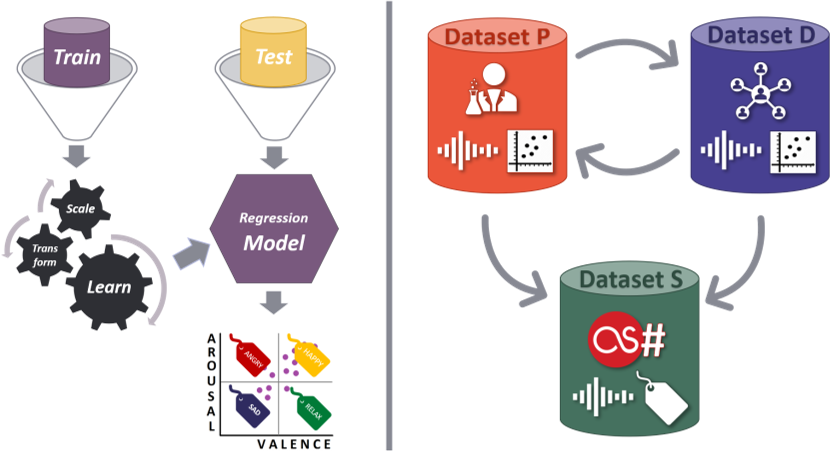
The team extracted 458 audio features (spectral, tempo, etc.) using LibROSA and applied standard regression techniques like Ridge Regression and Support Vector Machines (SVM) to keep the algorithmic variables constant.
Key Insights: Precision over Volume
The results (Table 2) showed a fascinating asymmetry. When a model trained on the smaller, high-quality PMEmo was tested on DEAM, the performance loss was relatively minor. In fact, for predicting Arousal, the model trained on PMEmo actually outperformed the model trained on DEAM itself!
Conversely, models trained on the larger DEAM dataset saw a massive drop in performance when applied to PMEmo.
Comparison Table: Performance Loss
| Direction | Avg. Valence Loss | Avg. Arousal Loss |
|---|---|---|
| D → P (Large to Small/Quality) | 0.24 | 0.51 |
| P → D (Small/Quality to Large) | 0.16 | 0.07 |
Note: Lower "Loss" indicates a more transferable and robust model.
Why Does This Happen?
The authors suggest two primary reasons for the superiority of the PMEmo-based models:
- The "Chorus" Effect: In Western pop music, the chorus is the emotional heart of the song. Models trained on these salient segments learn more distinct and reliable audio-emotion correlations.
- Ground Truth Reliability: Lab-controlled environments minimize contextual variables (distractions, varying hardware), leading to a cleaner signal-to-noise ratio in the ground truth data.
Critical Analysis & Conclusion
Takeaway for Researchers
This paper serves as a vital reminder that Data Engineering is often more important than Model Engineering. Instead of chasing 10,000 poorly labeled tracks, the MER community should focus on creating datasets with "emotional salience"—choosing segments that actually represent the intended affect.
Limitations
The study is limited by its focus on Western popular music. Emotions in classical music or non-Western traditions may not follow the "chorus" logic, and further research is needed to see if these findings hold across diverse cultural contexts.
Future Outlook
We are moving toward an era of Data-Centric AI. This work suggests that for niche domains like music emotion, we don't need billions of parameters or millions of tracks; we need a few thousand tracks labeled with the precision of a musicologist.