
RNN vs. SVM: Decoding the Future of Regional Electricity Demand
Day-ahead electricity consumption prediction of a population of households: analyzing different machine learning techniques based on real data from RTE in France
This paper evaluates day-ahead electricity consumption prediction for the Île-de-France region using publicly available RTE data. It compares the performance of two prominent machine learning models—Support Vector Machines (SVM) and Recurrent Neural Networks (RNN)—specifically implementing the Nonlinear AutoRegressive with Exogenous inputs (NARX) architecture.
TL;DR
Predicting exactly how much electricity a population will consume tomorrow is the "Holy Grail" for grid operators. This study evaluates two heavyweights in machine learning—Recurrent Neural Networks (RNN) and Support Vector Machines (SVM)—using real-world data from France's RTE. The result? RNNs win on precision (3.52% error), but SVMs win on raw speed, training 12x faster.
Background: The High Stakes of Grid Balancing
Electricity is a "just-in-time" commodity. If supply doesn't meet demand, the grid frequency destabilizes, leading to blackouts. For stakeholders in the Île-de-France region (including Paris), day-ahead forecasting is the primary tool for purchasing power and managing demand. However, energy consumption isn't just a simple line; it's a volatile mix of seasonal cycles, workday habits, and sudden temperature shifts.
The Core Challenge: Capturing the "Non-Linear"
The authors identify that traditional regression often fails because electricity demand is highly non-linear.
- Weather Sensitivity: As seen in the paper's correlation analysis, temperature is the single biggest driver of consumption.
- Edge Cases: General patterns break during "Ascension Day" or "Pentecost." A model that doesn't understand "holidays" will fail precisely when the grid is most vulnerable.
Methodology: Two Architectural Philosophies
The paper pits two different mathematical approaches against each other:
1. Support Vector Machines (SVM)
SVMs attempt to find an optimal "tube" in a high-dimensional space where data points can be linearly regressed. By using Kernel Functions, they transform non-linear energy data into a space where a straight line can fit the trend.
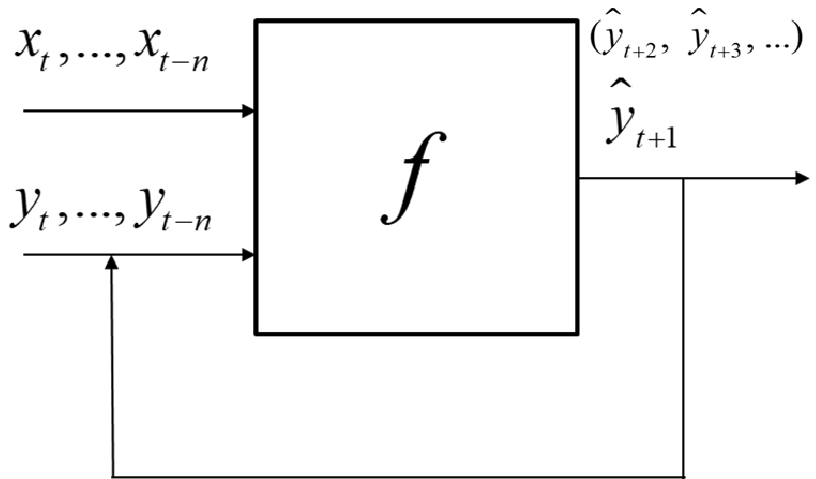 Figure: The SVM uses support vectors to define a "tube" of allowed error (ε), prioritizing computational simplicity.
2. Recurrent Neural Networks (RNN)
The authors used a NARX (Nonlinear AutoRegressive with Exogenous inputs) structure. Unlike standard networks, the RNN feeds its previous predictions back into itself. This creates a "memory" effect, allowing the model to understand that what happened at 8:00 AM today is highly relevant to 8:00 AM tomorrow.
Results: Accuracy vs. Efficiency
The experiments were conducted on a tough test set: 10 days in 2017 that included major French holidays.
| Model | Best MAPE (%) | Training Time |
|---|---|---|
| RNN (NARX) | 3.52% | ~4 Minutes |
| SVM | 13.99% | 20 Seconds |
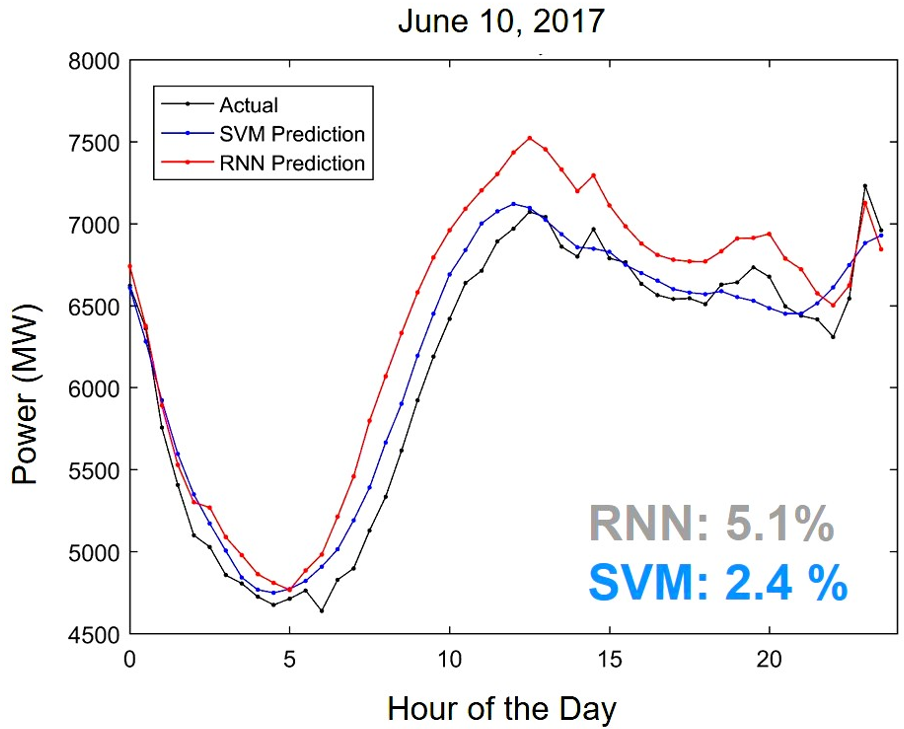 Figure: RNN (dashed line) follows the "shape" of actual consumption (solid line) much more closely than the smoother, less reactive SVM.
The "Holiday" Insight
The paper reveals that simply having weather data isn't enough. The breakthrough in accuracy (dropping RNN error from 5.5% to 3.5%) came from adding contextual features:
- Weekday vs. Weekend
- Tempo (RTE’s specific price/consumption period indicator)
- Holiday flags
Critical Analysis: Which one should you use?
While the RNN is the clear winner for accuracy, the authors raise a critical point regarding scalability.
- The RNN Advantage: It captures the "valleys and peaks" of daily life. If your goal is to prevent a local transformer from overloading at 6:00 PM, you need the RNN's sensitivity.
- The SVM Advantage: If you are running thousands of micro-forecasts for individual buildings or smart meters, the 12x speed advantage of SVM makes it significantly cheaper and faster to deploy at scale.
Conclusion & Future Outlook
The study proves that for regional-level forecasting, capturing temporal dependencies via RNNs is essential. However, the authors admit that LSTM (Long Short-Term Memory) networks—the successor to the RNNs used here—likely hold the key to even higher accuracy by solving the "vanishing gradient" problem in time-series data.
For researchers entering this field, the message is clear: the roadmap to SOTA (State of the Art) starts with high-quality exogenous data (weather/holidays) and moves toward deep, recurrent architectures.