
Tackling the "Inter-Day" Gap: Engineering Robust EEG Emotion Classifiers
Exploring day-to-day variability in EEG-based emotion classification
This study investigates the challenge of day-to-day variability in EEG-based emotion classification using a longitudinal music-listening protocol. It proposes a pipeline utilizing Independent Component Analysis (ICA) for artifact removal combined with Differential Caudality (DCAU) features, achieving improved stability across multiple recording sessions.
TL;DR
EEG-based emotion recognition often hits a wall when tested across different days due to signal variability. This paper provides a longitudinal analysis showing that while standard features (DLAT) might look good on paper for a single session, Differential Caudality (DCAU) combined with Independent Component Analysis (ICA) provides better scalability and robustness when training across multiple days.
Perspective: The Achilles' Heel of Affective BCI
The field of Affective Brain-Computer Interfaces (ABCI) has seen a surge in SOTA results, but there is a "reproducibility crisis" hidden in plain sight: day-to-day variability. Most models are "fragile"—they work perfectly for a 20-minute session but fail if the user puts the headset back on the next morning.
The authors argue that emotion is a time-evolving psycho-physiological process. Changes in electrode contact, the user’s baseline mood, and environmental noise create a distribution shift that makes single-session models obsolete.
Methodology: Beyond Simple Power Spectral Density
To combat this, the study focuses on two specific types of spatial-spectral features rather than raw power:
- DLAT (Differential Laterality): Measures left-right hemispheric asymmetry.
- DCAU (Differential Caudality): Measures front-to-back (fronto-posterior) asymmetry.
The pipeline is refined by the integration of ICA (Independent Component Analysis). Unlike simple band-pass filters, ICA acts as a blind source separation tool, weeding out eye blinks and muscle artifacts that vary day-to-day but are irrelevant to emotional states.
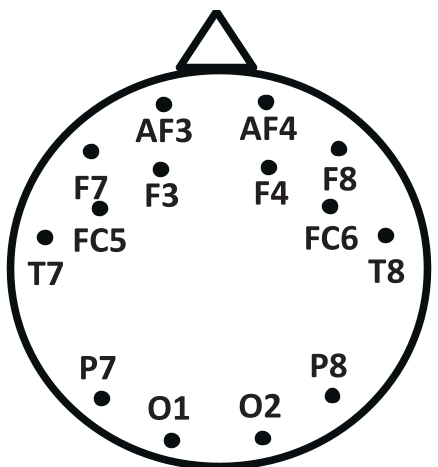 Fig 1: The 14-channel setup focusing on strategic pairs for DLAT and DCAU calculation.
The "Longitudinal" Experiment
Participants listened to music excerpts (Happy vs. Sad) over four sessions across two weeks. The authors tested two paradigms:
- LTO (Leave-Trial-Out): Within-day validation.
- LDO (Leave-Day-Out): Inter-day validation (The true test of robustness).
Key Insights from Experimental Results
The findings revealed a critical trade-off between Local Performance and Global Robustness:
- The Single-Day Trap: In within-day tests, DLAT features often outperformed DCAU. However, this success was illusory.
- The Power of ICA: Artifact removal significantly boosted performance for inter-day predictions, especially when combined with DCAU.
- Scalability: As shown in the chart below, DCAU (with ICA) was the only configuration that showed a clear monotonic improvement as more days were added to the training set.
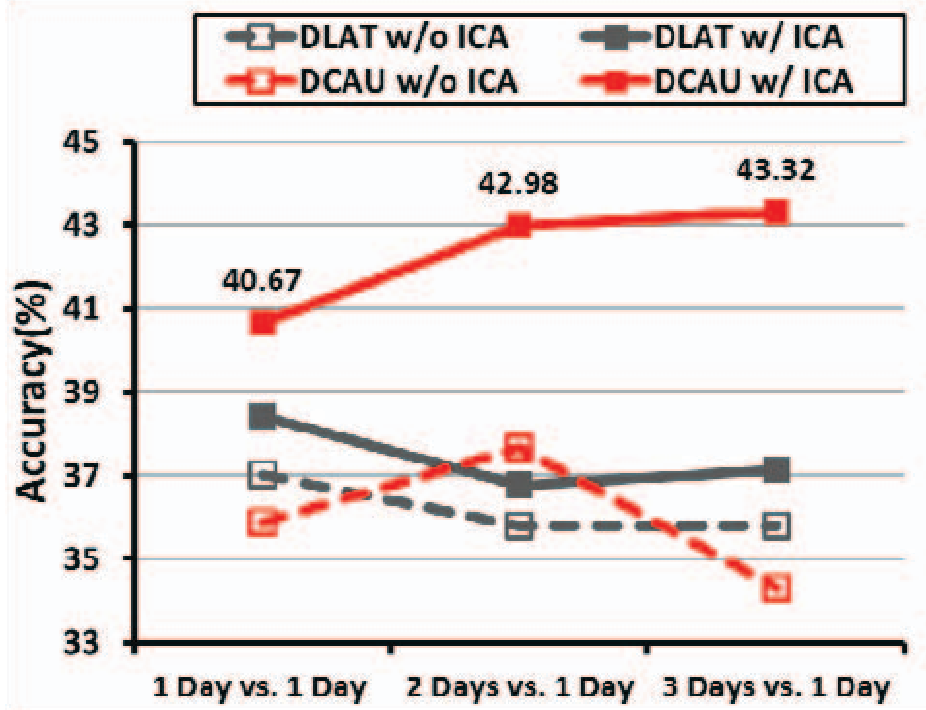 Fig 2: Note how DCAU (red line) climbs as training data spans 3 days, while other methods plateau or struggle.
Critical Analysis & Future Outlook
Contribution: The paper confirms that the choice of feature (DCAU) and preprocessing (ICA) acts as an "Inductive Bias" that helps the model ignore day-specific noise in favor of more stable neural correlates of emotion.
Limitations:
- Sample Size: With only 3 subjects (one excluded), the statistical power is limited, though the longitudinal nature (4 days per person) adds depth.
- Performance Ceiling: Even with 3 days of training, inter-day accuracy did not reach within-day levels, suggesting there is still a "residual" day-effect that current features cannot capture.
The Road Ahead: This work paves the way for Domain Adaptation in ABCI. Future researchers should look into extracting "Day-Invariant" representations using adversarial training or self-supervised learning to finally bridge the gap between laboratory success and real-world utility.