
DCAT: Decoding Trust in Social Networks via Deep Context-Awareness and GraphSAGE
DCAT: A Deep Context-Aware Trust Prediction Approach for Online Social Networks
The paper introduces DCAT, a novel deep learning-based, context-aware trust prediction framework for Online Social Networks (OSNs). By leveraging GraphSAGE for inductive node representation and integrating multi-dimensional context factors like level of expertise and textual footprints, it achieves state-of-the-art accuracy in predicting trust relationships between users.
TL;DR
Trust is the currency of Online Social Networks (OSNs), yet predicting it remains a challenge due to massive data sparsity. DCAT (Deep Context-Aware Trust) bridges this gap by moving beyond simple graph structures. It combines the inductive power of GraphSAGE with social-psychological textual analysis (like swear word usage and self-disclosure) to predict trust with a precision that outperforms traditional SOTA methods by up to 15 times.
The "Data Sparsity" Wall
Most legacy trust prediction models rely on the "Web-of-Trust" (if A trusts B, and B trusts C, then A might trust C). While theoretically sound, OSN data is notoriously sparse—most users never interact with one another. Furthermore, trust is contextual: you might trust a colleague's software recommendation but not their dietary advice.
Previous works often missed:
- Textual Footprints: The rich information hidden in user reviews.
- Context-Specificity: The domain in which the trust exists.
- Inductive Generalization: The ability to predict trust for "unseen" nodes that join the network after training.
Methodology: The DCAT Architecture
DCAT tackles these issues by redefining trust prediction as a supervised classification task powered by GraphSAGE. Unlike traditional GCNs, GraphSAGE doesn't require the entire graph to be present during training, making it ideal for the dynamic nature of OSNs.
1. Multi-Dimensional Feature Engineering
The authors identified two distinct types of features:
- Demographic & Behavioral: Level of Expertise (activeness x feedback) and Rating Similarity (homophily).
- Textual Content-Based: Utilizing LIWC (Linguistic Inquiry Word Count) to extract:
- Inclusive Words: Signifying a welcoming, trustworthy persona.
- Self-disclosure: Measuring intimacy via Social Penetration Theory.
- Swear Words: Correlating with psychopathic traits that diminish trust.
2. Framework Overview
The system processes raw reviews, calculates these factors, and feeds them into the StellarGraph implementation of GraphSAGE.
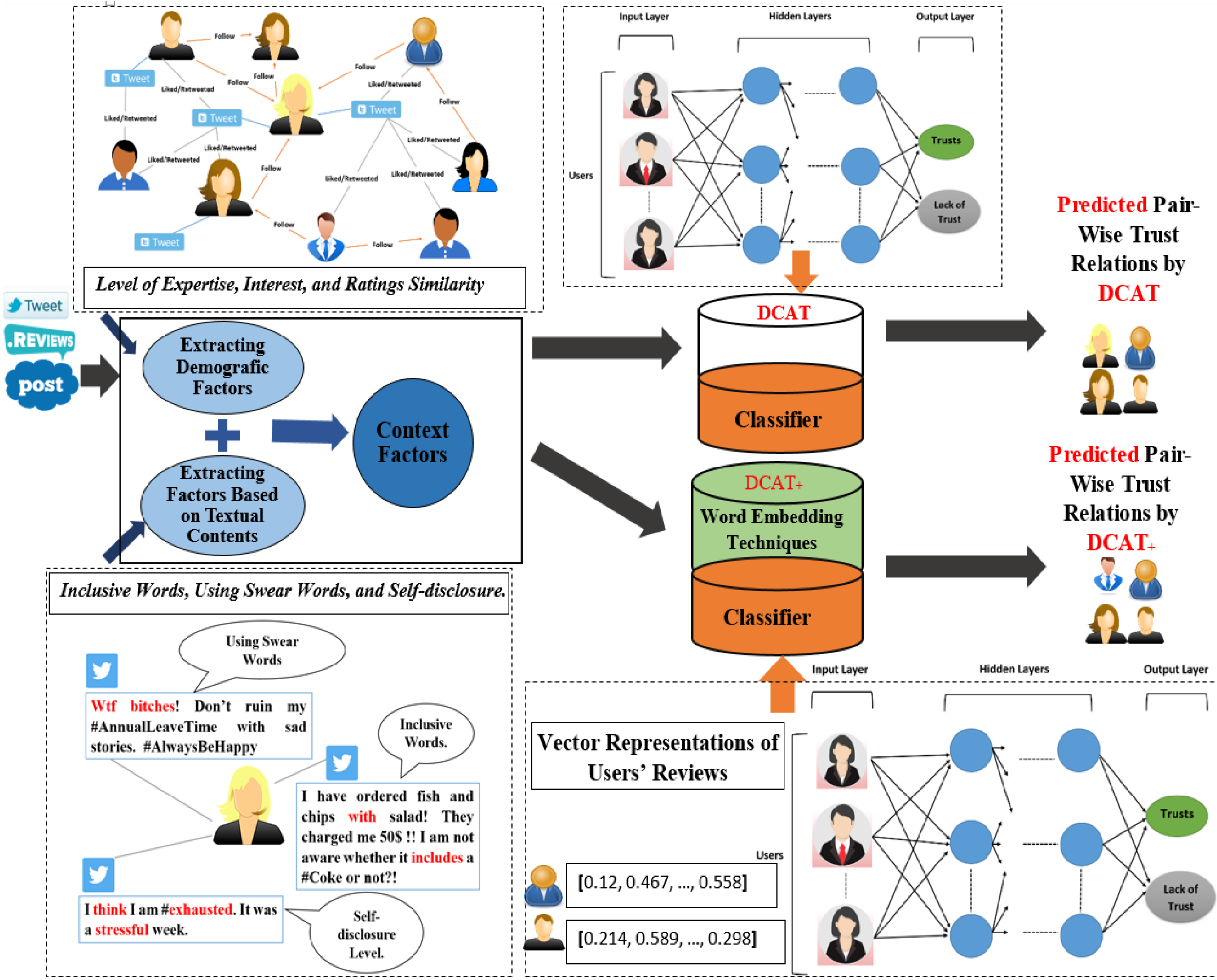 Figure 1: The DCAT workflow—from extracting context factors to deep classification.
Experiments and Results
The model was tested against two heavyweights in trust research: the Ciao and Epinions datasets.
SOTA Comparison
DCAT was pitted against context-less models (hTrust, sTrust) and existing context-aware models (TDTrust, Zheng).
| Dataset | DCAT MAE | Best Baseline (TDTrust) | Improvement |
|---|---|---|---|
| Ciao (90% training) | 0.36 | 0.76 | ~2.1x lower error |
| Epinions (90% training) | 0.40 | 0.97 | ~2.4x lower error |
 Figure 2: Performance comparison on the Ciao dataset across different training sizes.
The "DCAT+" Paradox
The authors also experimented with DCAT+, which adds raw Word2Vec embeddings of user reviews to the feature set. Surprisingly, DCAT (with hand-crafted psycholinguistic features) performed better than DCAT+. This reveals a profound insight: In trust prediction, the psychological signals in language (how we disclose info) are more important than the semantic content (what we are talking about).
Deep Insights & Future Work
The success of DCAT lies in its dual-nature: it respects the structural topology of the network via GraphSAGE while injecting human-centric social psychology through textual analysis.
Limitations & Horizon:
- Temporal Decay: The current model treats trust as static. However, trust is fragile and decays over time if not reinforced. Future iterations should incorporate a time-decay factor.
- Dynamic Graphs: Moving toward real-time trust updates as new reviews are posted would make this highly applicable to anti-fraud systems in e-commerce.
Conclusion
DCAT proves that trust isn't just about who you know, but how you talk and what you know. By combining Graph Neural Networks with high-level linguistic features, we can pierce through the problem of data sparsity and build more reliable social ecosystems.