
DCentroid: Balancing Worker Privacy and Mobility Efficiency in Spatial Crowdsourcing
DCentroid: Location Privacy-Preserving Scheme in Spatial Crowdsourcing
This paper introduces DCentroid, a location privacy-preserving framework for Spatial Crowdsourcing (SC) that utilizes a dummy-based obfuscation technique. It enables task assignment in Server Assigned Tasks (SAT) mode by generating three dummy locations and calculating a centroid for distance estimation, ensuring the SC-server never receives the worker's precise coordinates.
TL;DR
Spatial Crowdsourcing (SC) relies on knowing exactly where workers are to assign tasks efficiently, but this is a privacy nightmare. DCentroid is a novel framework that hides a worker's real location by sending three strategic "dummy" locations to the server. By using the centroid of these dummies for distance calculation, the system assigns tasks effectively while keeping the user's true position a secret from the service provider.
The Localization Dilemma: Efficiency vs. Privacy
In the world of Uber, TaskRabbit, or real-time traffic monitoring, the Server Assigned Tasks (SAT) mode is king. The server needs to know your exact coordinates to find the "closest" worker. However, this creates a massive vulnerability:
- Untrusted Servers: If the SC-server is compromised or malicious, your life's patterns (home, work, lifestyle) are exposed.
- Failure of Tradition: Traditional obfuscation (like drawing a big circle around a user) often leads to "Map Matching Attacks," where an attacker can rule out impossible locations like lakes or forests to pinpoint the user.
The authors argue that we need a way to provide "useful uncertainty"—enough info for the server to estimate distance, but not enough to identify the user.
Methodology: The DCentroid Approach
The core innovation of DCentroid is the DirectDummy Algorithm. Instead of randomly scattering points, it follows a structured geometric approach.
1. Generating Smart Dummies
The algorithm picks three points () from a set of sixteen distinct directions surrounding the worker. Crucially:
- The points are at least one unit away to prevent "closeness" inference.
- The real location is never sent to the server.
2. Centroid-Based Tasking
The server receives these three points and treats them as a triangle. It calculates the centroid () of this triangle: The server then calculates the distance from this centroid to the task. This "estimated distance" is used for the final assignment.
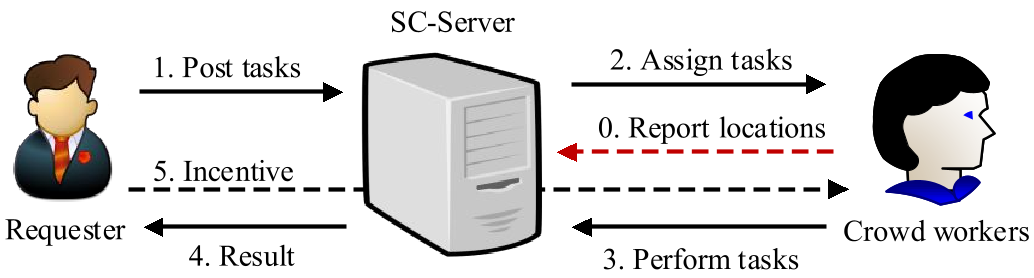 Fig 1: The Spatial Crowdsourcing Architecture where DCentroid sits between the worker and the server.
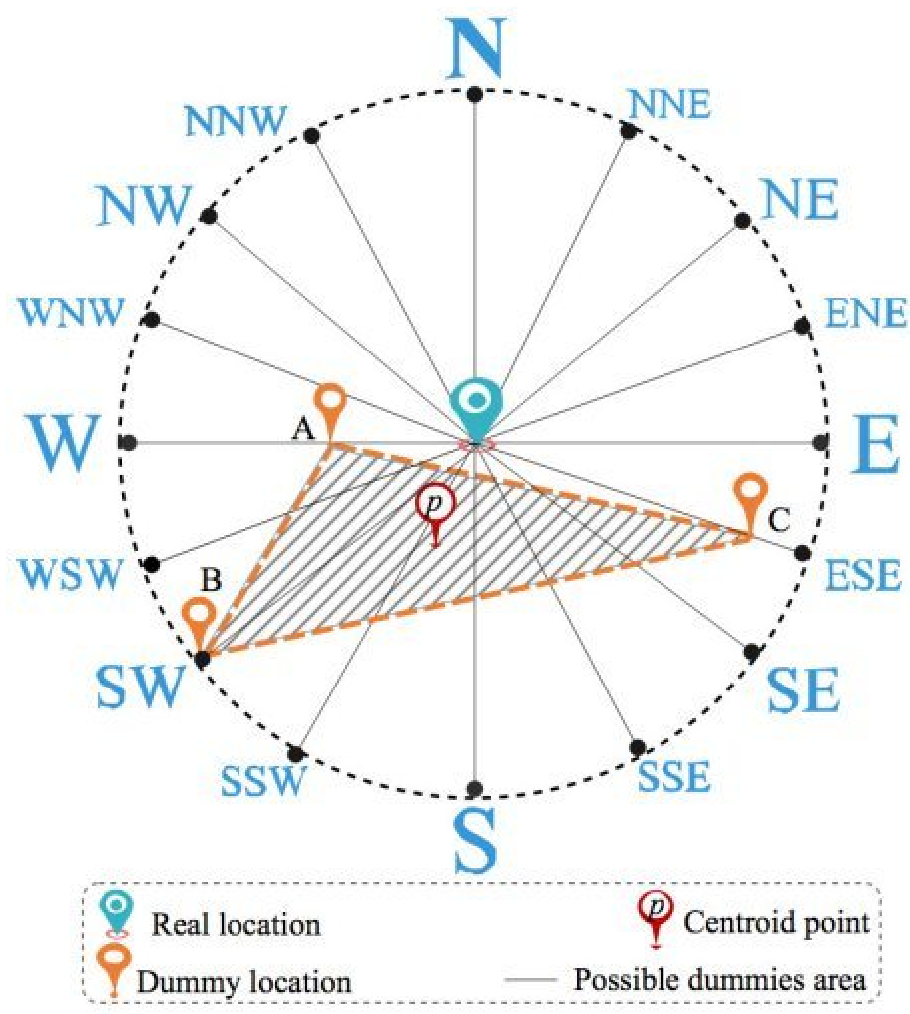 Fig 2: The 16-direction constraint system used to generate dummy locations (A, B, C) around the real location.
Experimental Insights
The researchers tested DCentroid using a real-world Yelp dataset, treating users as workers and restaurants as tasks.
Key Finding: The Distance Paradox
One might think that adding "fake" locations would ruin task efficiency. However, the evaluation shows a fascinating trend:
- Short Distances: If a worker is very close to a task, the Travel Distance Error (TDE) is relatively high because the dummy locations are spread out.
- Long Distances: As the distance to the task increases, the TDE decreases significantly. This means for most city-scale crowdsourcing tasks, the "error" introduced by privacy protection becomes negligible.
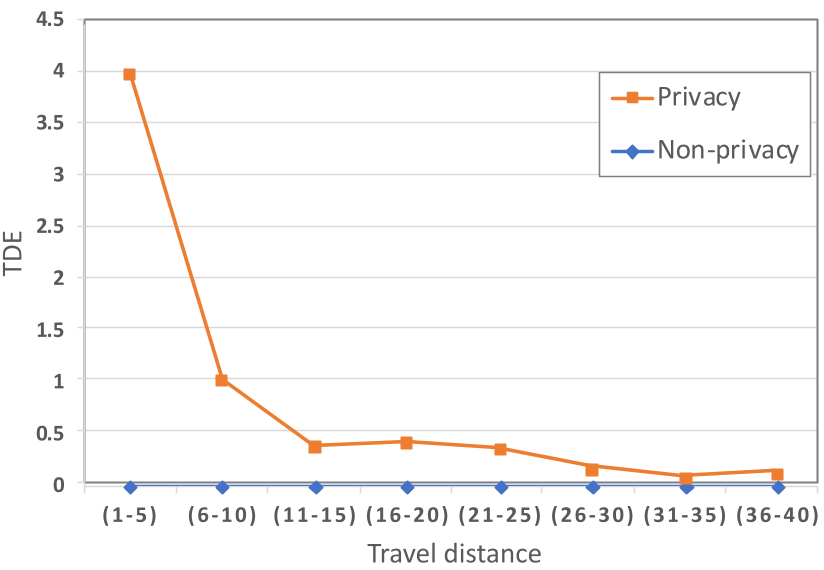 Fig 3: Results showing the convergence of Distance Error as task distance increases.
Critical Analysis & Conclusion
Takeaway
DCentroid successfully demonstrates that dummy-based techniques can achieve a high level of privacy without a "Trusted Third Party" or complex cryptographic overhead. It turns the geometric property of a centroid into a privacy-preserving proxy for distance.
Limitations & Future Work
- Computational Cost: While low, the server must calculate distances based on multiple points for every worker.
- Adversarial Strategy: A sophisticated adversary might attempt to use background knowledge (like population density maps) to filter which of the three dummies is "most likely" to be fake.
- Next Steps: The authors plan to expand this to Worker Selected Tasks (WST), where workers pull tasks from a list, adding another layer of anonymity to the process.
By bridging the gap between dummy-based obfuscation and mobility modeling, DCentroid offers a practical roadmap for the next generation of privacy-first gig economy platforms.