
DDSEIR: Curbing Rumors via Diffusion Power and User Discernment
DDSEIR: A Dynamic Rumor Spreading Model in Online Social Networks
This paper introduces DDSEIR, a dynamic rumor spreading model for Online Social Networks (OSNs) that extends the classical SIR framework. It incorporates two critical human factors—user dissemination capacity and discriminant ability—to simulate more realistic information propagation and control scenarios.
Executive Summary
TL;DR: The DDSEIR model (Disseminate & Discriminate-SEIR) is a sophisticated evolution of the classic epidemic model designed for Online Social Networks (OSNs). By quantifying who is spreading the information and how recipients judge its truthfulness, the model provides a more accurate prediction of rumor dynamics and offers a framework for delaying and reducing the scale of misinformation spread.
Background: This work moves beyond the "fixed probability" approach of early SIR models, positioning itself in the fourth generation of rumor models that emphasize human behavior and individual node heterogeneity.
Problem & Motivation: Why Static Models Fail
The viral nature of rumors in the OSN era is not just a function of the message itself, but a complex interplay of user influence and psychological filtering. Existing models (SIR, SEIR, SIHR) often ignore:
- Node Heterogeneity: Not all users have the same "megaphones"; an "Advanced User" (influencer) has a much higher impact than a "Common User."
- Information Evaluation: Real users don't just "catch" a rumor like a cold; they evaluate the source and the social context before deciding to share.
Methodology: The Core of DDSEIR
The authors propose a state-transition framework involving four statuses: Ignorant (I), Exposed (E), Spreader (S), and Stifler (R).
1. Hierarchical Dissemination Capacity
Using Degree Centrality, the model partitions the network. If an "Advanced User" (high degree) spreads a rumor, Ignorant nodes are much more likely to transition directly to the Exposed state.
2. The Discriminant Engine
The heart of the DDSEIR model is the transition from Exposed (E) to Spreader (S) or Stifler (R). This is governed by a calculated "Judgment" value:
- Source Trust (): Based on the number of mutual friends between the receiver and the spreader. The more common ground they share, the higher the trust.
- Information Popularity (): Calculated based on the cumulative influence of all current spreaders in the network. If everyone is talking about it, a user is more likely to jump on the bandwagon.
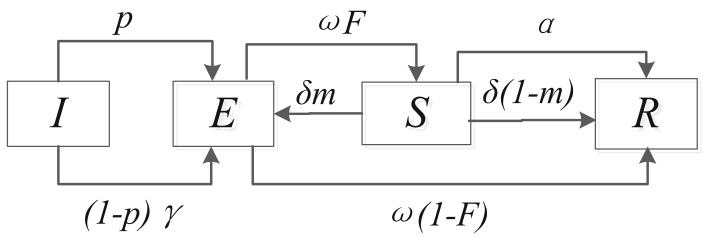 Figure 1: The state transition logic showing the evaluation process.
Experiments & Results
Simulated on NetLogo with a network of 5,000 nodes, the DDSEIR (S2) was compared against the standard SEIR (S0) and a version with only discriminant ability (S1).
- Delayed Peaks: DDSEIR effectively pushes the peak time of the rumor further into the future, providing a critical buffer for fact-checkers and authorities.
- Reduced Magnitude: Because users in DDSEIR can "identify" rumors and become Stiflers early, the total number of people ever infected by the rumor is significantly lower than in traditional models.
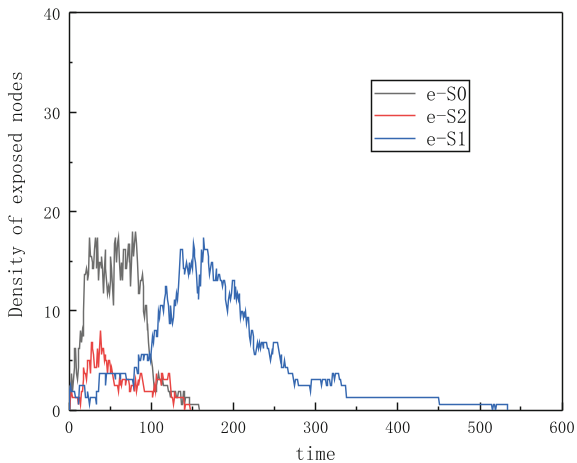 Figure 2: Comparison of Ignorant, Exposed, and Spreader node populations over time.
Critical Analysis & Conclusion
Takeaway: The DDSEIR model proves that internal user characteristics—specifically their social rank and their skepticism—are the most potent variables in rumor control.
Limitations:
- The model uses Degree Centrality, which is computationally efficient but may miss "bridge" nodes that are better identified via Betweenness Centrality.
- The "Baseline" for truth judgment is a fixed parameter; in reality, this threshold shifts over time as "rumor fatigue" set in.
Future Outlook: Integrating this model with real-time NLP (Natural Language Processing) to automatically determine "Information Attributes" could lead to a proactive, automated rumor-suppression system for modern social platforms.