
De-anonymizing the Flow: Leveraging Persistent Homology to Track Users in Dynamic Networks
De-Anonymization of Dynamic Online Social Networks via Persistent Structures
This paper introduces a novel de-anonymization framework for Dynamic Online Social Networks (OSNs) using Persistent Homology. By extracting "persistent structures" (polygons/holes) and their birth/death times across time slices, the authors achieve high-accuracy user identification (up to 99.58%) even when the adversary faces data collection latency.
TL;DR
Static snapshots are no longer enough to hide user identities. Researchers have developed a new attack method that uses Persistent Homology to "track" the evolution of social structures (holes/polygons) over time. Even if an attacker receives data with significant delays or errors, this method can map anonymized users to real identities with over 90% accuracy by focusing on how their relationships persist and evolve.
Problem & Motivation: The Static Graph Fallacy
Most privacy research treats Online Social Networks (OSNs) as frozen snapshots. In reality, OSNs are living entities—edges (friendships) appear and disappear constantly. Previous de-anonymization attacks typically split dynamic data into static slices and tried to match them independently.
The failure point? Evolution. If an adversary’s background knowledge has a "latency" (e.g., they find out about a friendship three months late), static matching fails because the graphs don't look the same at the same time. The authors realized they needed a metric that captures longevity and shape, not just a momentary connectivity matrix.
Methodology: Persistent Homology as a Structural Fingerprint
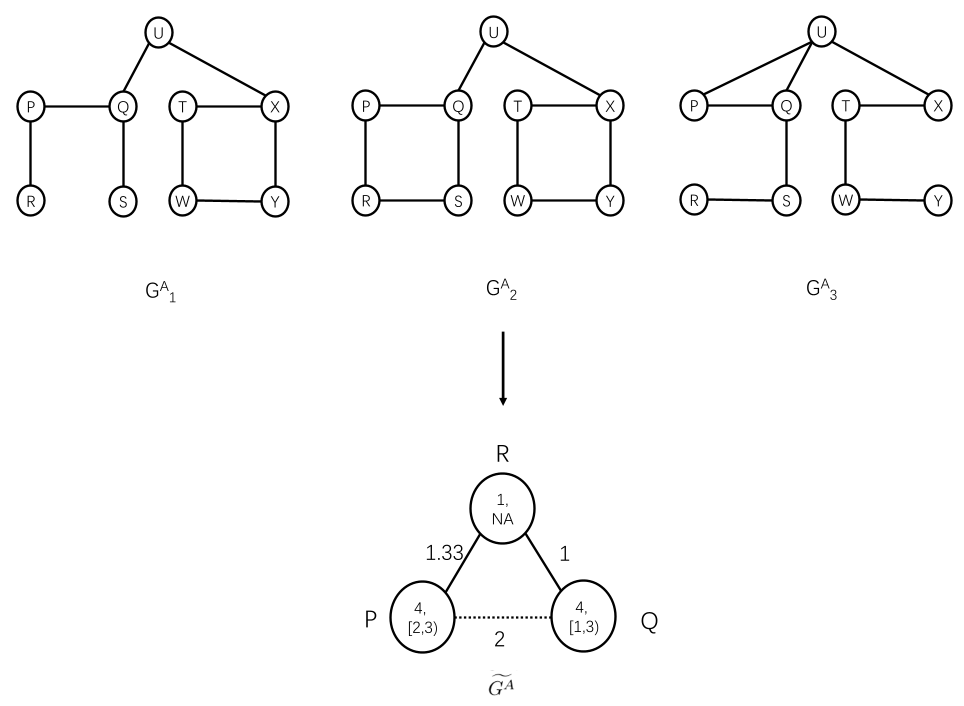
The core innovation lies in Persistent Homology. Instead of looking at individual nodes, the authors look for "holes" (polygons with four or more sides). These holes represent stable community structures.
1. Extracting Barcodes
Each hole has a birth time (when the last edge completes the polygon) and a death time (when a shortcut edge is added, splitting the hole into smaller triangles). This is visualized as a barcode. Even if GA (the anonymized graph) and GB (the adversary's knowledge) are offset in time, the "length" and "signature" of these bars remain similar.
2. The Converted Super-Node Graph
The authors convert these persistent structures into "super nodes." A super node encapsulates a group of users forming a stable cycle.
3. Seed-and-Grow Attack
- Phase 1 (Seeding): Map super nodes between the two graphs by comparing their birth/death times and sizes.
- Phase 2 (Growing): Use the nodes involved in these matched holes as high-confidence "seeds." Then, use a weighted similarity score (Equation 8) and BFS to map the remaining "simple" nodes in the network.
Experiments: Robustness Against Latency
Using a real-world Facebook dataset (2005-2009), the authors tested two critical variables: Latency () and Error ().
- Resilience to Delay: Unlike the "Baseline" which drops to near-zero accuracy when data is delayed, the PH-based approach maintains high performance because it matches the existence of a structure rather than its exact timestamp.
- Quantifiable Superiority: At a latency of , the PH method achieved ~71% accuracy, while the baseline struggled below 10%.
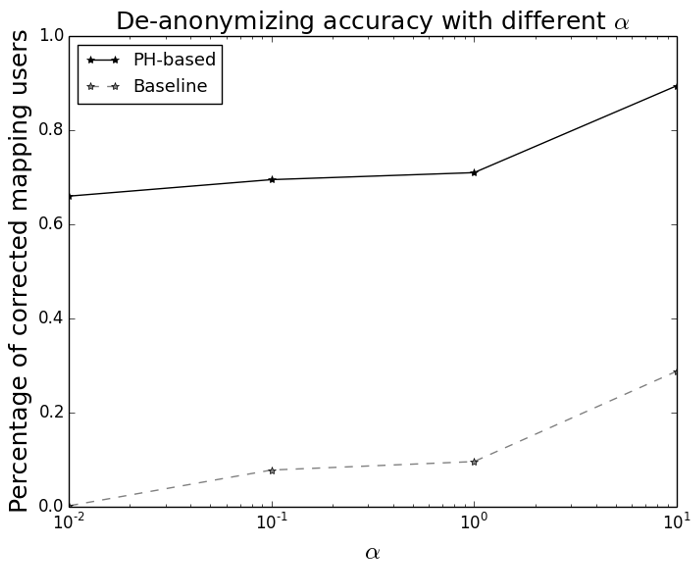 Fig: Our PH-based approach (top curves) remains robust even as latency increases, whereas baseline methods fail.
Critical Insight & Conclusion
This work demonstrates that topology is identity. The specific way you and your friends form "loops" in a social graph is so unique that it survives even if some edges are missing or delayed.
Takeaway: For service providers, anonymization must go beyond removing names or flapping edges. To truly protect privacy in a dynamic world, one must obscure the underlying persistent topological structures of the network. The study opens a new front in the privacy war: Temporal Topology Defense.