
De-anonymizing Scale-Free Social Networks: Fusing Spectrum Partitioning with Attribute Insights
De-anonymizing Scale-Free Social Networks by Using Spectrum Partitioning Method
The paper proposes a novel de-anonymization framework for scale-free social networks by combining spectral graph partitioning with a hybrid similarity metric. By integrating structural features (degree centrality, clustering coefficients) with personal attribute information, it achieves high re-identification accuracy on large-scale datasets like Facebook and Google+.
TL;DR
This research addresses the growing privacy risks of "anonymized" social media data. By using Spectral Partitioning to break down massive networks and a Hybrid Similarity Metric that considers both who you know (structure) and who you are (attributes), the authors demonstrate that even perturbed social graphs can be re-identified with high precision.
Problem & Motivation: The Structural Blind Spot
Most traditional de-anonymization attacks rely solely on the "skeleton" of a network—its edges and nodes. However, in the age of the Internet of Things (IoT) and Big Data, attackers often have access to "Auxiliary Information" (like public profiles or leaked databases).
The authors identify two fatal flaws in prior work:
- Scalability: Analyzing a graph with millions of nodes is computationally exhausting.
- Feature Poverty: Ignoring user attributes (like location, interests, or age) makes the matching process fragile against structural noise (perturbations).
Methodology: Divide, Conquer, and Match
The proposed framework follows a sophisticated pipeline designed for the "Scale-Free" (Power-Law) nature of real-world social networks.
1. Spectral Partitioning
To handle massive data, the authors use a spectral partitioning method to divide the social graph into disjoint subgraphs. This is not just about size; it’s about efficiency, allowing the algorithm to run in parallel across multiple processors.
2. The Multi-Dimensional Feature Vector
Instead of just looking at neighbor counts, the paper extracts a triplet of structural features:
- Degree Centrality: The number of connections.
- Weighted Degree Centrality: Accounting for the "strength" of connections (using a tuning parameter ).
- Clustering Coefficient: Measuring how "tight-knit" a user's social circle is.
3. Fusing Intuition: Structural + Attribute Similarity
The core of the "match" is the Similarity Score:
By adjusting and , the attacker can weigh the importance of the network shape versus the metadata of the users themselves.
 Note: The de-anonymization process iterates through these partitions, significantly reducing the search space for candidate nodes.
Experiments & Results
The authors tested their method on Facebook and Google+ datasets from SNAP.
- The Power of Attributes: As shown in the experiments, increasing the sampling frequency of attributes () leads to a sharp rise in matching accuracy.
- Robustness: Even when the graph edges were perturbed (sampled at ), the algorithm maintained high accuracy, proving that attribute data acts as a "stabilizer" for structural matching.
- Efficiency: The partition-based approach showed a direct correlation between sampling frequency and runtime, confirming the scalability of the parallel approach.
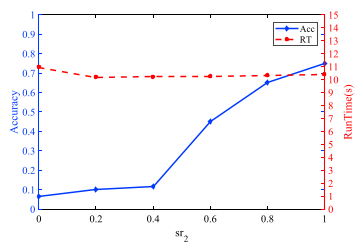 Above: The influence of weight coefficients and attribute sampling on de-anonymization accuracy.
Critical Analysis & Conclusion
Takeaway
The study proves that "anonymization" via ID removal is insufficient. The combination of graph topology and user attributes creates a unique fingerprint that is highly resilient to data perturbation.
Limitations
While spectral partitioning aids scalability, the "seeding" process (finding the first match in a subgraph) still remains a critical bottleneck. If the initial high-degree nodes in a partition are incorrectly matched, the error may propagate through the "percolation" process.
Future Outlook
Future research should look into Adversarial Machine Learning—can we perturb attributes or edges in a way that specifically decoys these hybrid similarity metrics? As social networks become increasingly multi-modal (containing text, images, and relationships), the "Attribute similarity" component of this paper will likely become the dominant factor in privacy research.