
De-Anonymizing Social Networks: Leveraging the Power of Overlapping Communities
De-Anonymizing Social Networks With Overlapping Community Structure
The paper investigates seedless social network de-anonymization using overlapping community structures. It proposes a Minimum Mean Square Error (MMSE) based cost function and a polynomial-time Convex-Concave Based De-anonymization Algorithm (CBDA) to map anonymized users to correlated auxiliary networks.
TL;DR
Social network de-anonymization is essentially a graph alignment puzzle. While most researchers tackle this by looking for "seed nodes" (pre-identified users), this paper addresses the much harder "seedless" case. By exploiting the fact that real-world users belong to multiple overlapping communities (e.g., a colleague who is also a fitness enthusiast), the authors propose an MMSE-based matching framework that achieves 90% accuracy in re-identifying users across different platforms.
The "Seedless" Dilemma and the Overlapping Reality
De-anonymization aims to link identities across two graphs (e.g., matching a "sanitized" Facebook dataset with a public LinkedIn profile). Most existing SOTA methods rely on MAP (Maximum A Posterior) estimation, which seeks the most likely single mapping. However, if the MAP estimate is slightly off, the entire error becomes imponderable.
The authors identify two fatal flaws in prior work:
- Assumption of Disjoint Communities: Traditional models assume you belong to only one group. In reality, your identity is the intersection of many overlapping circles.
- Algorithmic Intractability: Even if we have a perfect cost function, the search space for mappings is , making it NP-hard.
Methodology: From MMSE to WEMP
The core innovation lies in the Minimum Mean Square Error (MMSE) estimator. Unlike MAP, MMSE minimizes the expected number of mismatched users by considering all possible mappings weighted by their posterior probabilities.
The Analytical Leap
The paper transforms the complex MMSE goal into a Weighted-Edge Matching Problem (WEMP). They introduce a weight matrix , where the weight essentially penalizes mismatches between node pairs. Crucially, the authors prove that higher overlapping strength increases the "gap" between correct and incorrect matches, making the global optimum easier to find.
The Algorithmic Engine: CBDA
To solve the resulting optimization problem, the authors present the Convex-Concave Based De-anonymization Algorithm (CBDA).
- Convex Relaxation: Initially, the problem is solved in a continuous space where "partial" matches are allowed.
- Concave Transition: Through an adjustable parameter , the algorithm gradually shifts the objective function to become concave.
- The Intuition: Since the minimum of a concave function lies on the boundary of the feasible region, this process "pushes" the continuous solution toward a discrete permutation matrix (a 1-to-1 mapping).
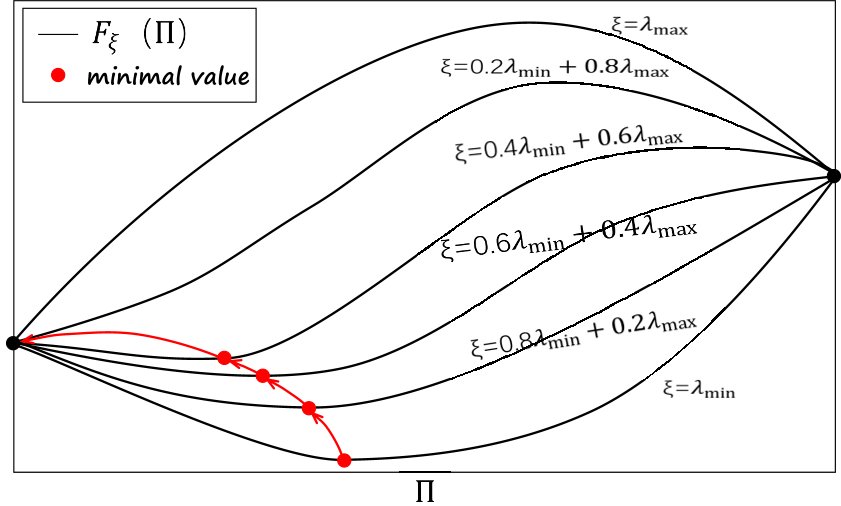 Figure 1: The trajectory of the optimizer moving from the center of the relaxed space to a discrete permutation matrix.
Experimental Proof: The Overlap Advantage
The authors validated their approach on the Microsoft Academic Graph (MAG), exploring cross-domain co-author networks.
- The 70% Enhancement: In networks with dense overlapping communities, the re-identification accuracy was roughly 70% higher than in cases where communities were treated as disjoint.
- Scalability: As the network size increases, the "relative Node Mapping Error (NME)" vanishes, proving the algorithm becomes even more reliable for large-scale social networks.
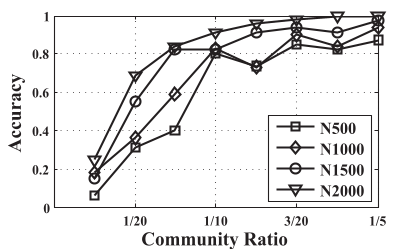 Figure 2: Performance on real cross-domain co-author networks, highlighting the superiority of CBDA in overlapping settings.
Critical Insight & Future Outlook
The most striking takeaway is that community overlap is not noise—it's a signature. In many privacy-preserving protocols, researchers try to hide individual edges. However, this paper suggests that as long as the underlying "community membership" (the latent roles we play) remains consistent across domains, your identity is remarkably unique.
Limitations: The computational complexity of (or with heuristics) remains a bottleneck for billion-node graphs. Future work must bridge the gap between these globally optimal convex-concave methods and the efficiency of local graph-traversal heuristics.
Conclusion
This work provides a rigorous bridge between the theoretical limits of privacy and the algorithmic reality of de-anonymization. By showing that WEMP returns negligible error in large networks, the authors have effectively set a new baseline for what an adversary can achieve without any starting "seeds."