
De-Virtualizing Social Events: Why Your Facebook "Join" Doesn't Mean You'll Show Up
De-Virtualizing Social Events: Understanding the Gap between Online and Offline Participation for Event Invitations
This paper explores the "De-virtualization" of social events by examining the behavioral gap between online RSVPs and offline attendance. Through interviews with 31 participants, the study identifies how social perceptions, relationship strength, and communication media influence the transition from digital commitment to physical presence.
TL;DR
Even when hundreds of people click "Going" on a digital event page, the actual venue often remains half-empty. This paper investigates the "De-virtualization gap"—the disconnect between online commitment and offline action. By interviewing 31 heavy SNS users, researchers uncovered that the way we interact with "Join" buttons is more about impression management and politeness than actual intent to attend.
The Problem: The "Join" Button Paradox
In the physical world, an invitation usually requires a binary, often high-stakes response. In the virtual world of Social Network Sites (SNSs), the "cost" of both sending and accepting an invitation has plummeted to near zero.
The authors argue that this efficiency is a double-edged sword:
- Host Perspective: It's easier than ever to reach a mass audience.
- Guest Perspective: The invitation feels like "spam," reducing the sense of social obligation.
This leads to Slacktivism—the act of supporting a cause or event online with zero intention of contributing effort offline.
Methodology: Peeking Behind the Screen
The researchers didn't just look at logs; they conducted deep-dive interviews. They analyzed 79 specific events (the majority from Facebook) and mapped online responses against offline attendance.
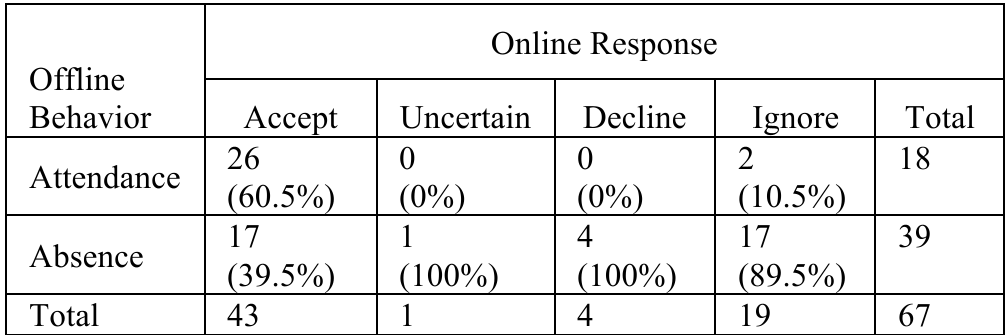
As shown in the data, nearly 40% of people who clicked "Accept" were no-shows. Interestingly, 10% of people who "Ignored" the invitation online actually showed up offline—showing that digital platforms aren't just failing to capture commitment; they're failing to capture actual social dynamics.
Key Insights: Why De-virtualization Fails
1. The Social Appropriation of Buttons
Users don't read "Join" literally. For many, clicking "Join" is:
- A Bookmark: "I want to remember this event."
- Face-Saving: "I don't want the host to feel bad, so I'll click Join and figure it out later."
- Status Signaling: "I want my friends to see I'm the type of person who goes to rock festivals or protests."
Conversely, clicking "Decline" is often viewed as aggressive or a sign of opposition to the event's cause, leading people to "Ignore" invitations rather than formally decline them.
2. Targeted vs. Spam Communication
The perceived effort of the host dictates the guest's accountability.
- Low Sincerity: A Facebook event sent to 500 people is "costless" and thus easy to ignore.
- High Sincerity: A personalized email, an Instant Message (IM), or a phone call signals that the host specifically wants you there. This "sincerity signal" triggers a much higher sense of social obligation.
3. Public vs. Private Dynamics (Social Loafing)
In large public events, Social Loafing kicks in. If 1,000 people are "Going," an individual feels their absence won't be noticed. In small, private groups, "Identifiability" is higher. You can't miss a 5-person dinner without a massive social penalty.
Critical Analysis & Design Implications
The paper makes a compelling case that current UI designs are too "flat." They treat every "Join" the same, whether it's a polite nod or a firm promise.
How can we fix this?
- Sincerity Gauges: Interfaces should require (or encourage) hosts to personalize invitations to prevent them from looking like spam.
- Nuanced Responses: Instead of just "Join/Decline," give users a "Support but cannot attend" option. This allows for face-saving without ruining the host's headcounts.
- Privacy Partitioning: For large events, platforms could group "friends of friends" into micro-clusters, re-introducing the sense of small-group accountability.
Conclusion
The gap between our virtual and physical selves is paved with "Join" clicks made out of habit rather than intent. To effectively "de-virtualize" society’s events, we need tools that respect the messy, nuanced, and high-stakes nature of real-world relationships, rather than reducing human connection to a simplified mouse click.