
DOUR: Optimizing Utility in Deadline-Sensitive Mobile Social Networks
Deadline-sensitive opportunistic utility-based routing in cyclic mobile social networks
The paper proposes DOUR (Deadline-sensitive Opportunistic Utility-based Routing) and its multi-copy extension m-DOUR, designed for cyclic Mobile Social Networks (MSNs). It introduces a utility model that maximizes the expected benefit (reward for delivery before a deadline) while minimizing forwarding costs, achieving SOTA performance in utility-oriented metric balancing.
TL;DR
The paper introduces DOUR, a routing protocol for cyclic Mobile Social Networks (MSNs) that treats message delivery like a business transaction. It focuses on maximizing Utility—defined as the reward for meeting a deadline minus the transmission costs. By using a greedy distributed algorithm to calculate optimal forwarding sequences, it outperforms traditional protocols that blindly optimize for speed or success ratio.
Background & Motivation: Beyond "Fastest Path"
In traditional Mobile Social Networks, the goal is usually simple: get the packet to the destination as fast as possible. However, in real-world applications (like a digital "postal service" for remote areas), every relay hop costs energy and bandwidth.
The authors identify a critical gap: Prior work (like TOUR) assumed benefits decrease linearly with time. In reality, many tasks have a hard deadline. If a message arrives one second late, the reward is zero. DOUR addresses this "all-or-nothing" reality by proposing a deadline-sensitive utility model that balances:
- Benefit (): The reward for success.
- Deadline (): The hard time constraint.
- Forwarding Cost (): The price paid for each relay.
Methodology: The Logic of Optimal Sequences
The core innovation lies in how a node decides whether to pass a message to a neighbor or wait for a "better" one later. This is determined by the Optimal Forwarding Sequence.
1. The Mathematical Intuition
A node evaluates a potential relay at time . The decision follows a simple but powerful greedy rule: Forward only if the expected utility from this relay is higher than the utility of waiting for the remainder of the sequence.
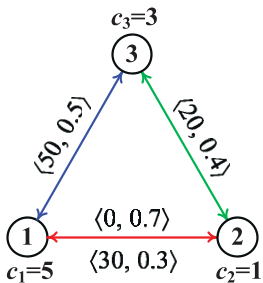 Fig 1: Representing a cyclic MSN as a weighted graph where edges represent probabilistic contacts and nodes have forwarding costs.
2. The DOUR Algorithm
The algorithm works backwards from the deadline. By sorting all potential contact opportunities in reverse chronological order, nodes can iteratively determine which contacts are "profitable."
- Step 1: Sort opportunities by contact time.
- Step 2: Starting from the latest opportunity, determine if it adds value.
- Step 3: Update the expected utility and move to the next earlier opportunity.
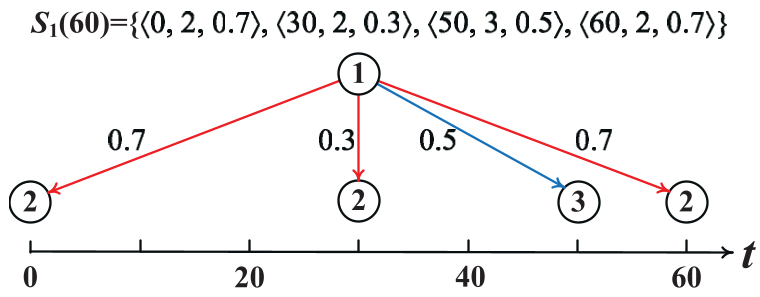 Fig 2: An example of an opportunistic forwarding sequence where node 1 chooses the best path based on evolving probabilities.
Extensions: Multi-copy Routing (m-DOUR)
While single-copy routing is efficient, it is risky. The authors extend the logic to m-DOUR, a two-hop multi-copy strategy. The source dynamically maintains the "top " best forwarding opportunities. If a highly reliable node appears unexpectedly, the source dynamically swaps out a worse-performing future contact to save costs while maintaining high delivery probability.
Experiments & Results
The researchers tested DOUR on the UMassDieselNet trace (real bus movement data).
Key Findings:
- Utility Superiority: DOUR significantly outperformed
MaxRatio(which ignores cost) andMinCost(which ignores deadlines). - Adaptability: As the Benefit () increases, DOUR becomes more "aggressive," choosing more expensive paths to ensure the reward.
- Cost-Effectiveness: m-DOUR achieved delivery ratios comparable to flooding-based methods but at a fraction of the transmission cost.
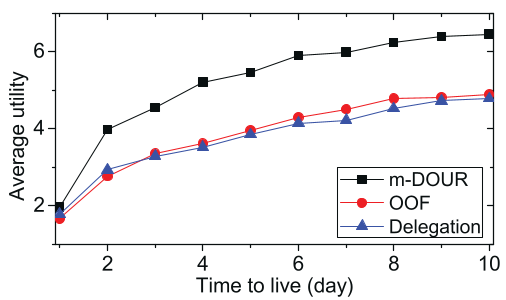 Fig 3: Utility comparison showing DOUR staying consistently above baseline algorithms across different TTL values.
Critical Analysis & Conclusion
Takeaway
DOUR proves that local greedy decisions can lead to global utility optimization in cyclic networks. It treats network resources as a finite currency, making it highly applicable to IoT and rural networking scenarios where energy is scarce.
Limitations
- Cycle Knowledge: The algorithm assumes nodes know their contact probabilities. While historical data works for buses, it might be less stable for unpredictable human movement.
- Two-Hop m-DOUR: The multi-copy extension is limited to two hops for computational simplicity; a full multi-hop multi-copy version remains an open challenge.
Future Work
Exploring how this utility model adapts to Adversarial MSNs (where nodes might lie about their costs) or integrating reinforcement learning to predict cycles dynamically would be the next logical steps for this research lineage.