
Beyond the Screen: How E-Government and Social Media Subvert the Mechanics of Corruption
How to deal with corruption? Examining the roles of e-government maturity, government administrative effectiveness, and virtual social networks diffusion
This study investigates the anti-corruption impact of e-government maturity across 91 countries, specifically focusing on legislative, executive, and judicial branches. Utilizing structural equation modeling, the authors demonstrate that e-government reduces corruption primarily by enhancing "government administrative effectiveness," with Virtual Social Network (VSN) diffusion acting as a critical catalyst for this process.
TL;DR
Is digital government enough to stop corruption? This study argues it isn't. By analyzing data from 91 countries, researchers found that the true "anti-virus" for corruption is Government Administrative Effectiveness. E-government acts as the engine, but Virtual Social Networks (VSNs) serve as the fuel, creating a "Public Sphere" that holds officials accountable.
The "Iceberg" of Digital Governance
Most citizens see e-government as the "visible" layer: renewing a driver's license online or paying taxes. However, the authors identify an "Iceberg Phenomenon" in current research. We focus too much on these G2C (Government-to-Citizen) services while ignoring the "sub-surface" impact: how technology changes the internal administrative machinery.
The paper posits that if technology doesn't make the administration more effective at enforcing rules, the anti-corruption benefits of e-government remain superficial.
Methodology: The Trinity of Reform
The authors grounding their research in three heavy-hitting theories:
- Technological Determinism: Technology (E-Gov) forces organizational change.
- General Deterrence Theory (GDT): Rational actors only stop being corrupt if the certainty of punishment (sanction) is high.
- Habermas’ Public Sphere: Citizens need a "neutral ground" (now VSNs like Twitter/Facebook) to generate public opinion and pressure.
The Core Model
The study proposes that e-government maturity leads to administrative effectiveness, which then deters corruption in the three co-equal branches of government defined by Montesquieu: the Legislature, the Executive, and the Judiciary.
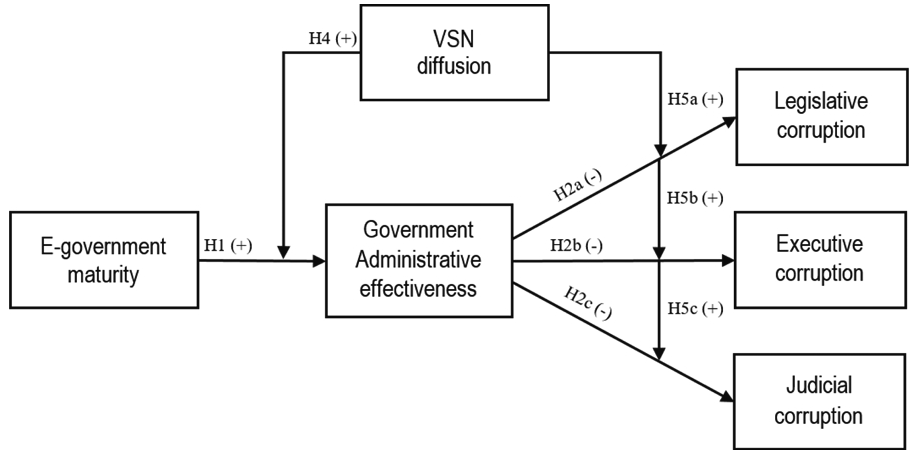 Fig 1. The structural model linking e-government, administrative effectiveness, and corruption branches.
Key Findings: The VSN Multiplier Effect
The most striking insight is that the diffusion of social networks acts as a moderator.
- The Catalyst: When social media use is high, the link between e-government and administrative effectiveness is significantly stronger.
- The Oversight: High VSN diffusion helps citizens "spot" corruption in the executive and legislative branches, supporting the administration in enforcing laws.
- The Judicial Exception: Interestingly, VSN diffusion had a weaker effect on judicial corruption. The authors suggest this is because the judiciary often operates behind a "veil of secrecy" (low transparency) compared to other branches.
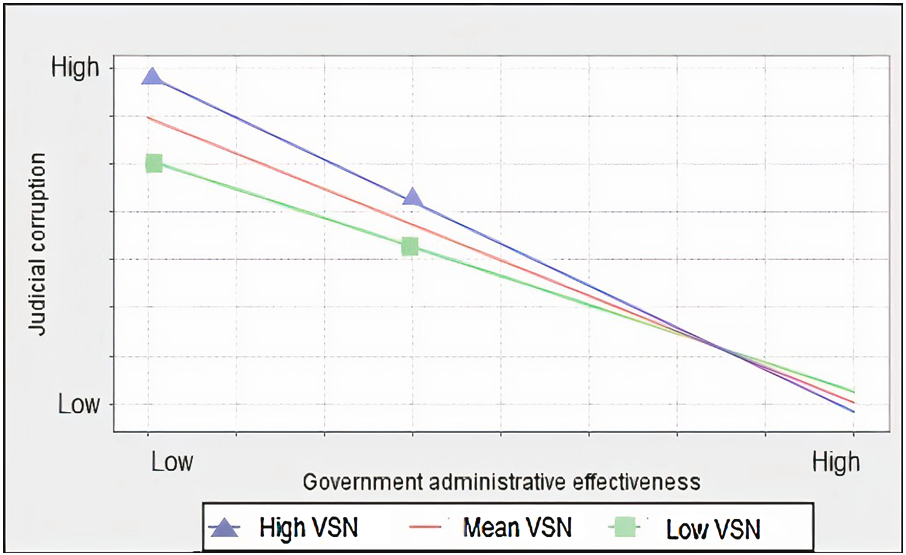 Fig 2. Simple slope analysis showing how VSN diffusion strengthens the efficacy of e-government.
Empirical Evidence
Using PLS-SEM (Partial Least Squares Structural Equation Modeling), the research validated that:
- E-gov maturity has a path coefficient of 0.438 to administrative effectiveness.
- Administrative effectiveness has a massive negative correlation with executive corruption (-0.758) and judicial corruption (-0.812).
- The model explains over 90% of the variance in executive corruption, a remarkably high R-square value for social science research.
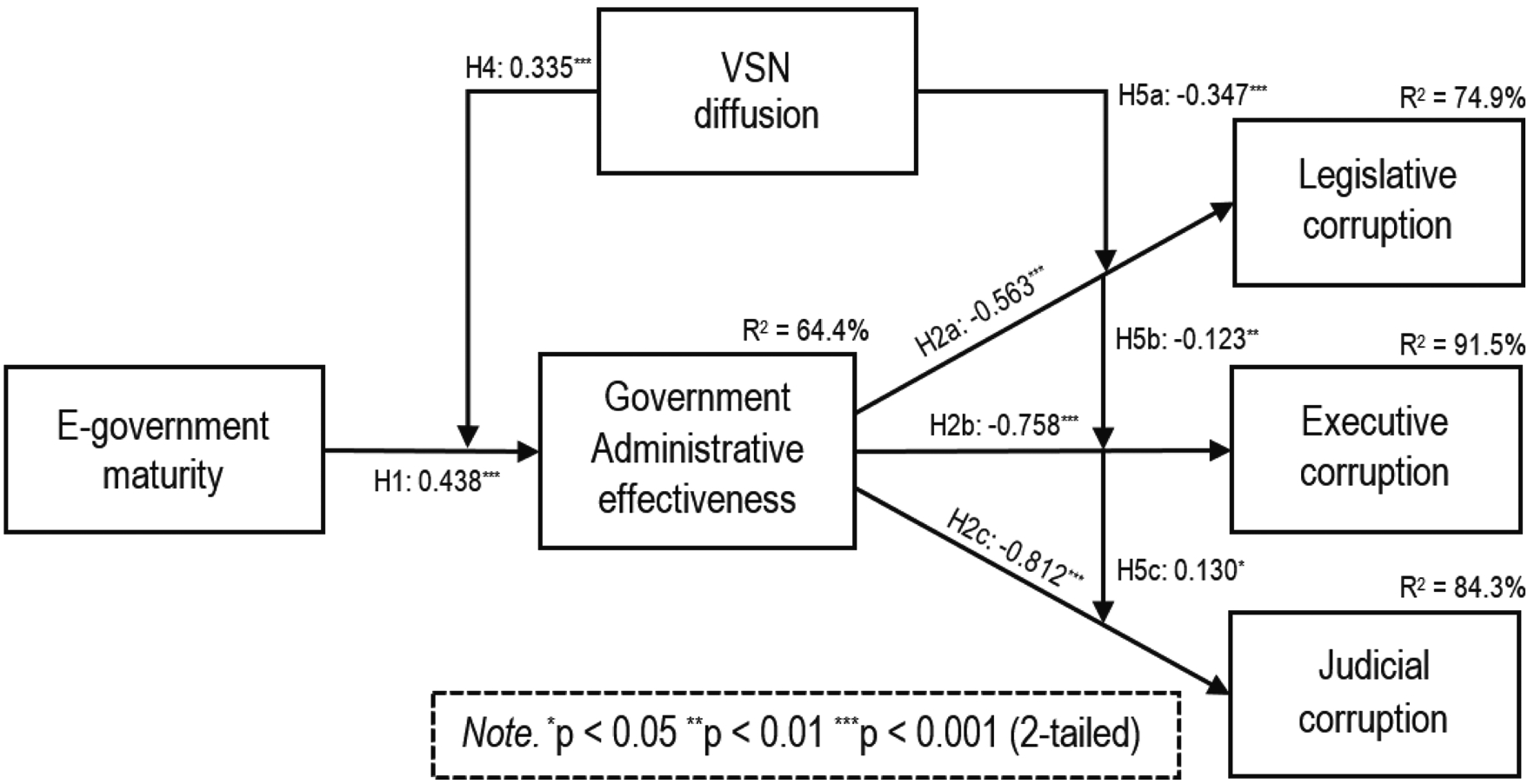 Fig 3. Final Path Analysis showing the validated linkages and their statistical significance.
Critical Insight: Why This Matters for Policy
The paper shifts the focus from investing in hardware to investing in administrative protocols. For digital government to work as an anti-corruption tool, the back-end "plumbing"—the rules, the enforcement, and the transparency of the administration—must be updated to leverage the data that digital systems provide.
Furthermore, governments that try to suppress social media (the Public Sphere) are effectively sabotaging the anti-corruption potential of their own expensive e-government systems.
Conclusion
This work provides a roadmap for "Dealing with Corruption." It proves that "you can't bribe a computer," but only if the person operating the computer is held accountable by an effective administrative system and an observant, digitally-connected citizenry.
Takeaway: E-government is a necessary condition, but not a sufficient one. True reform requires "The Trinity": Maturity, Administrative Will, and a Free Public Sphere.