
Preserving the Pulse: Dealing with Group Disappearance in Social Networks
Dealing with Disappearance of an Actor Set in Social Networks
This paper introduces a robust framework to handle the simultaneous disappearance of an actor set (group of nodes) in social networks. By extending the JOAN and JOAN-C algorithms, the authors maintain network connectivity and information flow quality through parsimonious link addition and group substitution.
TL;DR
Social networks are fragile ecosystems where the sudden exit of a group of actors—be it a team leaving a company or a cluster of users leaving a platform—can sever critical communication lines. This paper proposes a systematic approach to "heal" these networks by strategically adding a minimal number of links and identifying substitute groups to ensure information flow remains uninterrupted.
Problem & Motivation: Beyond Single-Node Failures
Most existing literature focuses on the "Influential Actor"—the single celebrity or manager whose removal hurts the network. However, the authors argue that a group of nodes, even if individual members aren't highly influential, can collectively hold the network together.
When a group leaves, two things happen:
- Fragmentation: The network may split into disconnected "islands."
- Flow Degradation: Even if connected, the "distance" for information to travel (eccentricity) might increase, making communication sluggish.
The authors' insight is that we shouldn't just predict links based on chance (like basic Link Prediction); we should add links with the explicit goal of maintaining the "Information Flow Quality" ().
Methodology: The Geometry of Disappearance
The core of the methodology lies in how the leaving group is configured. The authors identify three archetypes:
- Scattered Group: Nodes are isolated from each other. The solution is to handle them iteratively using JOAN/JOAN-C algorithms.
- Contiguous Group: Nodes are tightly knit. Removing them leaves a "hole." The system finds a Substitute Group () among the remaining neighbors that maximizes group degree centrality.
- Hybrid Group: A mix of the above, requiring a decomposed approach.
Architecture and Logic
The authors rely on a key performance indicator: Witness Eccentricity. The "witness" is the node closest to everyone else (the best entry point for info). The goal is to keep this witness as close to the rest of the network as possible after the group leaves.
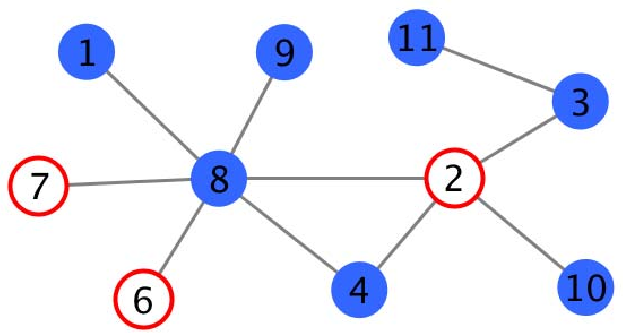 Figure 1: Illustration of a scattered group exit. Because nodes 2, 6, and 7 are not directly connected, their removal is treated as independent events.
For contiguous groups, the mathematical challenge is choosing a substitute that minimizes the "cost" of new links. The authors prove that choosing a substitute group with the same cardinality (size) as the leaving group is optimal for preserving the density of connections without over-linking.
Experiments: Efficiency and Scalability
The authors tested their approach on the AS-733 (Internet Routers) dataset, which contains over 6,000 nodes.
Key Findings:
- Parsimony: Even when 20% of the network vanishes, the algorithm only adds about 0.15 links per deleted node. This prevents the "link explosion" problem where every node becomes connected to everyone else.
- Community Parallelism: By breaking the network into communities first, the system can run updates in parallel on a cloud infrastructure (PiCloud), drastically reducing response times for large networks.
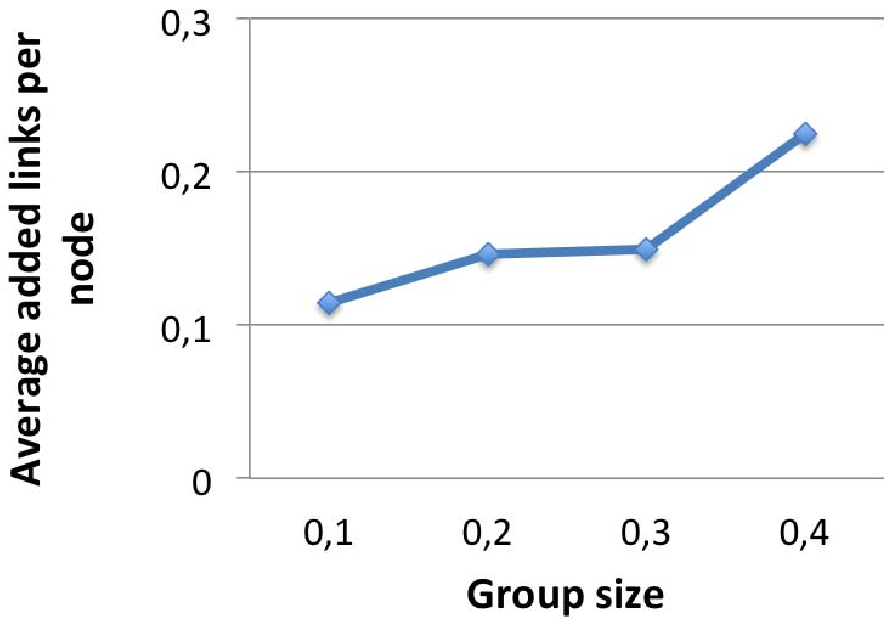 Figure 2: The dashed line shows the massive speedup achieved by processing node disappearances via communities in a parallel environment.
Critical Analysis & Conclusion
Takeaway
The paper successfully moves social network maintenance from a "reactive" state (fixing broken links) to an "objective-driven" state (preserving flow quality). The distinction between scattered and contiguous groups provides a necessary framework for real-world scenarios where failures are often correlated.
Limitations
- Unweighted/Undirected Assumption: The current model treats all links as equal. In real social networks, the strength of a link (frequency of contact) matters just as much as its existence.
- Static Substitution: The substitute groups are identified based on current topology, which might not reflect the actual social willingness of those nodes to take on new communication roles.
Future Outlook
The authors suggest a "pro-active" approach: instead of waiting for nodes to disappear, the system could identify "weak links" that are critical for flow and recommend strengthening them beforehand. This shifts the paradigm from "Network Repair" to "Network Resilience."