
Debiasing Social Wisdom: Recovering Truth from Networked Echo Chambers
Debiasing social wisdom
This paper introduces a framework for extracting the "Wisdom of Crowds" from interacting social networks by identifying and removing social influence bias. It utilizes the Friedkin-Johnsen opinion formation model and proposes "InfluenceSampling," a novel debiasing algorithm that estimates the average innate (original) opinion of a crowd using only their expressed (influenced) opinions and a propensity-to-conform parameter.
TL;DR
Social networks are fantastic for gathering opinions but terrible for "Wisdom of Crowds" because we influence each other, leading to collective bias. This paper proposes a way to "reverse-engineer" our true, original thoughts (innate opinions) from the biased ones we post online (expressed opinions). By understanding a user's propensity to conform, the authors' InfluenceSampling algorithm can estimate the true average opinion of a population with significantly higher accuracy and fewer samples than traditional polling.
Background: The Social Sabotage of Wisdom
The classic "Wisdom of Crowds" effect operates on the principle of independence: if 1,000 people guess the weight of an ox, their errors cancel out, and the average is remarkably accurate. However, in a social network, we see what others guess. This interaction undermines the effect by diminishing diversity and creating "herd" behavior.
The authors from Microsoft Research argue that we shouldn't just look at the What (the final opinion) but the How (the process of being influenced).
The Mathematical Intuition: Innate vs. Expressed
The core of the methodology relies on a specific model of opinion formation where a user's expressed opinion at any time () is a convex combination of:
- Innate Opinion (): Your gut feeling before logging onto Twitter.
- Neighborhood Influence: The average opinion of the people you follow.
The "Conformity Parameter" () determines the balance. If , you are stubborn and unshakeable. If , you simply parrot your environment.
The Methodology: Rewinding the Equilibrium
Instead of assuming we can ever see the innate opinion directly, the authors solve for the equilibrium of the network. They prove that as long as everyone has even a tiny bit of independent thought (), the network will settle into a unique state of expressed opinions.
 Figure 1: The mathematical formulation of the Friedkin-Johnsen model used to describe opinion updates.
The breakthrough is Lemma 4, which provides a closed-form way to calculate the population-wide average innate opinion using only the expressed values and a weighting factor (). This allows the creation of a sampling algorithm that targets the most "informative" nodes—those who aggregate their neighbors' thoughts effectively.
Experimental Validation
The authors didn't just stay in the realm of theory. They conducted experiments on Amazon Mechanical Turk, asking users to guess the number of dots in an image or predict the success of tablet computers.
Key Findings:
- Alpha is Stable: A user's tendency to conform is consistent across different topics. If you are influenced by others regarding a picture of dots, you are likely to be influenced regarding product reviews.
- Superior Sampling: Their "InfluenceSampling" approach consistently showed lower mean error and lower variance than uniform sampling.
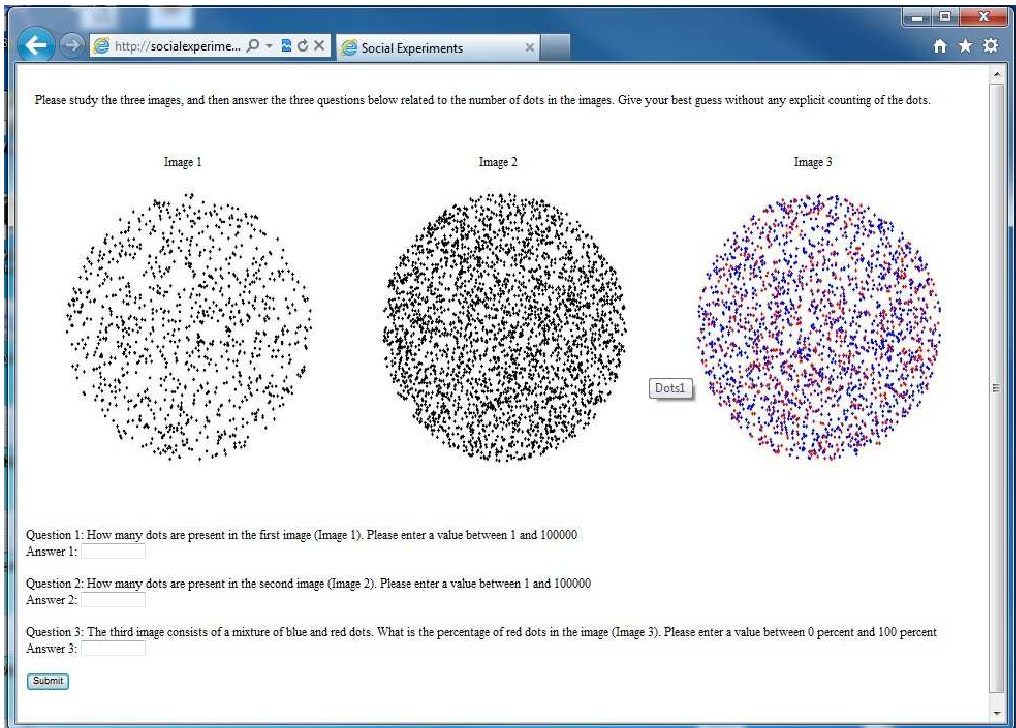 Figure 2: The UI for the Dot Estimation experiment where social influence was introduced.
On synthetic graphs of 200,000 nodes, the results were even more dramatic. InfluenceSampling reached a stable, low-error estimate much faster than any other method, proving its scalability.
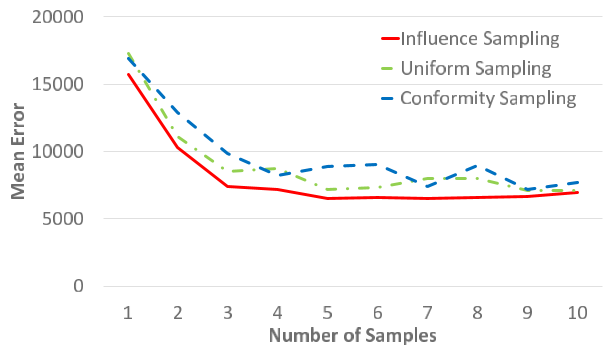 Figure 3: Performance of InfluenceSampling vs. Baselines. Note the significantly lower error and smoother convergence.
Critical Insight & Conclusion
This work shifts the paradigm of social data mining. Instead of treating social media posts as direct votes, we must treat them as signals passing through a noisy, interconnected filter.
Takeaway: The "Wisdom of Crowds" isn't dead in the age of social media; it's just hidden. By calculating the "Debiasing Weight" of specific individuals based on their position in the network and their personality (conformity), we can recover the true collective intelligence of the group.
Limitations: The model assumes we can estimate (perhaps through history of retweets or likes) and that the network structure is known. In the real world, "hidden" influences or bot accounts might complicate the estimation.
Future Work: Applying this to large-scale political discourse to separate "organic" consensus from "inflated" opinions driven by a few influential nodes.