
My3: Engineering Privacy and Availability in Decentralized Social Networks
A Decentralized Online Social Network with Efficient User-Driven Replication
This paper introduces My3, a decentralized online social network (DOSN) that replaces centralized servers with user-contributed resources. It leverages social properties like geographic locality and predictable online patterns to implement efficient, user-driven profile replication achieving over 90% availability.
TL;DR
My3 is a privacy-first, decentralized alternative to mainstream social networks. By treating your trusted friends' devices as mini-servers (proxies), My3 achieves over 90% profile availability using a smart replication strategy that aligns with users' real-world online habits, effectively solving the "offline peer" problem in P2P networks.
Contextual Positioning
In the landscape of Privacy-Preserving OSNs, My3 sits between heavy encryption-based systems (like PeerSon) and "always-on" pod systems (like Diaspora). Its unique contribution is the User-Driven Replication model—it doesn't assume peers are always online but instead optimizes for when they are.
The Problem: The "Big Brother" Monopoly
Centralized OSNs face a structural conflict of interest: they prioritize advertisers over user privacy. While moving to a P2P (Peer-to-Peer) model solves the privacy issue, it introduces a massive technical hurdle—Availability. If your profile is stored on your friend's laptop and they close the lid, your profile disappears from the internet.
The authors identify that standard DHT (Distributed Hash Table) approaches ignore the social context. My3's core insight is that social interactions are not random; they are geolocalized and follow predictable temporal patterns.
Methodology: The Trusted Proxy Set (TPS)
Instead of distributing data to random strangers, My3 uses a Trusted Proxy Set (TPS). Users choose a subset of friends they trust to host their content and enforce access control.
The Online Time Graph (OG)
The system constructs an "Online Time Graph" where edges represent overlapping online windows between friends. This allows My3 to treat the network not as a static graph, but as a dynamic synchronization window.
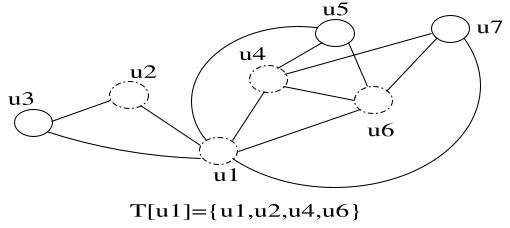
Specialized Replication Strategies
My3 offers five distinct algorithms for choosing replicas:
- MaxAv (Maximize Availability): Greedy selection of friends with the longest non-overlapping online times.
- MNR (Minimize Number of Replicas): Uses a Minimum Connected Dominating Set to keep storage overhead low.
- MPD (Minimize Propagation Delay): Focuses on data freshness by picking peers with the best synchronization "handoff" times.
- MAC (Minimize Access Cost): Prioritizes low latency by picking the geographically closest peers.
- Hybrid: A weighted objective function balancing all of the above.
Experiments and Results
The researchers tested My3 against Facebook (New Orleans) and Twitter datasets. The most striking finding is the efficiency of the MaxAv and Hybrid approaches.
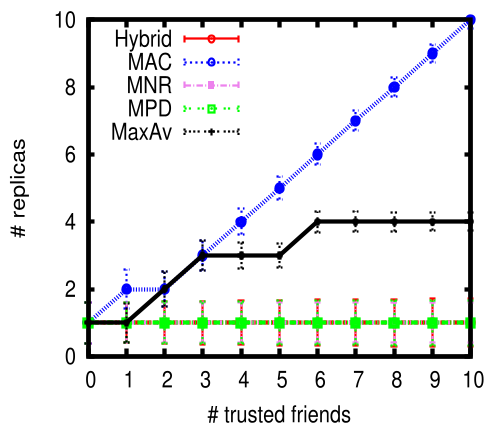 (The charts show how MaxAv reaches near 100% availability much faster than other methods as the number of trusted friends increases.)
Key Performance Metrics:
- Availability: Achieved >90% with only 4-5 replicas.
- Availability-on-Demand: In a social context where you only need to be online when your friends are, the system reached near 100% efficiency with a replication degree of 6.
- Storage Load: Even with 10 replicas per user, the system load remained manageable, preventing "super-nodes" from being overwhelmed.
Critical Insights & Takeaways
The brilliance of My3 lies in its Inductive Bias: it assumes that friends who interact more are more likely to be trusted and more likely to be online at similar times.
Comparison to SOTA
Unlike Diaspora, which requires expensive always-on servers (pods), My3 proves that "intermittent" peers (like family laptops) can sustain a network if the replication matches the "Social Heartbeat" of the users. Compared to encryption-only models like Persona, My3 simplifies key management by leveraging social trust for access control delegation.
Limitations
- Trust Dynamics: The system assumes trust in a friend translates to trust in their device; a compromised laptop could leak unencrypted data.
- Consistency: My3 settles for eventual consistency. For real-time applications (like instant messaging), the propagation delay might still be a hurdle.
Conclusion
My3 provides a viable technical roadmap for a truly decentralized social web. It demonstrates that we don't need a central "Big Brother" to ensure a reliable experience; we just need a mathematically optimized way to rely on our friends.