
Verifiable Medicine: Solving Data Scarcity through Blockchain and zk-SNARKs
A Decentralized, Privacy-preserving and Crowdsourcing-based Approach to Medical Research
The paper proposes a decentralized, privacy-preserving medical crowdsourcing platform using blockchain and zk-SNARKs. By utilizing the LegoSNARK-based CPlink compiler, researchers can solicit medical data contributions where patients provide verifiable model updates without revealing raw sensitive health records.
TL;DR
Access to high-quality medical data is the "holy grail" of modern AI-driven healthcare, yet it is locked behind privacy regulations and trust barriers. This paper introduces a decentralized crowdsourcing platform that allows patients to contribute to medical research using zk-SNARKs. Patients can prove that their data fits a research model without ever revealing the data itself, while smart contracts ensure they are paid fairly for valid contributions.
The Trust Gap in Medical Research
The central dilemma of medical informatics is the Privacy-Utility Trade-off. Researchers need massive datasets, but patients cannot (and should not) expose their most private information.
Current methods are insufficient:
- Differential Privacy: Adds "noise" to data, which can be dangerous in medicine where precision is a matter of life and death.
- MPC (Multi-Party Computation): Computationally heavy and fails to scale when thousands of individual patients are involved.
The authors identify a third path: Crowdsourcing via Blockchain, where the "truth" of the data is verified cryptographically rather than through organizational trust.
Methodology: The "Commit-and-Prove" Magic
The core technical innovation is the use of Commit-and-Prove zk-SNARKs (CP-SNARKs). In a standard ZK-proof, you prove you know a secret. In a medical context, we need to prove that the secret (the patient's data) matches a record already known to the system.
The Modular Architecture
The paper utilizes the CPlink compiler to build a specialized proof system. This allows the system to be "Modular":
- The Commitment: A patient commits their health record to the blockchain (making it immutable and private).
- The Proof: When a research study starts, the patient generates a proof that their model update (e.g., a gradient in a machine learning training step) is correctly derived from that specific committed record.
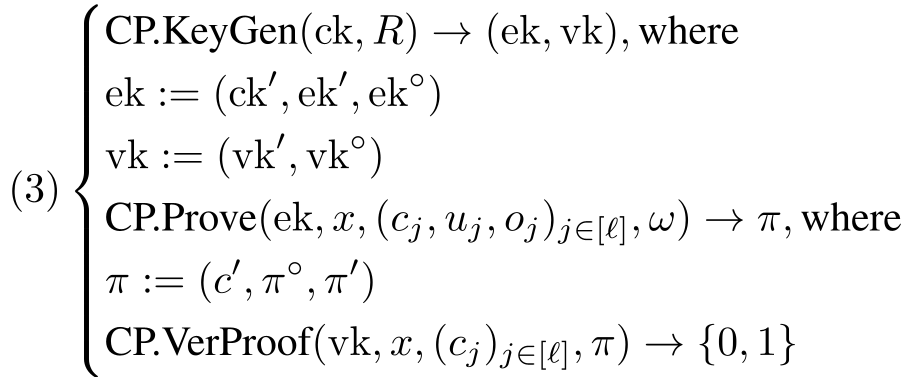
This decoupling is vital. It means a patient can commit their data today and use it for ten different research studies over the next five years without ever re-uploading the raw data.
Smart Contracts as the Fairness Engine
A crowdsourcing platform is nothing without incentives. The authors propose an Ethereum-based smart contract that acts as an automated escrow.
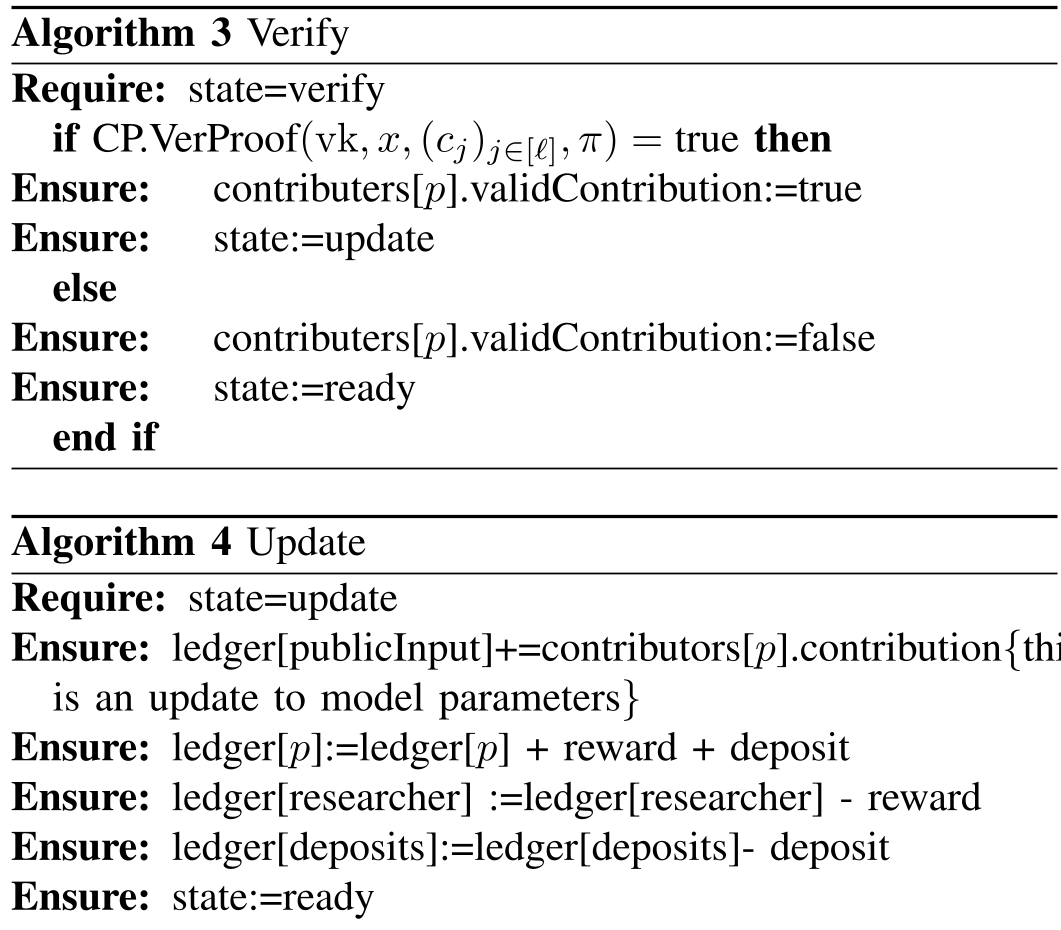
- Deposit & Reward: Participants put down a deposit to ensure "skin in the game." If the ZK-proof fails (indicating a fake contribution), the deposit is slashed. If it passes, they receive an immediate reward in Ether.
- Verifiable Computation: The blockchain doesn't just store data; it acts as the judge. It runs the
Verifyfunction of the zk-SNARK, which is computationally "succinct"—meaning it's cheap and fast enough to run on-chain.
Deep Insight: Why This Matters
The most profound part of this research is the transition from Data Sharing to Computation Sharing. In this model, the researcher never sees the data. They only see the result of the computation and a mathematical guarantee that the result is honest.
By using quasi-adaptive NIZK for linear subspaces, the authors ensure the platform is scalable. The verification time remains constant () regardless of how complex the patient's medical history is.
Conclusion & Limitations
While the paper provides a robust cryptographic framework, it acknowledges that the next frontier is creating verifiable machine learning models that can handle non-linear training algorithms efficiently. As blockchain technology evolves (e.g., Layer 2 scaling), platforms like this could allow millions of patients to become active stakeholders in global medical discovery, finally breaking the deadlock between privacy and progress.
Takeaway: This is a blueprint for a "Global Medical Commons" where trust is code, and privacy is a mathematical certainty.