
Smart Things, Better Advice: Trust-Driven Decentralized Recommendations in SIoT
A Decentralized Recommendation Engine in the Social Internet of Things
This paper introduces a decentralized recommendation engine tailored for the Social Internet of Things (SIoT), integrated within the DANOS framework. By leveraging autonomous objects that form dynamic, trustworthy social relationships, the system achieves SOTA performance in decentralized environments, significantly outperforming centralized baselines in recommendation accuracy (MRR) and item discovery.
TL;DR
Researchers have developed a decentralized recommendation engine for the Social Internet of Things (SIoT) that allows smart devices to act as autonomous agents. By mimicking human social behaviors—forming and breaking friendships based on trust and shared interests—this system surprisingly outperforms centralized "all-knowing" algorithms. It slashes recommendation failure rates by nearly 20% while providing superior privacy.
The Problem: The Privacy-Efficiency Paradox
In the world of IoT, your smart devices know everything about you. Sending this intimate data to a central cloud for recommendations is a privacy nightmare. However, decentralized systems usually suffer from a "data silo" problem: if a device can only see its immediate neighbors, how can it find the best recommendations?
Existing decentralized methods were often static. They formed a network once and never changed it, leading to "filter bubbles" where a device only ever sees the same narrow set of information.
Methodology: The "Quality of Friendship" (QoF)
The core innovation lies in treating objects as social actors within the DANOS (Dynamic & Anthropomorphic Network of Objects System) framework. Instead of a fixed database, the system uses a dynamic social graph where connections are governed by a unique QoF metric.
1. Multi-Dimensional Similarity
Objects calculate similarity based on three pillars:
- Profile Similarity (): Personality and device traits.
- Preference Similarity (): Content-based interests.
- Rating Similarity (): Collaborative filtering based on shared item history.
2. Guarding Against Filter Bubbles
To ensure diversity, the authors introduced a Diversity term (). An object isn't just looking for friends who are identical to itself; it seeks friends who bring new information that the rest of its "friend circle" doesn't have.
3. The Virtual Meeting Space
Objects "travel" to virtual rooms called Cells. Each cell has a Cell Proxy (a summary of the interests of objects who found success there). This allows new objects to find relevant communities without exposing the raw data of individual members.
 The decentralized flow where objects interact within the DANOS framework.
Experiments: More Local is More Vocal
The evaluation used a real-world dataset of 48 professionals and 16 technology topics. The results were counter-intuitive: the decentralized Danos-8 configuration achieved an MRR (Mean Reciprocal Rank) of 0.243, while the Centralized baseline only reached 0.159.
| Method | No-Rec | RMSE | MRR |
|---|---|---|---|
| Central (Global Knowledge) | 61.7% | 1.994 | 0.159 |
| Static (Fixed Network) | 60.2% | 2.085 | 0.156 |
| Danos-8 (Proposed) | 48.1% | 1.978 | 0.243 |
Why does Decentralization win?
The paper argues that by forcing objects to specialize in small "cells," they create highly relevant neighborhoods. A centralized system gets "distracted" by the noise of the global population, whereas a DANOS object curates a circle of friends that are hyper-relevant to its specific needs.
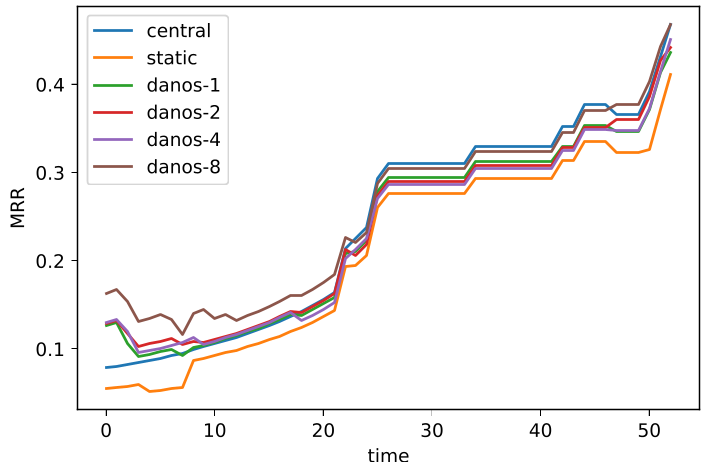 Figure 2: The rolling average of MRR shows that the dynamic DANOS approach continues to improve as it refines its social network.
Conclusion & Key Insights
This research proves that the Social Internet of Things (SIoT) shouldn't just be viewed as a networking challenge, but as a recommendation opportunity.
- Takeaway: Dynamicity is key. A static network is worse than a centralized one, but a self-evolving social network of things is superior to both.
- Limitations: The dataset was small-scale (48 users). The real test will be scaling this to millions of devices where the computational overhead of "traveling" between cells might become a bottleneck.
By shifting from "Data Processing" to "Relationship Management," the authors have provided a blueprint for more human-centric, private, and effective AI in our pockets and homes.