
Twitter Indicators & Technical Analysis: A Hybrid Approach to Stock Market Simulation
Decision-Making Simulator for Buying and Selling Stock Market Shares Based on Twitter Indicators and Technical Analysis
The paper introduces a stock market decision-making simulator that integrates Twitter-derived social mood indicators with classical Technical Analysis (EMA, MACD). Focused on the Brazilian market (B3), the system employs sentiment analysis and volume heuristics to generate buy/sell signals, achieving superior profitability compared to legacy methods in specific scenarios like the VALE5 stock.
Executive Summary
TL;DR: This paper explores whether the "social mood" captured on Twitter can predict stock market movements better than traditional technical indicators (EMA/MACD). By building a specialized simulator for the Brazilian stock exchange (B3), the researchers demonstrated that a combination of sentiment analysis, buzz volume, and rule-based heuristics can outperform standard trading strategies, particularly when specific volume "thresholds" are applied to filter out noise.
Context: This work sits at the intersection of Behavioral Economics and Data Science, evolving from early sentiment-matching studies into a practical, rule-based simulation framework for emerging markets.
Problem & Motivation: The Missing "Human" Factor
Standard technical analysis operates on the hypothesis that price patterns repeat. However, it fails during "black swan" events or sentiment-driven rallies. The authors argue that collective emotions—optimism, pessimism, and anticipation—are leading indicators of market behavior.
The challenge? Twitter is incredibly noisy. Sarcasm, abbreviations, and off-topic posts (like music events sponsored by companies) dilute the signal. The paper seeks to answer: Can we create a filter robust enough to turn microblogging chaos into profitable trade signals?
Methodology: The Hybrid Architecture
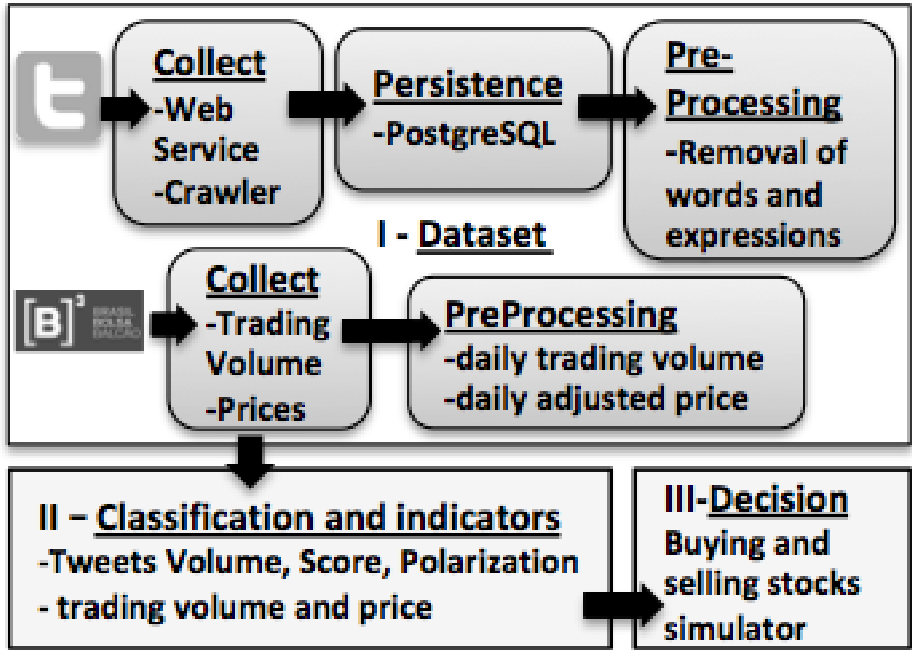
The proposed system, as shown in the Architecture Model, consists of three distinct layers:
- Data Acquisition: Collecting Portuguese-language tweets and B3 closing prices.
- Indicator Modeling: Generating four Twitter indices (Buzz , Mood , Expectation , Sentiment ) alongside Technical indices (EMA and MACD).
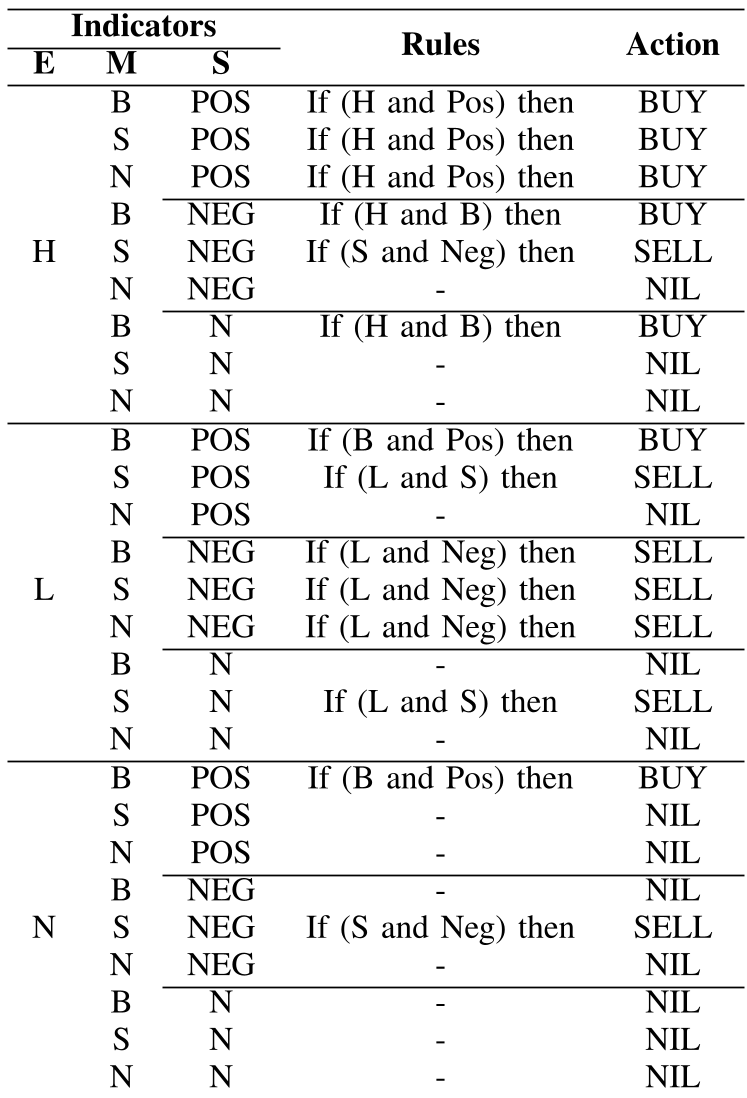
- Decision Simulator: A rule-based engine that only executes trades if the indicators align according to a predefined heuristic table.
The Heuristic Core
Instead of a "black box" AI, the authors used a transparent Decision Rule Table. For instance, a "BUY" signal is only triggered if the price trend indicator () is High and the Sentiment () is Positive.
Experiments & Results: The Power of the Threshold
The researchers tested their simulator on two major Brazilian stocks: PETR4 (Petrobras) and VALE5 (Vale S.A.).
The most striking discovery was the impact of the Threshold (the minimum number of tweets required to act).
- Low Volume (VALE5): Adding a threshold actually hurt profits because valuable signals were filtered out.
- High Volume (PETR4): The threshold was the "secret sauce." Without it, the Twitter strategy was unprofitable. With a threshold of 40 tweets, average profits spiked significantly, proving that in high-noise environments, selectivity is key.
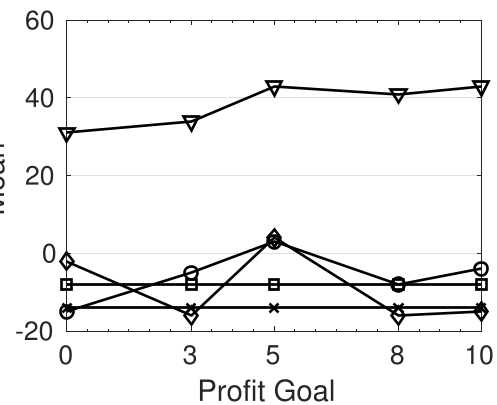 (a) Without Threshold (Unprofitable) vs (b) With Threshold (Profitable)
Critical Analysis & Conclusion
Takeaway
The study successfully proves that Twitter sentiment in Portuguese is a potent resource for the Brazilian market. The hybrid approach (Twitter + Technical Analysis) provides a safety net, ensuring trades aren't made on hype alone.
Limitations
- Sample Size: The study only looked at two stocks. Market-wide dynamics might differ.
- Cost Realism: Trading fees and taxes were not included in the profit calculations, which could turn marginal gains into losses.
- Linguistic Complexity: Traditional sentiment tools (Lingpipe) may struggle with the nuanced sarcasm frequent in Brazilian financial Twitter compared to modern LLMs.
Future Outlook
The next frontier for this work involves integrating Machine Learning to dynamically adjust thresholds and incorporating Google Trends data to capture a broader spectrum of public interest.