
Designing a Digital Mind: Applying the Society of Mind Theory to Daihinmin
15518_A Decision Making Method Based on Society of Mind Theory in Multi-player Imperfect Information Games.
This paper proposes a decision-making model for the card game "Daihinmin" (a multi-player imperfect information game) by integrating Marvin Minsky’s "Society of Mind" theory with Deep Learning. By treating game agencies as neural networks, the system learns to emulate diverse player behaviors and strategies from historical competition records.
TL;DR
Researchers have successfully bridged the gap between Marvin Minsky's symbolic "Society of Mind" theory and modern Deep Learning. By modeling the Japanese card game Daihinmin, the team created a system that doesn't just play the game, but emulates the "mental agencies" of other competitive programs, achieving over 80% accuracy in predicting player strategies.
Positioning: This work serves as a bridge between structural cognitive psychology and connectionist machine learning, specifically targeting multi-player games with hidden information.
The Challenge: Modeling "Mindless" Processes
Marvin Minsky’s Society of Mind posits that the human mind is not a single entity but a collective of small, mindless "agents." In a game like Daihinmin—characterized by imperfect information and complex house rules—simulating this interaction is notoriously difficult.
Prior attempts relied on manual tuning of parameters for various agencies (Recognition, Evaluation, Strategy). However, manual adjustment cannot scale to the complexity of top-tier AI players using Monte Carlo Tree Search (MCTS). The core question was: How can we automatically learn the intricate relationships between these mental agents?
Methodology: From Logic to Latent Space
The authors proposed a shift from manual logic to Deep Representation Learning.
1. The Agency Architecture
The model divides the player’s "mind" into specific agencies:
- Recognition Agency (K-line): Handles context and evaluation (e.g., "What cards are out? Am I in a 'Revolution' state?").
- Competition Agency: Contains search and strategy agents that decide which role (Single, Pair, Triple, etc.) to play.
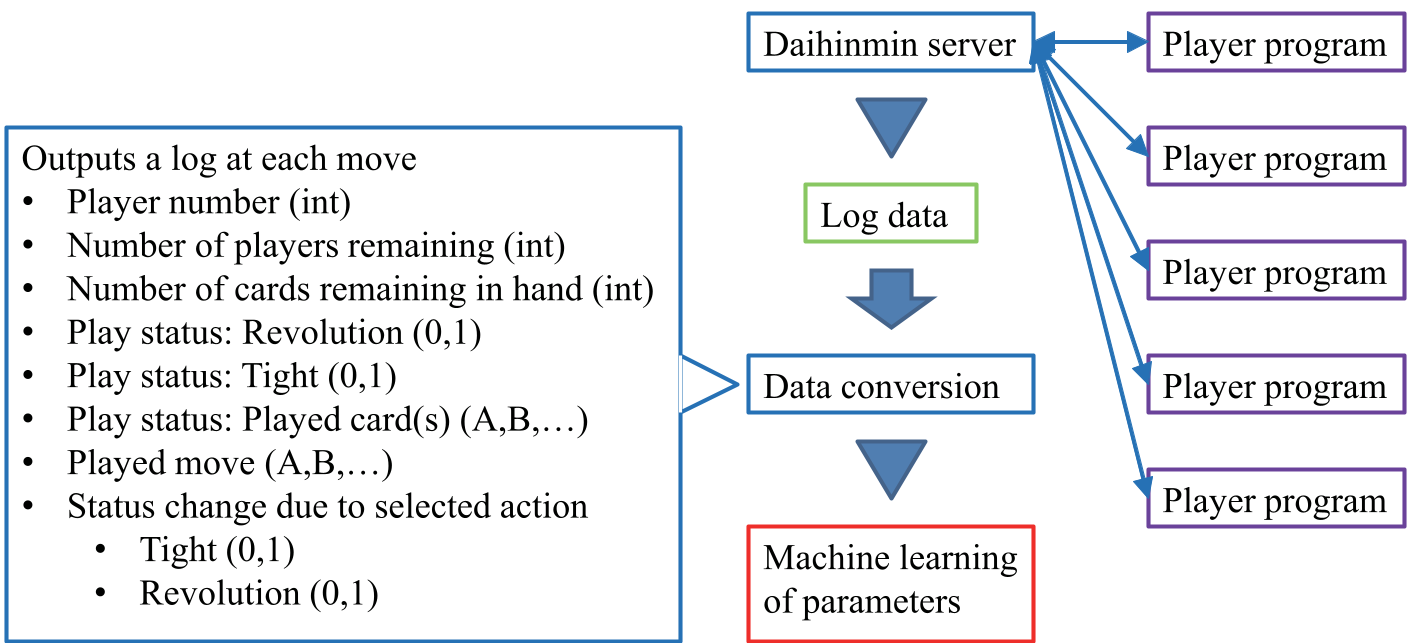
2. Pseudo-Visual Mapping
In an ingenious move to leverage image recognition techniques, the researchers converted internal agency states into 28x28 pixel bit-maps. This allowed them to treat the decision-making process as a classification task where the "image" is the game state and the "label" is the winning strategy agent.
3. Stacked Denoising Autoencoder (SdA)
The system utilizes an SdA with three hidden layers. By adding noise to the input during training, the model learns robust features of the game state, preventing it from simply memorizing moves (overfitting) and instead learning the "intuition" behind the strategy.
Experiments & Results: Surpassing the Baseline
The researchers tested their model against three distinct Daihinmin AI types: default, Nakanaka, and snowl (a championship winner).
| Client Program | SdA Recognition (Proposed) | 1-NN Recognition (Baseline) |
|---|---|---|
| default | 84.5% | 69.65% |
| Nakanaka | 83.97% | 71.05% |
| snowl | 82.25% | 71.25% |
The results show a clear victory for the Deep Learning approach. Interestingly, the recognition rate for "snowl" was the lowest among the three; this suggests that more complex algorithms (like MCTS) are harder to emulate, providing a potential metric for "algorithmic intelligence."
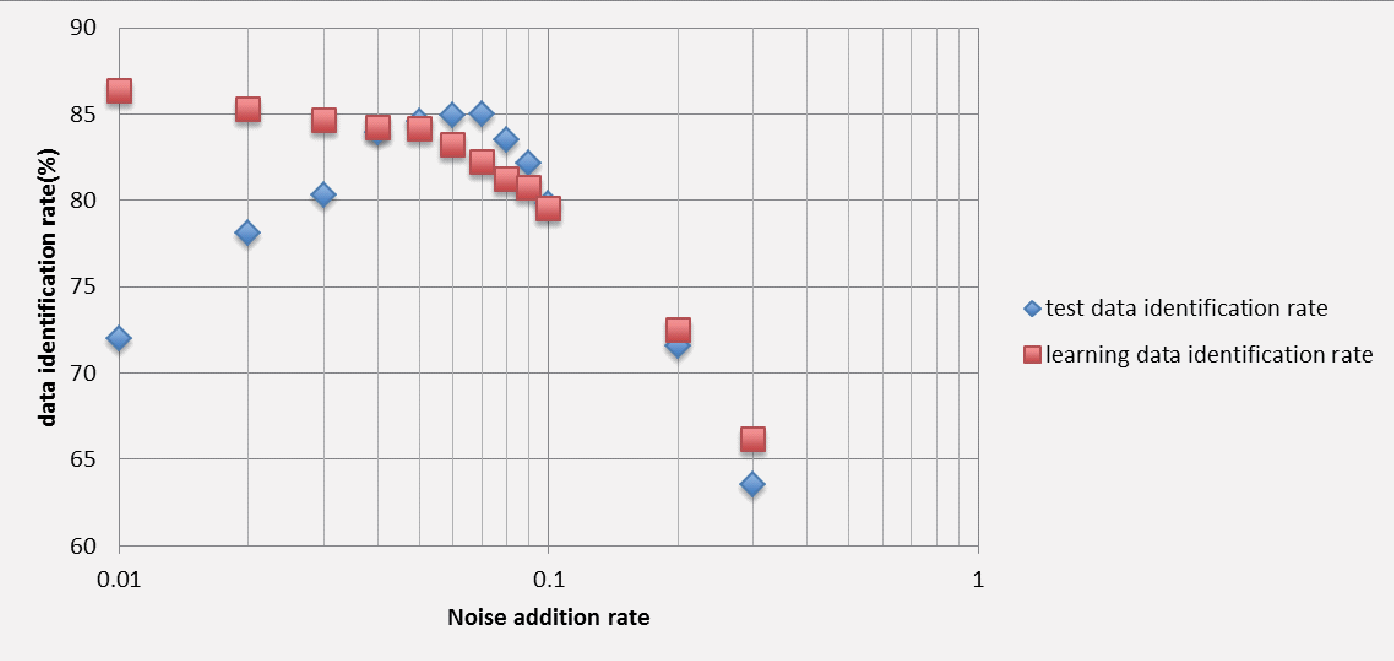 Figure: The study found that a noise addition rate of ~0.05 optimized the balance between learning and generalization.
Critical Insight & Future Outlook
The true value of this work lies in Explainability.
Traditional high-performance AI like snowl are often "black boxes"—they win, but we don't know why they chose a specific move. By mapping these moves back to the "Society of Mind" agents, we can provide a rationalization for AI behavior (e.g., "The 'Revolution' strategy agent was activated because the Recognition agency detected a sequence of five cards").
Limitations: The model currently struggles with rare game events (like "Revolution" or specific "Sequences") because the training data is naturally skewed toward common moves like "Pass." Future work requires balancing the dataset to ensure the AI understands high-impact, low-frequency strategic pivots.
Conclusion: This research proves that we can use Deep Learning not just to play games, but to build emulators of thought itself, making the "mind" of the machine one step closer to human-like structure and transparency.