
Deciphering Decision Support: How Online Social Networks Transform Healthcare Choices
Decision Making and Support in Healthcare Online Social Networks
This paper explores the utility of Healthcare Online Social Networks (HOSNs) as decision support tools. It integrates classical decision-making (DM) theory with "Netnography" to investigate how online interactions assist patients and professionals across phases like intelligence, design, and choice.
TL;DR
This research by Sadovykh and Sundaram investigates the role of Healthcare Online Social Networks (HOSNs) as pivotal tools for decision-making. By applying classical decision theory to modern digital communities, the paper reveals how the "wisdom of crowds" supports patients through phases of problem intelligence and alternative design, while acknowledging the inherent trade-offs between digital convenience and physical intimacy.
Context & Motivation: The Digital Shift in Health
Decisions in healthcare are high-stakes, often constrained by time and emotional stress. Traditionally, these decisions were made in the doctor's office. However, with the rise of OSNs, 50-60% of people in developed nations now turn to the web for advice. The authors identify a critical gap: existing Decision Support Systems (DSS) are often rigid and clinical, failing to leverage the Electronic Word of Mouth (e-WOM) that provides the emotional and instrumental support patients crave.
Methodology: Mapping Behavior to Frameworks
The core of this work lies in the application of Herbert Simon's decision-making phases to the HOSN environment:
- Intelligence Phase: Users retrieve real-time data and find "tested" solutions from peers with similar conditions.
- Design Phase: OSNs allow users to explore and evaluate alternatives by browsing experiences (e.g., someone with psoriasis suggesting a specific lotion).
- Choice Phase: While the network doesn't "choose" for the user, it provides the models and social validation needed to finalize a decision.
The researchers utilize Netnography—a specialized qualitative method for studying internet cultures—to observe these interactions without being obtrusive.
 The study seeks to reconcile traditional DM theories with the fluid nature of online social interactions.
Key Findings: The Benefits and Barriers
The study highlights a fascinating dichotomy in HOSN participation. While HOSNs are superior in reach and anonymity, they lack the "tangible support" of offline groups.
Advantages vs. Disadvantages of HOSNs
| Category | Key Insight |
|---|---|
| Convenience | 24/7 access to information without leaving home. |
| Anonymity | Enables sharing of sensitive or stigmatized health issues. |
| The "Human Touch" | Missing physicality is a major drawback for 1:1 care. |
| Cues | Lack of auditory/visual social context cues can lead to misinterpretation. |
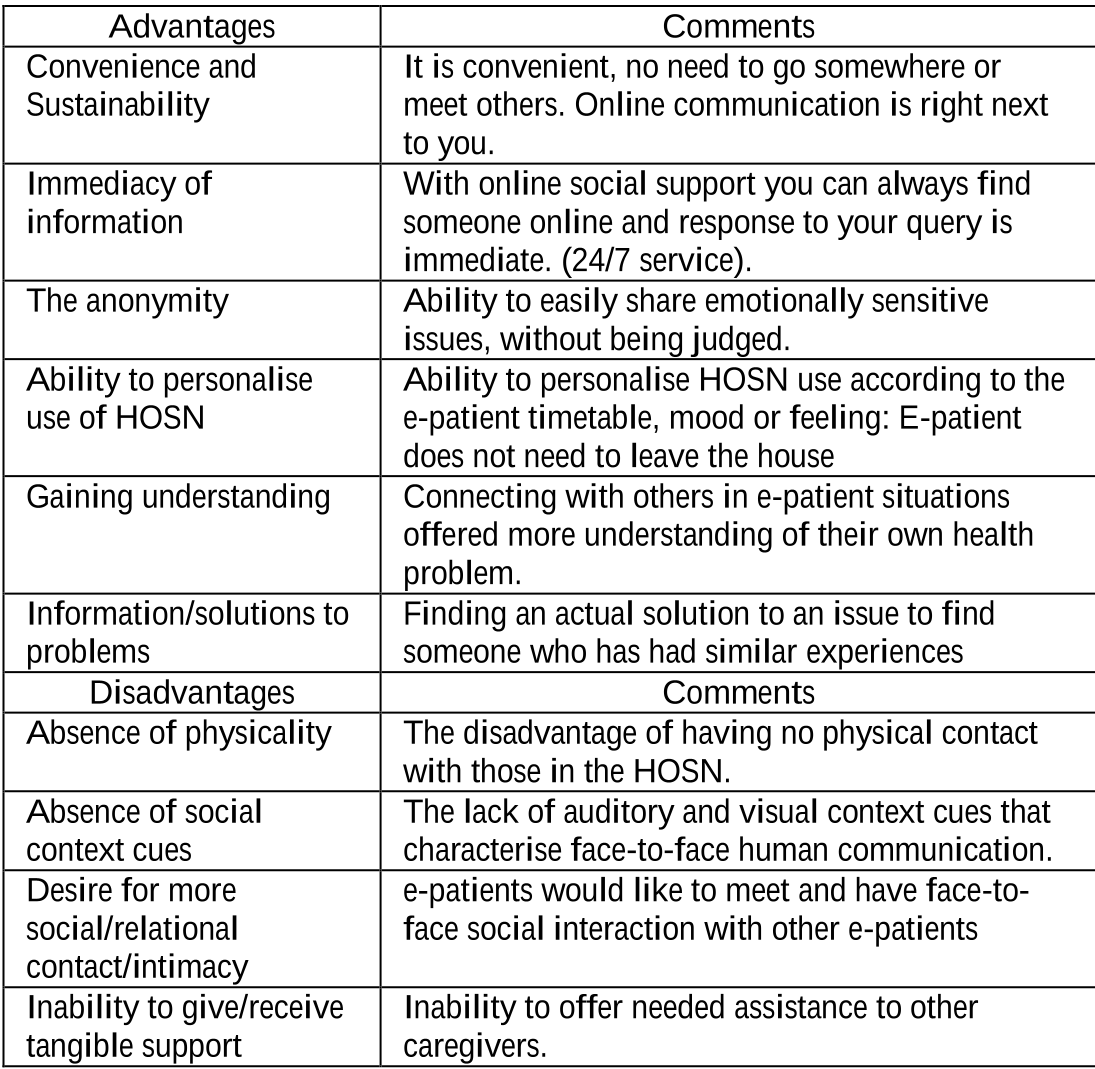 Summary of the social and psychological trade-offs in HOSN participation.
Critical Insight: The Role of e-WOM
The paper emphasizes that users trust HOSNs because of specific e-WOM factors:
- Shared Interest: Participants have "skin in the game."
- Tangible Evidence: Users provide real-world results of treatments (e.g., photos or success stories).
- Concern for Well-being: There is an altruistic element to community-driven support.
Conclusion & Future Outlook
This short paper serves as a foundation for designing better HOSNs. The authors suggest that future platforms should not just be "wikis" of information but structured environments that actively guide users through the DM phases—Intelligence, Design, and Choice.
Takeaway for Practitioners: When designing health platforms, prioritize engagement and trust-building mechanisms over mere information density. The goal is to move from "searching for data" to "collaborative decision-making."
Limitations: The study notes that the "Implementation" and "Monitoring" phases of decision-making remain difficult to observe within the transparent layer of an OSN, as personal actions often happen offline.