
DS-SC: Strengthening Healthcare Diagnosis through Decision Fusion of DS and StackingC
Decision Stump and StackingC-Based Hybrid Algorithm for Healthcare Data Classification
The paper introduces DS-SC, a hybrid classification algorithm combining Decision Stump (DS) and StackingC (SC) via an average voting scheme. Evaluated on five benchmark healthcare datasets (cancer, diabetes, thyroid, lymphography), DS-SC achieves state-of-the-art diagnostic accuracy, outperforming standalone base learners and several prior ensemble methods.
TL;DR
Predicting diseases accurately from diverse medical datasets remains a hurdle due to noise and feature complexity. This paper proposes DS-SC, a hybrid algorithm that fuses Decision Stump (DS) and StackingC (SC). By averaging their predictive probabilities, the system achieves a significant accuracy boost (up to 30%) across benchmarks for breast cancer, thyroid, and diabetes.
Motivation: The Complexity of Healthcare Data
Medical data is notoriously messy. It includes everything from past medical history to diverse diagnostic measurements. While advanced models like Deep Neural Networks or SVMs exist, they often act as "black boxes" with high computational costs and long training durations.
The authors observed that Decision Trees (DT) are highly effective for healthcare because they generate clear rules. However, standard trees can overfit or become redundant. The researchers' insight was to combine a "minimalist" tree (Decision Stump) with a "regressive" ensemble (StackingC) to balance simplicity with mathematical rigor.
Methodology: The Fusion of Simplicity and Regression
1. Decision Stump (DS)
A Decision Stump is essentially a one-level decision tree. It makes predictions based on a single attribute. While it seems overly simple, its mathematical strength lies in its score-based attribute selection, which helps filter out noise and irrelevant attributes in high-dimensional medical data.
2. StackingC (SC)
StackingC is a more sophisticated meta-classifier. It transforms the classification task into a regression problem at the tree's leaf nodes. By using Linear Regression (LR) functions to smooth the tree from leaves to the root, it handles continuous variables much more effectively than standard discrete decision trees.
3. The Hybrid Mechanism (DS-SC)
The core contribution is the Average Voting Scheme. Instead of choosing one model over the other, the algorithm calculates the class probabilities from both DS and SC and averages them:
This fusion compensates for the individual weaknesses of each—DS provides a strong initial bias on key features, while SC refines the boundaries using linear trends.

Experimental Validation
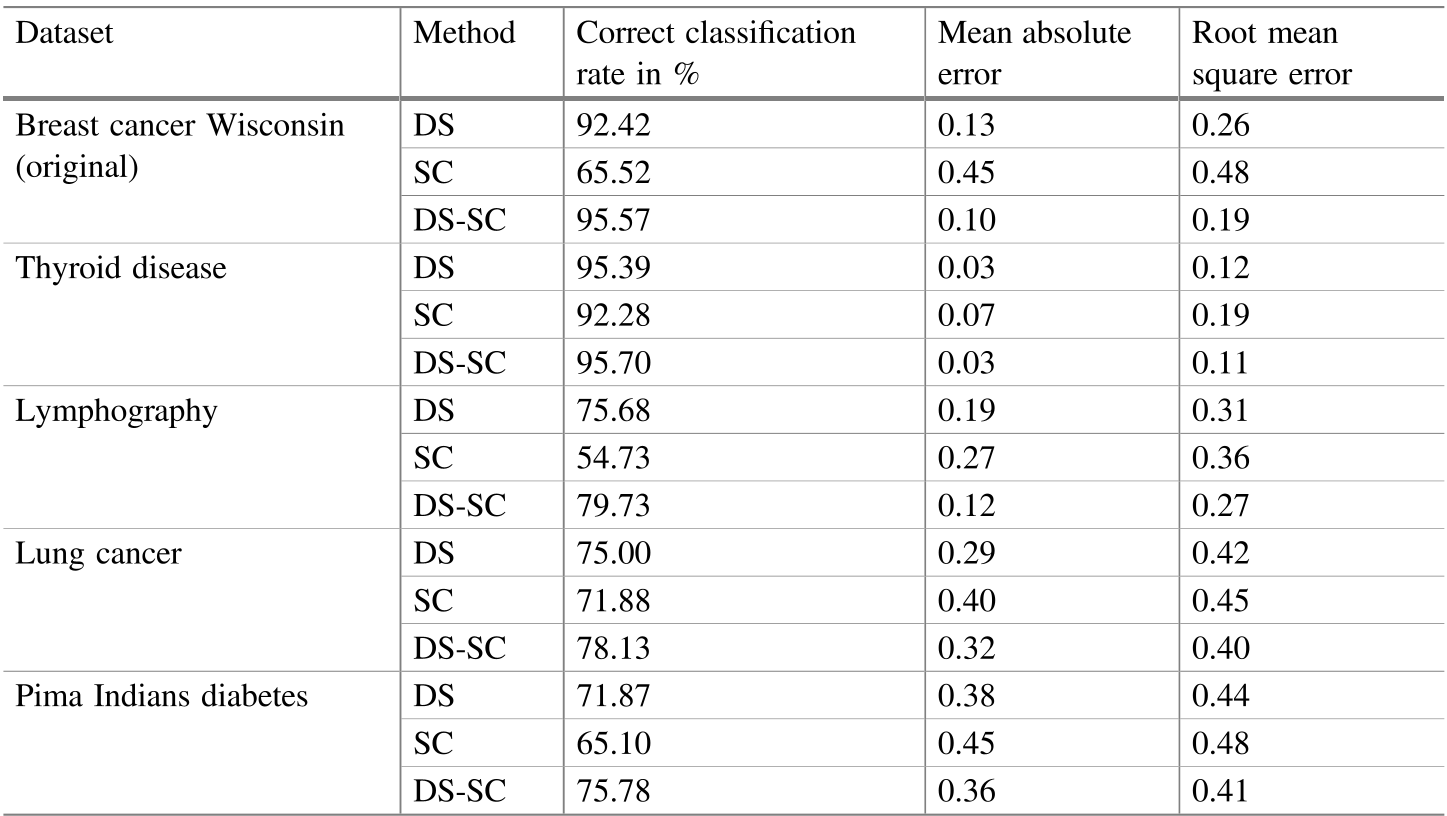
The authors validated DS-SC using five UCI benchmark datasets. The results were measured against six metrics, including Precision, Recall, and ROC Area.
Key Results:
- Breast Cancer: Accuracy jumped to 95.57%, significantly higher than the 65.52% produced by StackingC alone.
- Thyroid Disease: Achieved 95.70% accuracy with a very high ROC area of 0.992, indicating near-perfect class separation.
- Lymphography: Showed a 25% improvement over the standalone SC method.
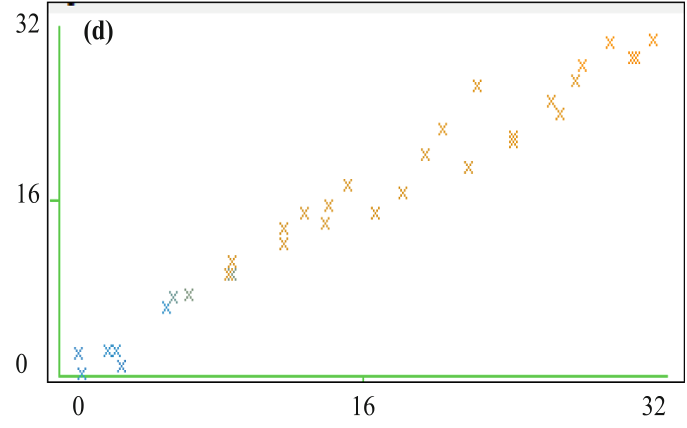
The margin curves below illustrate how the Decision Stump helps in visually discriminating disease classes despite the inherent overlap in clinical features:
Critical Insight: Why Does It Work?
The success of DS-SC lies in the Inductive Bias alignment. Decision Stumps act as a "gatekeeper," focusing on the most statistically significant attribute, which prevents the final model from "getting lost" in the noise of irrelevant medical variables. StackingC then takes the probabilities and applies a local linear fit, capturing the nuances that a simple binary split might miss.
Conclusion & Future Outlook
While DS-SC provides a robust framework, it is not always the winner against every single specialized hybrid (like those using Genetic Algorithms). However, its low computational overhead and high accuracy make it an ideal candidate for low-cost medical diagnostic tools in developing regions. Future research will likely focus on integrating feature selection pre-processing (like PSO or Rough Sets) even deeper into the DS-SC pipeline to further squeeze out performance gains.