
SIDSS: Closing the Loop on Precision Agriculture with Machine Learning
A decision support system for managing irrigation in agriculture
The paper introduces SIDSS (Smart Irrigation Decision Support System), an automated closed-loop framework for agricultural water management. It leverages machine learning (PLSR and ANFIS) to estimate weekly irrigation needs by combining real-time soil sensor data with local climatic variables, achieving a 22% improvement in accuracy over traditional weather-only models.
TL;DR
The Smart Irrigation Decision Support System (SIDSS) is a breakthrough in automated farming. By fusing real-time soil moisture data with atmospheric monitoring and processing it through ANFIS (Adaptive Neuro-Fuzzy Inference Systems), it accurately predicts weekly irrigation needs. It reduces the error margin by 22% compared to traditional methods, effectively digitizing the intuition of expert agronomists.
Context & Motivation: The Limits of Open-Loop Farming
In arid regions like South-East Spain, water is gold. Historically, farmers relied on two extremes:
- Meteorological Models: Using "Reference Evapotranspiration" (ET0) to guess water loss. This is "open-loop"—it doesn't know if the soil is actually dry or if a local micro-burst just watered the field.
- Human Experts: Agronomists who look at charts and make calls. While accurate, they are slow, expensive, and impossible to scale across thousands of hectares.
The authors argue that a truly "Smart" system must be closed-loop, using the soil itself as a feedback mechanism to correct the errors of general weather predictions.
Methodology: The "Brain" of the System
The SIDSS architecture relies on two sophisticated machine learning engines tasked with solving the multicollinearity problem (where sensors provide redundant or highly correlated data).
1. The Reasoning Engines
- PLSR (Partial Least Square Regression): Ideal for scenarios with more variables than samples. It compresses high-dimensional sensor data into "latent variables" that explain the most variance in irrigation needs.
- ANFIS (Adaptive Neuro-Fuzzy Inference Systems): The star performer. It combines the "If-Then" logic of human reasoning (Fuzzy Logic) with the iterative learning power of Neural Networks.
2. Multi-Depth Sensing
The system doesn't just look at the surface. It monitors Volumetric Water Content (VWC) and Soil Matric Potential (SWP) at depths of up to 80cm, providing a 3D view of the root zone's hydration.
 The SIDSS workflow: From in-field sensors to cloud-based ML processing.
Experimental Battle: AI vs. Human Expert
The researchers tested the system against the gold standard: the weekly reports of a professional agronomist over an 18-month period.
- Scenario 1: Prediction with Historical Data: When the system "knew" the field's history, ANFIS achieved an impressive weekly error of just 87.6 minutes—well within the 10% tolerance accepted in professional agriculture.
- Scenario 2: The Universal Estimator: This was the "cold start" test. Could the system manage a new field it had never seen before? By focusing on Soil Matric Potential (SWP)—which is less dependent on specific soil types than VWC—the system remained viable, proving it can be deployed "out of the box."
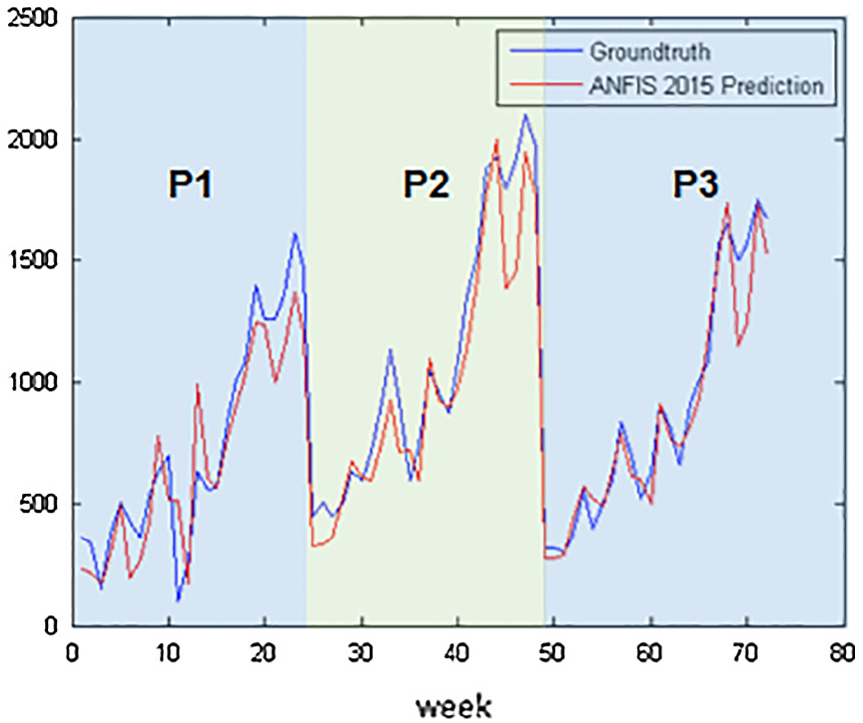 Weekly prediction accuracy: The ANFIS model (red) closely tracks the human expert's ground truth (blue).
Critical Insight: Why Soil Sensors Matter
One of the paper's most significant findings is the 22% accuracy boost gained by adding soil sensors. While weather data gives you the "demand" (how much the sun is pulling water out), soil sensors give you the "supply" (how much is actually left in the tank). Without soil feedback, models consistently over- or under-irrigate because they cannot account for the soil's hydraulic conductivity or unexpected local rain.
Conclusion & Future Outlook
SIDSS proves that we can automate the "gut feeling" of an agronomist. The study highlights that ANFIS is superior for long-term management where data is abundant, while PLSR is a better "starter" model for new farms.
Limitations: The current system was optimized for citrus. Different crops (like grapes or almonds) have different "Crop Coefficients" (Kc). Future work will likely integrate weather forecasts to move from "reactive" to "proactive" management, potentially saving even more water by skipping irrigation sessions before predicted rainfall.