
This paper explores the decodability of Honeycomb (hTC) and Square (sTC) lattice Toric Codes under X- and Z-type coherent errors. By establishing a duality to 1+1D monitored Majorana fermion dynamics, the authors demonstrate that the Altland–Zirnbauer (AZ) symmetry classes (D and DIII) dictate the universal structure of decodability phase diagrams, identifying transitions between area-law and critical entanglement phases.
TL;DR
Quantum error correction typically treats noise as a "coin flip" (stochastic), but real-world hardware often suffers from "rotation" (coherent) errors. This paper maps the decoding of these complex errors to 1+1D Majorana fermion circuits. The breakthrough? It reveals that the symmetry class (D or DIII) of the physical lattice decides whether a code is robust or will fail catastrophically under quantum interference.
The Motivation: Interference is the Enemy
In standard topological codes like the Toric Code, we look for "syndromes" (errors) and fix them. For stochastic noise, this is like finding the shortest path on a graph. However, coherent errors are unitary rotations; they interfere with each other. A small rotation on every qubit can add up in ways that look like a mess to a standard decoder.
The authors wanted to know: Is there a universal law governing these thresholds? Why do some lattices behave differently than others?
The Methodology: The Monitor Duality
The core insight is a mathematical bridge. The authors map the Syndrome Probability Distribution () to the Quantum Trajectories of a Majorana chain.
- Ising Mapping: First, the code is mapped to a 2D disordered classical Ising model where couplings are complex ().
- Circuit Duality: Through Jordan-Wigner transformation, this Ising model becomes a 1+1D quantum circuit where "measurements" in the circuit correspond to syndromes in the code.
Symmetry is Destiny
The paper classifies these systems into two Altland–Zirnbauer classes:
- Class DIII: (hTC X-type errors) No Time-Reversal (TR) symmetry. It supports a Critical Phase where entanglement scales logarithmically.
- Class D: (sTC and hTC Z-type errors) Preserves TR symmetry. Here, the critical phase is unstable, and the system jumps between different Area-Law phases.
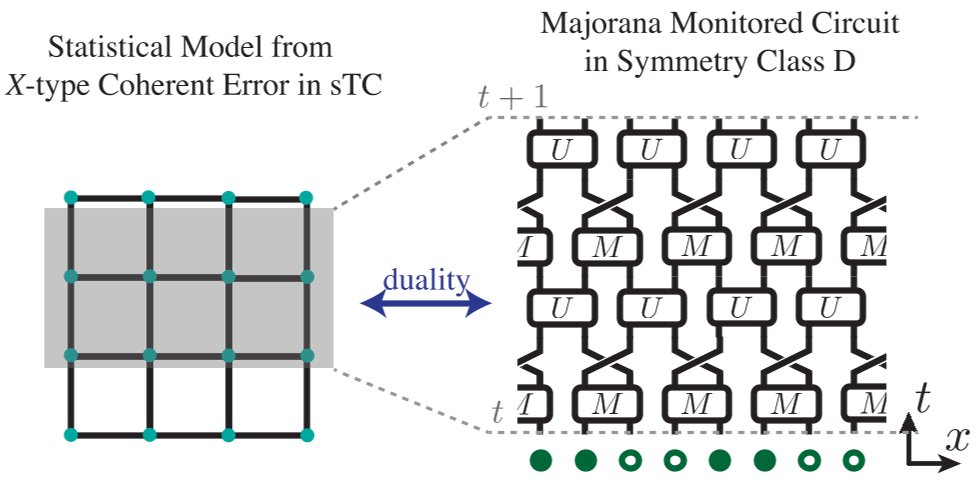 Figure: The mapping from a square lattice Toric Code to its dual Majorana monitored circuit.
Experiments & Critical Insights
The authors introduced a two-parameter model allowing for non-uniform errors.
1. The Square Lattice (sTC) Surprise
Historically, sTC with uniform errors seemed to have a "metallic" phase. This paper argues that was a finite-size illusion. In Class D, RG flow (the way physics changes as you zoom out) forces the system into an area-law phase eventually. However, by varying and independently, they discovered a genuine transition between two topologically distinct phases ( and ).
2. The Honeycomb (hTC) Transition
In the hTC model, they observed a much richer phase diagram. Because it belongs to Class DIII, there is a stable "Critical Phase" (undecodable) that separates two decodable regions.
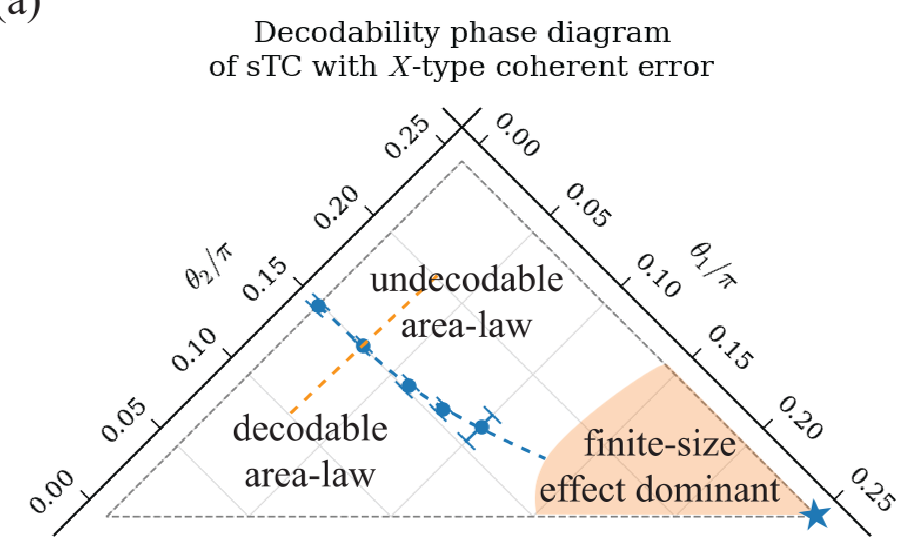 Figure: Phase diagram of the two-parameter sTC model showing the decodable (I=0) and undecodable (I=1) regimes.
Critical Analysis: Why This Matters
For quantum computer architects, this is a warning: Non-uniformity matters. The study shows that sTC is more vulnerable to spatially varying coherent errors than uniform ones. If your calibration drifts across the chip, the "interference" of these errors lowers the error threshold significantly.
Limitations: The study focuses on non-interacting Majoranas (Gaussian states). In reality, correlated errors or more complex rotations might introduce "interactions" in the dual circuit, potentially leading to even more exotic phases like Volume-Law entanglement (total decodability failure).
Future Outlook
This work sets a gold standard for using condensed matter physics (symmetry classes and RG) to solve quantum information problems. The next step is clearly interacting dynamics—to see if "Quantum Chaos" in the dual circuit provides the ultimate limit to how much noise our logical qubits can handle.