
Decoding the Soundtrack of the Soul: Can fMRI Read the Emotions We Feel While Listening to Music?
Decoding music-induced experienced emotions using functional magnetic resonance imaging - Preliminary results
This study explores decoding music-induced experienced emotions from fMRI data using a machine learning framework. By employing Support Vector Machines (SVM) on brain activity patterns elicited by movie soundtracks, the researchers successfully classified emotional states into arousal (High/Low) and valence (Positive/Negative) categories.
TL;DR
Researchers have successfully used machine learning to "read" the emotions experienced by listeners of movie soundtracks from their fMRI brain scans. By focusing on Arousal (intensity) and Valence (positivity/negativity), the study shows that our brains produce distinct, decodable patterns when music moves us, especially when we are actively reflecting on our feelings.
Background: Perceived vs. Experienced Emotion
In the world of music psychology, there is a vital distinction between perceived and felt (experienced) emotion. You might perceive a song as "sad" without actually feeling sad yourself. This study targets the latter—the actual affective response of the listener. While previous work has used EEG or physiological markers like heart rate, this research dives into the high-dimensional space of functional Magnetic Resonance Imaging (fMRI) to locate where and how these feelings are mapped in the brain.
The Methodology: MVPA and Brain Masking
The researchers employed Multi-Variate Pattern Analysis (MVPA). Unlike traditional fMRI analysis that looks at single voxels, MVPA looks at the pattern of activity across thousands of voxels simultaneously, much like identifying a face from a collection of pixels.
The Secret Sauce: Feature Selection
A key challenge in fMRI is "The Curse of Dimensionality"—too many voxels and too few data points. The team compared three different ways to "mask" the brain:
- Gray Matter Mask: Looking at all brain cells (very broad).
- Primary Auditory Cortex: Focusing only on where sound is processed.
- SPM Mask: A functional mask that only includes voxels that "lit up" during the music task.
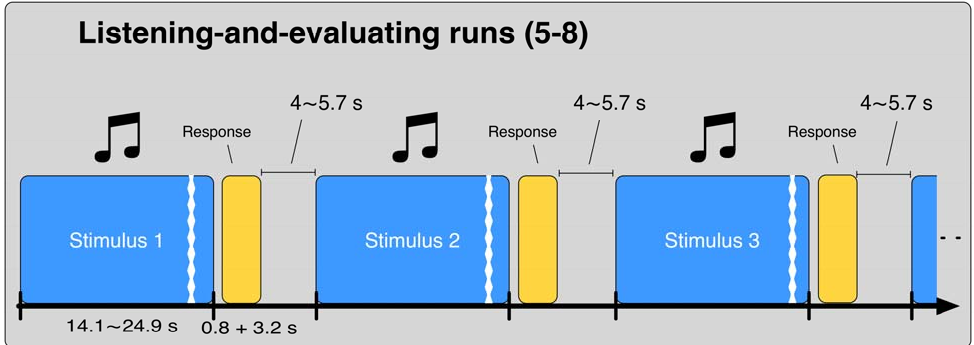 Figure 1: The study compared passive listening versus active evaluation to see if task engagement improved decoding.
Key Insights from the Data
The results revealed a fascinating psychological nuance: decoding was significantly more accurate when participants were asked to evaluate their emotions immediately after listening, compared to just listening passively.
- Arousal vs. Valence: Both could be decoded, but Valence (Positive/Negative) often showed more robust results across different participants.
- Beyond Hearing: The fact that the functional SPM mask (which covers areas outside the auditory cortex) performed best suggests that music-induced emotion is a "whole-brain" experience, involving regions responsible for memory, reward, and high-level evaluation.
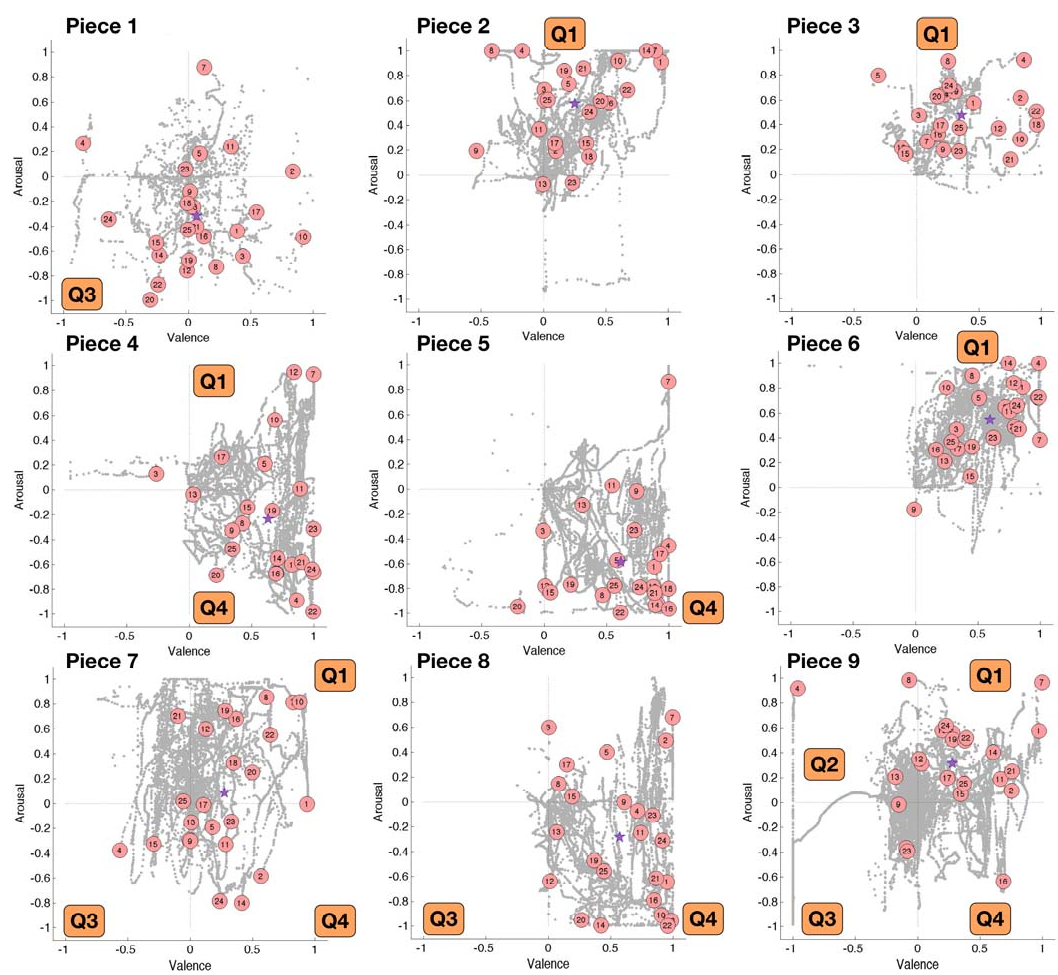 Figure 2: Subjective reports showed high consistency for positive emotions (Q1, Q4), while negative emotions (Q2, Q3) proved more variable across listeners.
Critical Analysis & Future Outlook
While the results are promising, the study is "preliminary" for a reason. With only five participants, the generalizability is limited. Furthermore, the "Active Evaluation" requirement suggests that we might need to be consciously aware of our emotions for them to create a signal strong enough for current AI to detect.
The Future of "Neural Playlists": Imagine a future where a music streaming service doesn't just ask what you like, but monitors your neural response to find the music that truly changes your mood. This work is a foundational step toward understanding the profound biological link between sound and the human heart.
Takeaway
The brain does not just "process" music; it "lives" it. By using MVPA, we are beginning to decode the complex, distributed patterns that represent our most intimate emotional experiences.