
DSN: Decoding the Hidden Social Fabric of Anonymous Digital Libraries
Deduced social networks for an educational digital library
The paper introduces the concept of Deduced Social Networks (DSN) to uncover latent user relationships in educational digital libraries (DLs) using passive log data. Applied to the AlgoViz Portal, the method combines graph partitioning and Latent Dirichlet Allocation (LDA) to identify user communities and their topical interests without requiring explicit user feedback.
TL;DR
In the world of educational Digital Libraries (DLs), users are often "lurkers"—they consume content but rarely leave ratings or reviews. This paper introduces Deduced Social Networks (DSN), a clever methodology to map out invisible communities by analyzing passive server logs. By linking users who view the same resources and applying topic modeling, the authors transform raw IP clicks into actionable insights for recommendation and ranking.
Background: The Ghost Town Paradox
Educational portals like AlgoViz (a repository for algorithm visualizations) face a common paradox: they have high traffic but low engagement. Without "Likes" or "Stars," traditional recommendation engines fail. The authors argue that we don't need active participation to understand a community; their navigation patterns—their digital exhaust—already tell the story.
The "Deduced" Logic: Turning Logs into Graphs
The core innovation is the Deduced Social Network (DSN). The authors define a network where:
- Nodes: Represent users (identified by IP addresses).
- Edges: Represent shared activity between two users.
- Threshold (): Two users are only connected if they have viewed at least common pages.
This -threshold is critical. If is too low (e.g., 1), the graph is a "hairball" where everyone is connected to everyone (likely via the homepage). If is too high, the network fragments. The authors found to be the "sweet spot" for revealing structure.
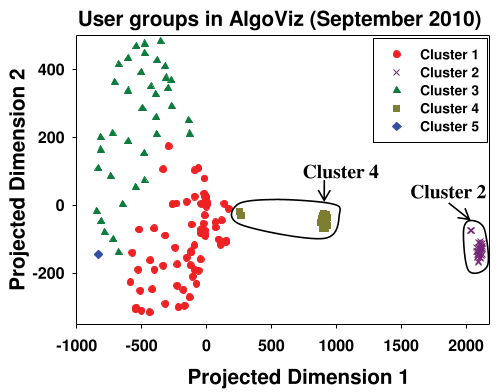 Figure: The transition from a raw DSN (top) to partitioned clusters (bottom), revealing distinct user groups.
Methodology: From Clusters to Topics
Once the graph is built, the authors treat user groups as "communities" using Modularity Clustering (Girvan-Newman). But a cluster is just a set of IDs; to understand what they want, the authors use Latent Dirichlet Allocation (LDA) on the titles of the pages those users visited.
The Workflow:
- Filtering: Strip out the noise (crawlers and bots).
- Network Generation: Connect IPs based on shared views.
- Partitioning: Break the dense graph into sub-communities.
- Topic Modeling: Extract keywords like "biblio," "sorting," or "tree" to label what each group is interested in.
 Table: The raw materials—Accesslog entries—that serve as the foundation for the DSN.
Experimental Insights
The study analyzed two months of data from AlgoViz. They found that:
- Behavioral Consistency: User groups weren't random; they clustered around specific functional areas—some were "Bibliophiles" (researchers looking for citations) while others were "Learners" (students looking for sorting visualizations).
- Practical Utility: By knowing which "Topic" a cluster belongs to, the portal can boost relevant search results for new users who exhibit similar initial click-stream behavior.
Critical Analysis: The Professional Verdict
The beauty of DSN is its Inductive Bias: it assumes that "interest" is an object-centric phenomenon. If you and I both look at the same ten pages on "B-Trees," our interests are likely identical for the duration of that session.
Limitations:
- The IP Problem: In 2012, IP-based identification was common, but in today's mobile/NAT-heavy world, this is much noisier.
- Static vs. Dynamic: The paper looks at monthly snapshots; real-world behavior often shifts in real-time.
Conclusion
This work provides a robust blueprint for any platform suffering from the "cold start" problem. By shifting the focus from Active Sentiment (ratings) to Passive Latent Relationships, the authors proved that the social network of a library exists whether the users choose to "join" it or not. For modern developers, the takeaway is clear: your server logs are a goldmine of social structure—if you know how to cluster them.