
Deep Ensemble Classifiers: Harvesting Social Intelligence for Bank Churn Prediction
Deep Ensemble Classifiers and Peer Effects Analysis for Churn Forecasting in Retail Banking
This paper introduces a deep learning framework for customer churn prediction in retail banking, specifically proposing a Deep Ensemble Classifier (StCNN) based on Convolutional Neural Networks (CNNs). By integrating cost-effective social network (peer) features derived from customer addresses and surnames, the model achieves state-of-the-art performance on highly unbalanced datasets from a North American financial institution.
TL;DR
Customer churn is a multi-billion dollar headache for the banking sector. This paper presents a breakthrough approach by extracting "peer effects" from existing bank records and fusing them into a novel Deep Ensemble Classifier (StCNN). By stacking multiple machine learning predictions into a 1D Convolutional Neural Network, the researchers achieved near-perfect accuracy even in highly unbalanced datasets.
The Social Blind Spot in Banking
In retail banking, up to 71% of customers consult family and friends before choosing a product. Despite this, most predictive models treat customers as silos. Previous attempts to include "network data" were either too expensive (surveys) or only applicable to massive banks (transactional logs).
The authors identify two fatal flaws in the status quo:
- Context Ignorance: Ignoring the fact that if a head of household churns, the family likely follows.
- Class Imbalance: Churners represent a tiny fraction (often <5%) of the data, making it hard for standard algorithms to "see" the signal.
Methodology: Building the "Family Network" and the StCNN
1. Cost-Effective Peer Networks
Instead of complex surveys, the authors use a clever proxy: Address + Family Name. By grouping customers who share these identifiers, they create "Family Cliques." They then engineer features like:
- Presence of churners: Has anyone in this family already left?
- Aggregated metrics: Total family savings, average tenure, and total credit balance.
2. The Stacking CNN (StCNN)
The real innovation lies in the architecture. Instead of just averaging model results, they feed the predictions of multiple base-learners (Random Forest, XGBoost, etc.) into a CNN.
 Figure 1: Visual representation of family network cliques and feature extraction.
Why a CNN for stacking? Convolutional filters are excellent at finding patterns between variables. In this case, the "variables" are the opinions of different classifiers. The CNN learns which combination of which model’s prediction is most reliable for specific customer segments.
Experimental Results
The study utilized 3.5 years of transaction data from a Canadian institution. The results were categorized into four scenarios (Single vs. Stacked, Individual vs. Network features).
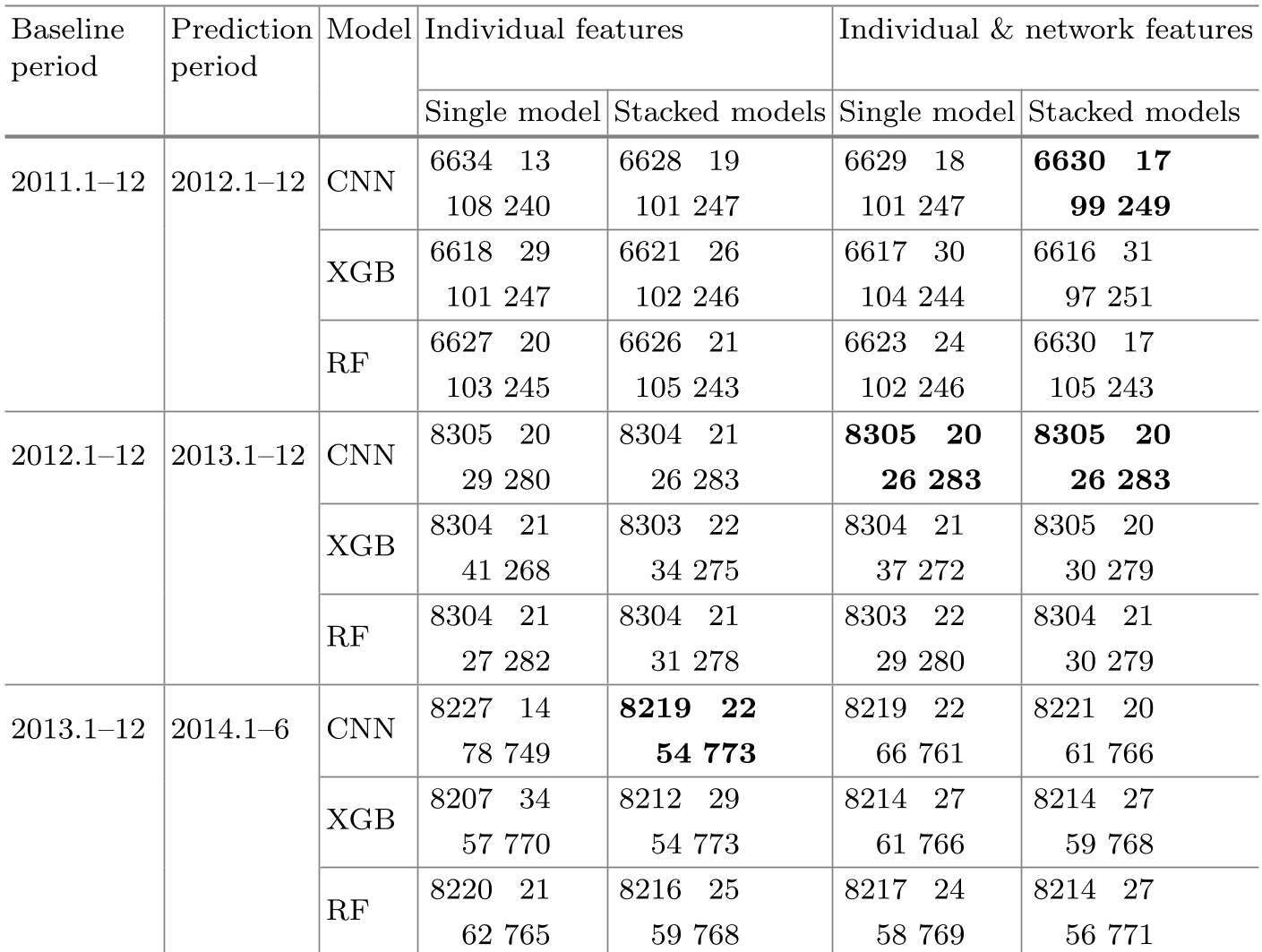 Table 1: Comparison across different periods. Highlighted cells show the StCNN consistently achieving the lowest False Negatives.
Key Insights from the Benchmarks:
- Network Synergy: Adding family features improved the performance of all models.
- Ensemble Power: StCNN was the top performer, specifically excelling in reducing False Negatives—the "silent killers" in churn where the bank fails to identify a customer about to leave.
- Cost Sensitivity: When the cost of losing a customer was set to 20x the cost of retention marketing, the StCNN maintained high utility, whereas single models' performance decayed rapidly.
Critical Analysis & Conclusion
This work demonstrates that "Deep Learning" in finance doesn't always mean bigger LLMs; it can mean smarter ways to combine existing models.
Pros:
- The method used to build networks is brilliantly simple and requires no new data collection.
- Stacking with CNNs provides a non-linear way to resolve conflicts between base classifiers.
Limitations:
- The "Family Clique" assumption (everyone with the same name at the same address is linked) may be less accurate in large multi-generational apartment complexes.
- The study focuses on "Activity Churn" (zero transactions); "Partial Churn" (switching primary banks but keeping an account open) remains a harder problem.
Future Outlook: As banks move toward Open Banking, the potential to expand these "Peer Networks" beyond family units into broader social circles is the next frontier for churn intelligence.
Takeaway for Practitioners: If you aren't looking at who your customer lives with, you're missing half the story. Don't just pick the best model; build a CNN to manage the ensemble.