
Deep Feelings: Decoding the Emotional DNA of Viral News
Deep Feelings: A Massive Cross-Lingual Study on the Relation between Emotions and Virality
This study investigates the relationship between emotional evoke and news virality using a massive bilingual corpus of 65k articles with 1.5 million reader-provided annotations. By mapping specific emotions to the Valence-Arousal-Dominance (VAD) circumplex model, the authors propose a generalized framework to explain why certain content goes viral across different cultures.
TL;DR
Why do some news stories explode on Twitter while others only spark heated debates in the comment section? This study analyzes 65,000 articles and 1.5 million reader votes to reveal that virality isn't just about "being emotional." By shifting the focus from specific emotions (like anger or joy) to deep psychological dimensions—Valence, Arousal, and Dominance (VAD)—the researchers provide a universal blueprint for how content spreads across different languages and cultures.
The Problem: The "Arousal" Myth and Cultural Clashes
For years, the gold standard in virality research (notably Berger et al., 2012) suggested that Arousal (the level of physiological activation) was the primary driver of content sharing. However, when you look at different cultures, this theory starts to crack.
In this study, the authors found a striking contradiction:
- In the English (Rappler) dataset, SADNESS (low arousal) was negatively correlated with virality.
- In the Italian (Corriere della Sera) dataset, SADNESS was actually a strong driver for broadcasting on social media.
This discrepancy suggests that looking at surface-level emotions is not enough. To find a truly global model of virality, we need to go deeper into the "atoms" of emotion.
Methodology: The VAD Circumplex and Multi-Facet Virality
The researchers mapped human emotional responses into a three-dimensional space:
- Valence: Is the feeling positive or negative?
- Arousal: Is the feeling exciting or calming?
- Dominance: Does the reader feel "in control" or "controlled by" the emotion?
Moreover, they split "virality" into two distinct behaviors:
- Narrowcasting: Engaging in a specific, localized discussion (e.g., posting a comment).
- Broadcasting: Transmitting content to a wide, public audience (e.g., Tweeting or G+ sharing).
 The distribution of reader-voted emotions across the two datasets shows significant differences, necessitating a deeper VAD analysis.
The Core Insight: Arousal vs. Dominance
The breakthrough of this paper lies in how different VAD dimensions control different viral facets.
1. Narrowcasting (Comments) is driven by Arousal
When readers encounter content that is highly arousing but leaves them feeling less in control (low Dominance), they tend to comment. The act of commenting serves as a way to process high-activation emotions within a relatively "safe," narrow audience.
2. Broadcasting (Shares) is driven by Dominance
When readers feel in control (high Dominance), they are far more likely to broadcast that content to their entire social network. Sharing is an assertive act; it requires the user to feel empowered by the information they are distributing.
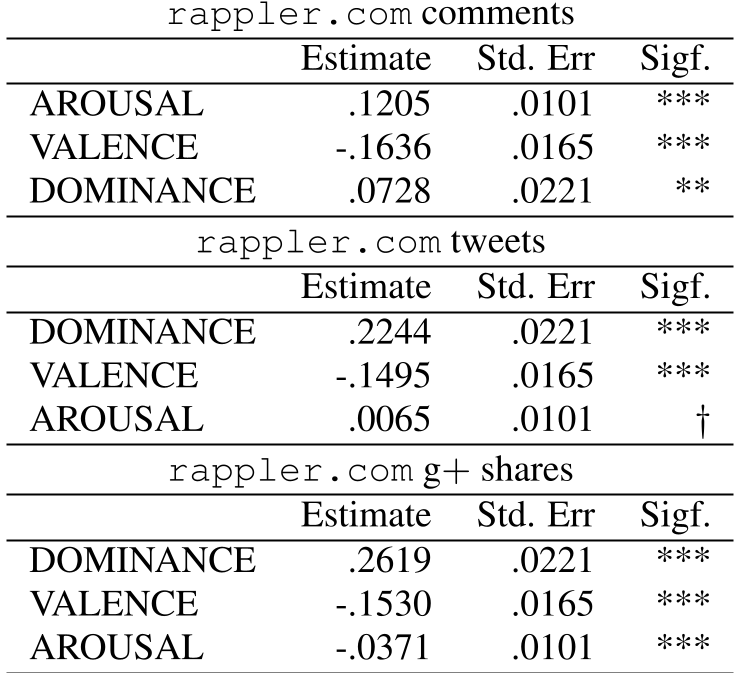 The statistical models show that while Arousal dominates Narrowcasting, Dominance becomes the key driver for Broadcasting (Twitter).
Experiments & Results: Outperforming the SOTA
To validate their findings, the authors compared their VAD-based models against the established benchmarks in the field.
- Better Explanatory Power: Their models achieved significantly higher R² values than the automated lexicon-based models used in prior high-profile studies.
- Cross-Lingual Consistency: While "Sadness" worked differently in Italy vs. the Philippines, the VAD configurations remained consistent. Negative valence, high arousal for comments, and high dominance for shares held true across both languages.
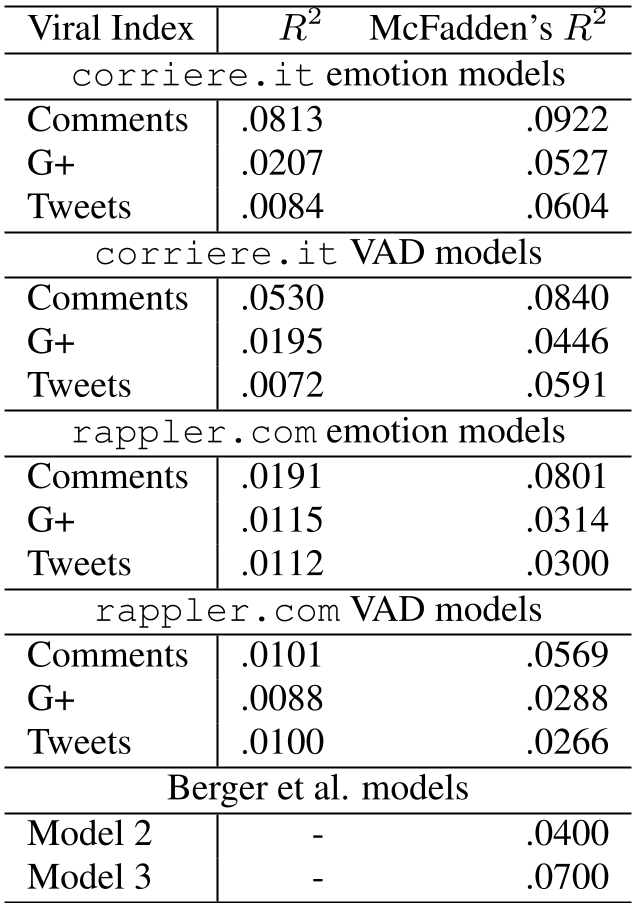 Comparison of model performance against Berger et al., illustrating the superior predictive power of reader-annotated VAD data.
Critical Analysis & Conclusion
Takeaway
For marketers and publishers, this research is a goldmine. If you want discussion, trigger high arousal (surprise, anger). If you want reach, empower the reader (inspiration, utility) so they feel "in control" when sharing.
Limitations
The study relies on crowd-sourced "Mood Meter" data. While massive, this data is subject to the layout of the website’s UI (e.g., the order of emoticons), which might introduce subtle biases in how users report their feelings.
Future Outlook
The next frontier is automating the extraction of VAD scores directly from text using LLMs. If we can predict the "Dominance" score of a headline before it's published, we can essentially "engineer" virality with unprecedented precision.