
GNN-SoR: Elevating Social Recommendation via Item Attribute Correlation
6552_A Deep Graph Neural Network-Based Mechanism for Social Recommendations.
The paper introduces GNN-SoR, a deep Graph Neural Network-based social recommendation framework designed for Industrial IoT. It uniquely integrates both user social influences and fine-grained item attribute correlations into a matrix factorization backbone, achieving state-of-the-art performance in rating prediction.
Executive Summary
TL;DR: While most Recommender Systems (RS) focus on "who you know" (social influence) and "what you liked" (historical ratings), they often ignore "how items relate to each other" internally. GNN-SoR bridges this gap by using Graph Neural Networks (GNN) to model both the social fabric of users and the complex web of item attributes.
By treating item features as a graph rather than a flat vector, the researchers achieved significant accuracy gains on major benchmarks like Epinions and Yelp, proving that the synergy between item attributes (like a specific director-actor pairing) is a powerful predictor of user interest.
Problem & Motivation: The Missing Link in Social Recommendation
In the era of the Industrial Internet of Things (IIoT), information overload is a critical bottleneck. Social Recommendation (SoR) aims to solve this by leveraging social trust. However, the authors identify a significant flaw in current SOTA (State-of-the-Art) methods: Item Feature Isolation.
Most models assume that item attributes are independent. In reality, attributes are deeply correlated. For instance, a user might not like a director or an actor individually, but they might love their collaboration. GNN-SoR is designed to capture these "hidden topologies" within the item space that previous Matrix Factorization (MF) models missed.
Methodology: A Dual-Graph Architecture
The core of GNN-SoR lies in its ability to encode two separate feature spaces into a shared latent space for Matrix Factorization.
1. User Feature Modeling
The model splits user features into two components:
- Inherent Preference: Encoded from the user-item rating matrix.
- Social Influence: Encoded from the user-user social graph. These are processed through a GNN-based mean operator and concatenated to form a robust user latent factor.
2. Item Feature Modeling (The Innovation)
Instead of simple One-Hot encoding, GNN-SoR treats items as graphs of attributes.
- Node Features: Structured data (category, country) and unstructured data (textual reviews processed via Twitter-LDA).
- Edge Features: Directed correlations calculated via co-occurrence frequencies between attributes.
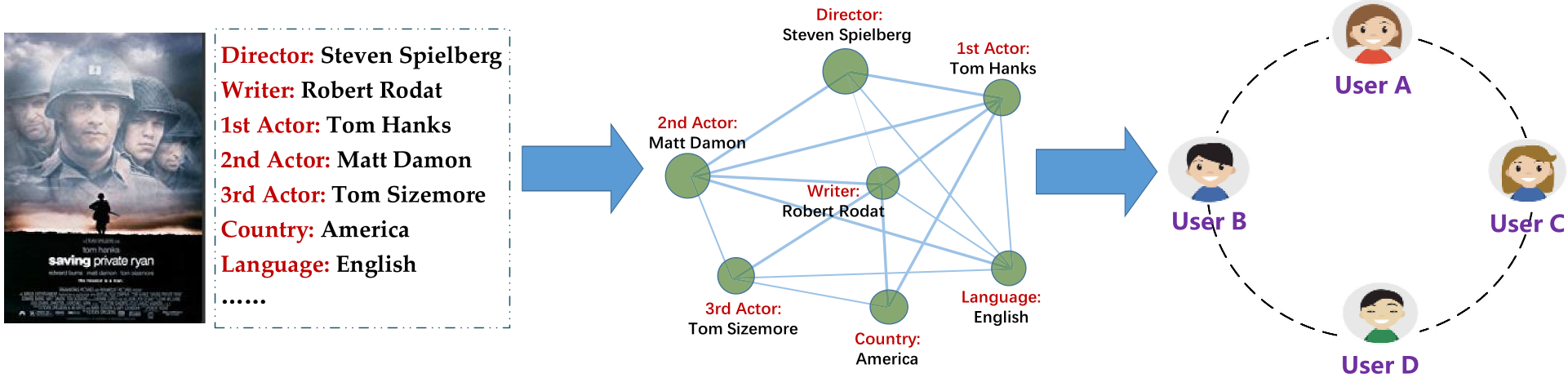 Fig 1: The GNN-SoR Roadmap highlighting the parallel processing of User and Item graphs.
Experiments & Results
The framework was tested against benchmarks like TrustMF, SocialMF, and TrustSVD across three real-world datasets:
- Epinions (Shopping)
- Yelp (Local Business)
- Flixster (Movies)
Performance Gains
In almost every metric (RMSE, MAE, and NDCG), GNN-SoR took the lead. For example, on Epinions with 80% training data, GNN-SoR achieved an RMSE of 0.805, materially outperforming TrustSVD (0.834).
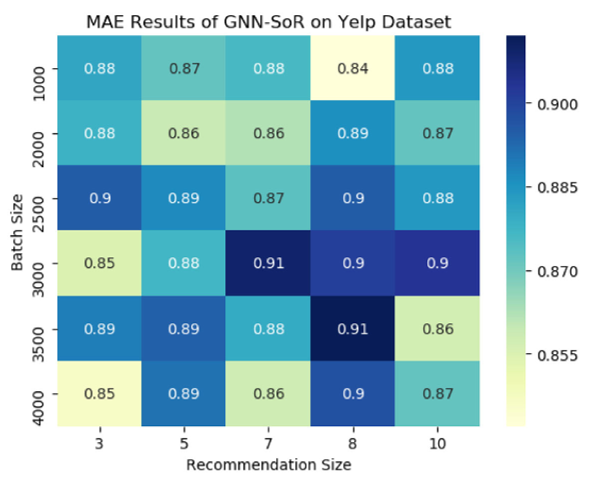 Fig 2: Parameter sensitivity heatmaps showing GNN-SoR’s stability across different batch sizes and recommendation lengths.
The results suggest that modeling attribute-attribute correlations provides the model with a "structural prior" that helps it navigate the sparsity of user-item ratings.
Critical Insight & Conclusion
The success of GNN-SoR highlights a shifting paradigm: Structured Knowledge is the key to Sparse Data.
By representing item attributes as a graph, the authors essentially performed Knowledge Graph Embedding at a micro-level (per item). While the computational cost of node-wise GNN updates is higher than traditional MF, the stability and accuracy gains make it a compelling candidate for future IoT-based personalization engines.
Limitations: The model currently assumes a static social and item graph. Future research should look into Dynamic GNNs that can handle evolving social ties and changing item trends in real-time IoT environments.