
Efficient Emotion Recognition: Bringing Affective AI to Low-Power Edge Devices
Deep Learning Algorithms for Emotion Recognition on Low Power Single Board Computers
This paper presents a real-time Facial Emotion Recognition (FER) system optimized for low-power Single Board Computers (SBCs) like the Raspberry Pi 3B+. By evaluating various Deep Neural Network (DNN) architectures and leveraging hardware accelerators like the Intel Movidius Neural Compute Stick (NCS), the study achieves up to 69% accuracy on the FER2013 dataset with acceptable real-time processing speeds.
Executive Summary
TL;DR
This study bridges the gap between high-complexity Deep Learning and the restrictive power envelopes of Single Board Computers (SBCs). By optimizing CNN architectures specifically for the FER2013 dataset and utilizing the Intel Movidius Neural Compute Stick (NCS), the authors achieved a 69% accuracy rate and real-time frame rates (up to 8 FPS) on a Raspberry Pi 3B+.
Academic Context
Positioned at the intersection of Human-Computer Interaction (HCI) and Embedded AI, this work is a practical "SOTA-to-Edge" adaptation. It focuses on the engineering feasibility of deploying facial expression analysis in constrained environments where high-end GPUs are unavailable.
Problem & Motivation: The High Cost of Perception
Effective HCI requires computers to understand human emotional states. While modern Transformers and deep ResNets excel at this, their computational hunger makes them "basement-bound"—tied to heavy servers or desktops.
The authors identify a critical bottleneck: Inference Latency. On a standard Raspberry Pi, processing high-dimensional image data through a deep network often results in "slideshow" frame rates, rendering the interaction useless for real-time feedback. The challenge lies in finding the "Goldilocks" model: deep enough to extract nuanced features but light enough to run on an ARM-based CPU or a specialized USB accelerator.
Methodology: Architecuting for the Edge
The system workflow is divided into three distinct phases: Face Detection, Feature Extraction, and Classification.
1. The Pipeline
To handle faces, the authors compared the classical Haar Cascade method with the more modern MTCNN (Multi-Task Cascaded CNN). While MTCNN offers higher robustness, Haar Cascades remain the efficiency king on pure CPU setups.
2. Custom CNN Variants
The heart of the paper lies in the evaluation of five model variants, ranging from 3 to 13 convolutional layers.
- Architecture Detail: Each model uses 3x3 kernels to minimize parameters, followed by ReLU activation and Max-Pooling.
- The Sweet Spot: Interestingly, the 11-layer model (ermodel_cls7_conv11) outperformed the 13-layer version, suggesting a saturation point where additional depth leads to overfitting or diminishing returns on limited datasets.
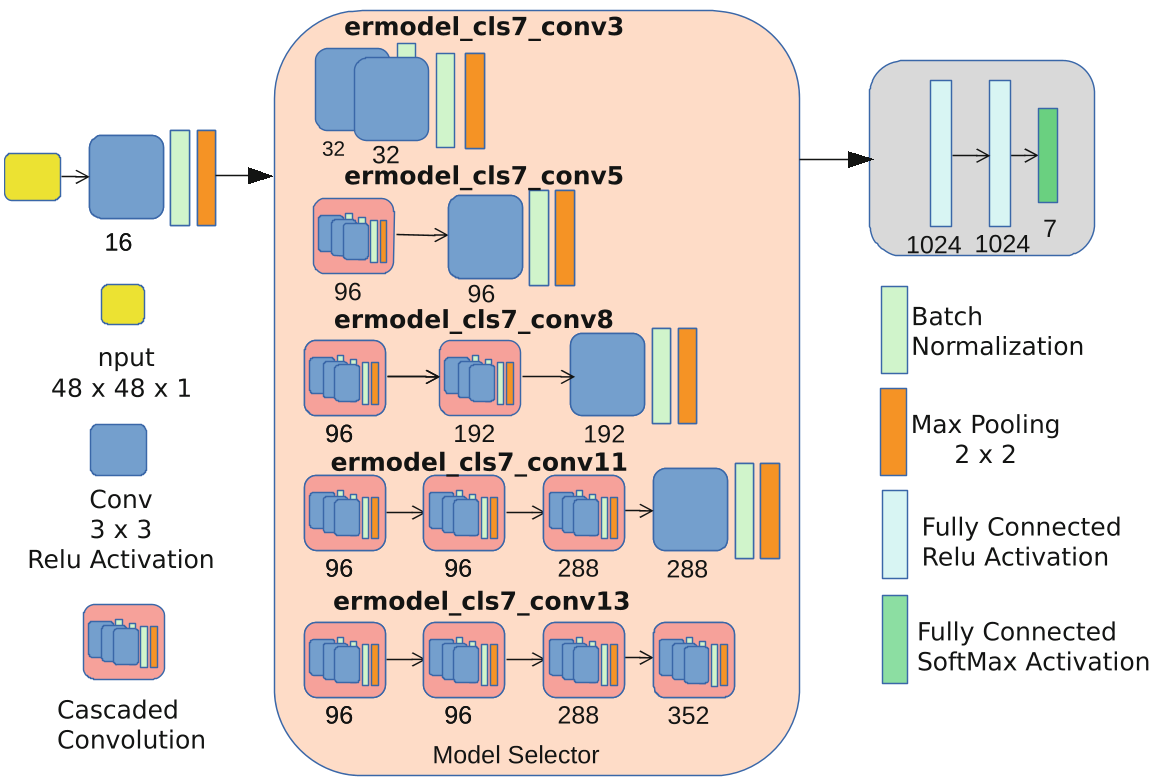 Fig 1: The proposed CNN architecture featuring cascading convolution blocks for hierarchical feature extraction.
3. Hardware Acceleration
By offloading the CNN weights to the Intel Movidius NCS, the system bypasses the ARM CPU's limitations for matrix multiplication, significantly slashing inference times.
Experiments & Results
The models were trained on the FER2013 dataset, which includes seven emotions: Angry, Disgust, Fear, Happy, Sad, Surprise, and Neutral.
Quantitative Performance
The experimental results highlight a crucial trade-off between parameter count and accuracy:
| Model | Conv Layers | Parameters | Test Accuracy | NCS Inference Time |
|---|---|---|---|---|
| ermodel_cls7_conv8 | 8 | 2.8M | 67.9% | 12.07 ms |
| ermodel_cls7_conv11 | 11 | 4.3M | 69.0% | 16.07 ms |
Feature Map Visualization
The authors visualized the ReLU outputs to confirm the network's learning logic. Early layers captured primitive edges, while deeper layers synthesized complex facial structures.
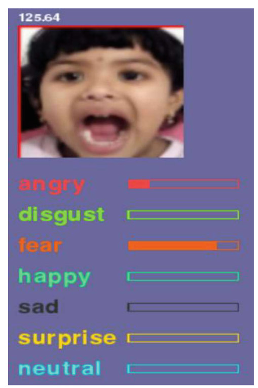 Fig 2: Real-time emotion classification output showing the probability distribution across labels.
Critical Analysis & Conclusion
Takeaway
The research confirms that ARMv8 64-bit architectures combined with dedicated AI accelerators can handle meaningful DNN tasks. For developers, the "ermodel_cls7_conv8" offers the best balance: it has the lowest parameter count (2.8M) while maintaining near-peak accuracy, making it ideal for memory-constrained devices.
Limitations
- Class Imbalance: The system struggled significantly with the "Disgust" emotion. This isn't a failure of the architecture, but a reflection of the FER2013 dataset's skewness.
- Environmental Sensitivity: While performance is stable at 5-8 FPS, dramatic lighting changes in "wild" environments remain a challenge for the initial face acquisition step.
Future Work
The authors suggest that future iterations could implement Active Learning to better label ambiguous data and explore Binary-Weight CNNs to push inference speeds even further without requiring external hardware like the NCS.