
ResNet for Side-Channel Attacks: Why Traces Still Need Alignment
Deep learning mitigates but does not annihilate the need of aligned traces and a generalized ResNet model for side-channel attacks
This paper investigates the necessity of trace alignment in Deep Learning (DL) based Side-Channel Attacks (SCA). It introduces a generalized Residual Network (ResNet) architecture that outperforms previous state-of-the-art CNN and MLP models in extracting keys from protected AES implementations.
TL;DR
Does Deep Learning (DL) make signal preprocessing obsolete in hardware security? This paper says no. While Deep Learning is robust against noise, the authors demonstrate that aligning power/EM traces remains vital for efficiency. Furthermore, they introduce a Residual Network (ResNet) architecture that establishes a new SOTA for Side-Channel Attacks (SCA), outperforming existing CNNs on the widely recognized ASCAD dataset.
Problem & Motivation: The Illusion of "End-to-End" SCA
In the world of Side-Channel Analysis, "Misalignment" is a primary defense. Hardware designers use clock jitter and interrupts to shift the time at which a secret operation (like an AES S-box) occurs, making it difficult for traditional Template Attacks to succeed.
The community recently pivoted toward Convolutional Neural Networks (CNNs), which are inherently shift-invariant. However, the authors identify a dangerous trend: researchers assuming . They argue that for highly protected implementations, the search space for a DL model becomes so large that training becomes computationally infeasible or fails to converge without proper alignment.
Methodology: The Power of Residual Learning
The paper introduces a specialized ResNet for SCA. Unlike standard Multi-Layer Perceptrons (MLP), ResNets use "shortcut connections" that allow the network to learn "residual" mappings.
1. The ResNet Architecture
The proposed model follows this structure:
- Residual Blocks: Stacks of Convolutional layers, Batch Normalization, and ReLU activation.
- Global Average Pooling: Replaces dense layers to drastically reduce the number of trainable parameters, preventing overfit.
- Formula logic: .

2. Recursive Alignment
The authors don't just rely on the model. They use a correlation-based synchronization method recursively. By narrowing down the interval step-by-step, they "compress" the trace from tens of thousands of samples to just the essential leakage points.
Experiments & Results: The "ResNet" Advantage
The authors tested their model against two Device Under Tests (DUTs) and the public ASCAD dataset.
Key Breakthroughs:
- Efficiency: On DUT2 (AES S-box), attacking misaligned traces took a week on a GTX 1080Ti without success. Once aligned, the attack took only 4 hours and reached 100% key disclosure.
- SOTA Comparison: The ResNet consistently achieved a lower "Guessing Entropy" (Key Rank) compared to
ASCAD_CNNandSCANet.
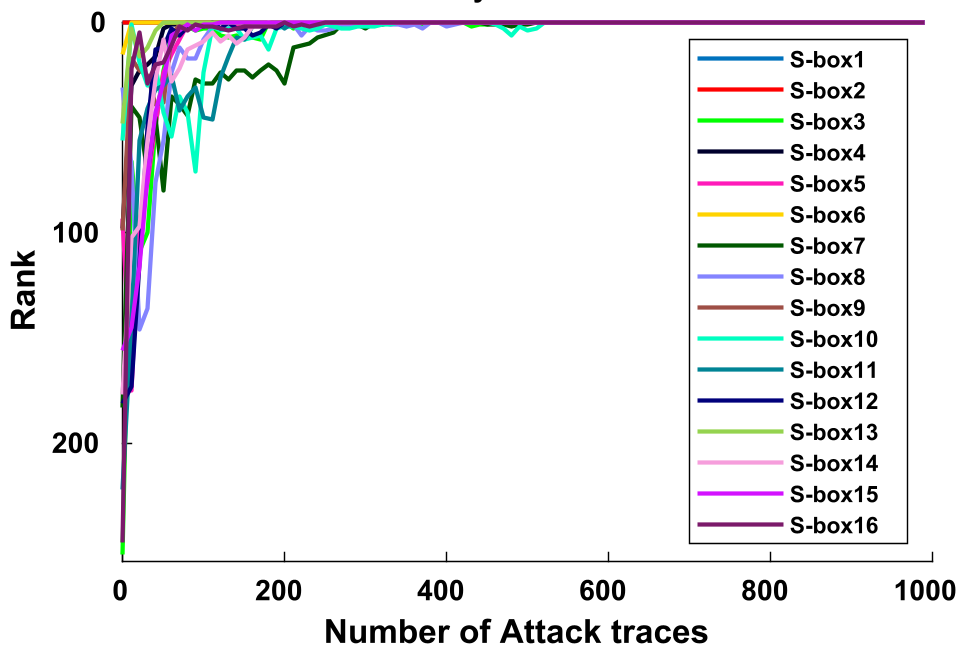 Fig: ResNet (top) vs. ASCAD_CNN (bottom) on 16 S-boxes. ResNet converges to a rank of 0 much faster (within 600 traces).
The Impact of Alignment
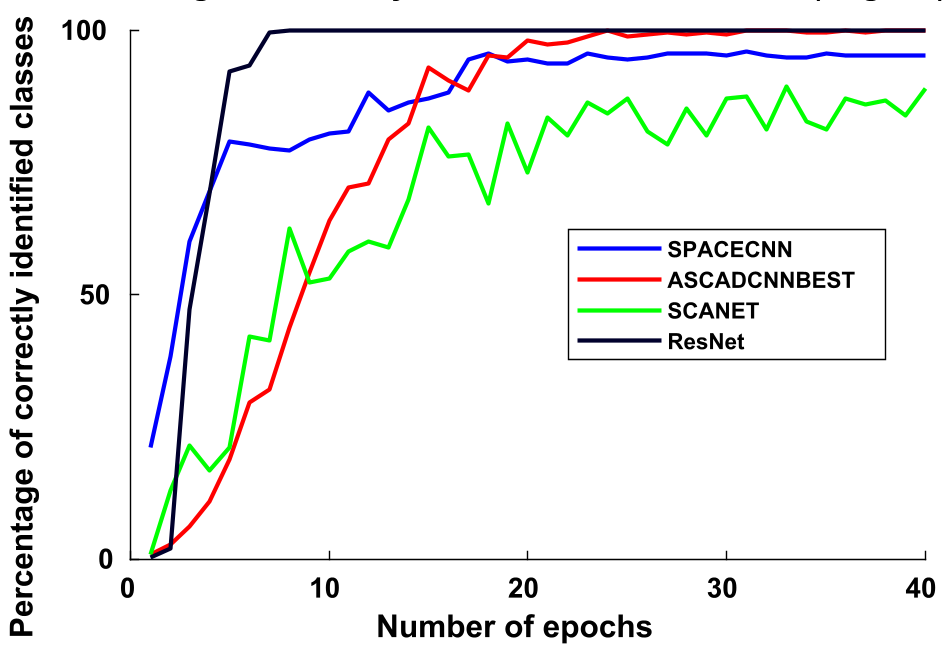
Even with ResNet's power, "Aligned" traces (blue lines) reached 100% accuracy in fewer epochs than "Misaligned" traces (orange lines) in almost every scenario.
Deep Insight & Conclusion
This work serves as a reality check for the "Black Box" approach to AI.
Takeaway 1: The Inductive Bias of a ResNet is superior for SCA because it handles deep feature extraction without the "degradation" seen in deep MLPs or simple CNNs.
Takeaway 2: Alignment is not just about accuracy; it is about Time Complexity. In a professional evaluation lab, reducing an attack from weeks to hours is the difference between a "secure" and "vulnerable" certification.
While DL mitigates the effort required for feature engineering, signal processing—the "old school" art of alignment—remains the secret sauce for high-performance side-channel exploitation.