
Scaling Crisis Informatics: Large-Scale Benchmarks for Social Media Image Classification
Deep Learning Benchmarks and Datasets for Social Media Image Classification for Disaster Response
This paper presents a comprehensive benchmark and consolidated datasets for social media image classification in disaster response, covering four key tasks: disaster type, informativeness, humanitarian categories, and damage severity. By refining and unifying multiple datasets (CrisisMMD, DMD, DAD, and new AIDR collections) into a non-overlapping standardized split, the authors evaluate several state-of-the-art CNN architectures, establishing new baselines for the crisis informatics community.
TL;DR
In the chaos of natural disasters, social media images provide vital "ground-truth" for humanitarian aid. This paper tackles the scarcity of high-quality, non-overlapping data by consolidating multiple datasets into a massive unified benchmark. By testing ten different deep learning architectures, the authors prove that EfficientNet and VGG16 are powerhouses for disaster response, provided that the training data is cleaned of the duplicates that typically plague Twitter and Instagram feeds.
Background: The "Data Leakage" Trap in Crisis Computing
Most disaster response models are trained on small batches of social media data. However, social media is an echo chamber; the same viral image of a flood or fire is often posted thousands of times. If a researcher performs a random split, the same image likely ends up in both the training and test sets. This creates an overfitting illusion, where models appear to perform perfectly but fail in real-world deployment.
The authors of this study identified this "leakage" as a primary barrier to progress and set out to create a "Clean & Consolidated" benchmark.
Methodology: Building the "ImageNet" of Disasters
The researchers addressed four critical dimensions of crisis awareness:
- Disaster Type: Recognizing the event (Fire, Flood, Earthquake, etc.).
- Informativeness: Distinguishing actionable images from "noise" (memes, ads, or unrelated photos).
- Humanitarian Categories: Identifying specific needs (rescue efforts, infrastructure damage).
- Damage Severity: Quantifying destruction (Severe, Mild, or None).
Architecture & Duplicate Filtering
The core innovation lies in their data hygiene. Using a pre-trained ResNet to extract features and a Nearest Neighbor approach, they identified images with a Euclidean distance of as near-duplicates. These were moved into the training set to ensure the test set was entirely "unseen" content.
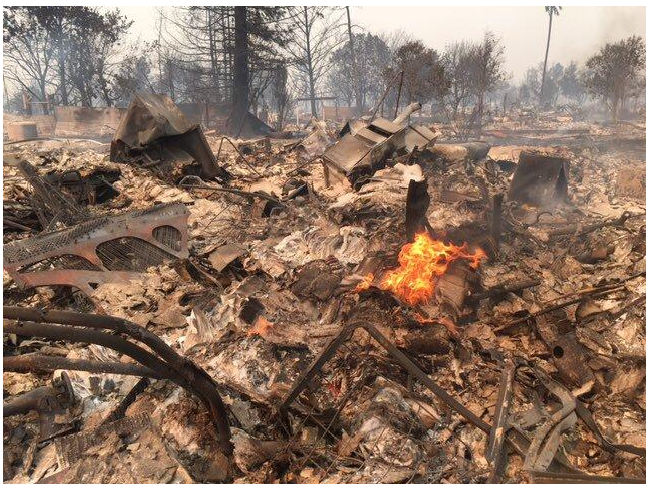 Fig 1: A multi-task annotation example: This single fire image is labeled across Disaster Type, Informativeness, Humanitarian category, and Damage Severity.
Experiments: Benchmarking the Giants
The study compared a "Who's Who" of computer vision backbones, including ResNet, AlexNet, VGG16, MobileNet, and EfficientNet.
Key Findings:
- Data Consolidation Wins: Training on the consolidated dataset boosted the F1-score for Informativeness from 0.725 (individual dataset) to 0.851.
- The EfficientNet Edge: EfficientNet (b1) achieved the highest average F1-score (0.801) while maintaining a high throughput of 260 images/second—making it the prime candidate for real-time disaster monitoring.
- The Difficulty of "Mild" Damage: Models frequently confused "Mild" damage with "Severe" or "None," indicating that damage assessment remains the most subjective and challenging task in the pipeline.
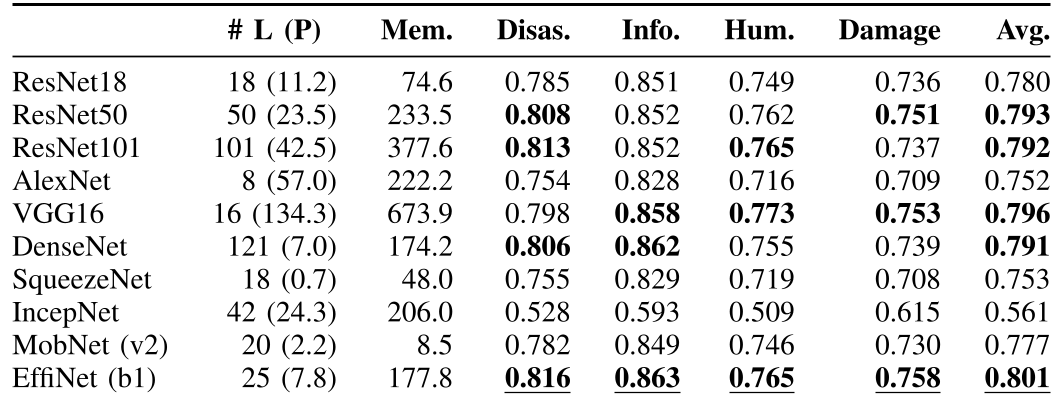 Table 1: Benchmark results highlighting EfficientNet's superior average performance and VGG16's strength in humanitarian classification.
Critical Analysis & Conclusion
The study successfully provides a "gold standard" for disaster image classification. By releasing the data splits, the authors enable a level playing field for future researchers.
Takeaway: If you are building a disaster response system, forget small-batch training. Use consolidated datasets and prioritize EfficientNet for a balance of accuracy and speed.
Limitations: While powerful, the models still struggle with class imbalance (e.g., "Landslides" are rarer than "Floods"). Future work should explore Multi-task Learning (MTL), where a single model learns all four tasks simultaneously, potentially sharing features to better understand the nuances of a crisis scene.