
DIR: Fusing Topology and Content via Deep Joint Reconstruction for Community Detection
Using Deep Learning for Community Discovery in Social Networks
The paper introduces Deep Integration Representation (DIR), a novel community detection algorithm that jointly embeds network topology and node attributes using stacked auto-encoders. By reconstructing a mixed spectral matrix, DIR achieves state-of-the-art results across various social and citation networks.
TL;DR
Community detection in modern social networks requires a delicate balance between "who you know" (topology) and "what you say" (node content). The Deep Integration Representation (DIR) model bridges this gap by reformulating community detection as a deep matrix reconstruction problem, outperforming traditional spectral and probabilistic methods by over 20% in clustering accuracy.
Background: The Limits of Linear Fusion
In the landscape of social network analysis, we often see a divide:
- Topology-only methods: Focus on link density (e.g., Modularity optimization).
- Content-only methods: Focus on node similarities (e.g., Normalized-cut).
Recent "hybrid" attempts usually rely on linear combinations (). However, these suffer from high sensitivity to the parameter and a failure to capture the non-linear, hierarchical nature of real-world data (vocabularies topics documents).
The Core Insight: From Spectral Clustering to Deep Auto-Encoders
The authors leverage a brilliant theoretical bridge: Spectral Clustering is essentially a low-rank matrix reconstruction problem.
According to the Eckart-Young-Mirsky Theorem, finding the largest eigenvectors of a matrix is equivalent to finding the best -rank approximation under the Frobenius norm. Since Auto-Encoders (AE) are designed to minimize reconstruction error, they can be viewed as a non-linear generalization of spectral clustering.
The DIR Pipeline
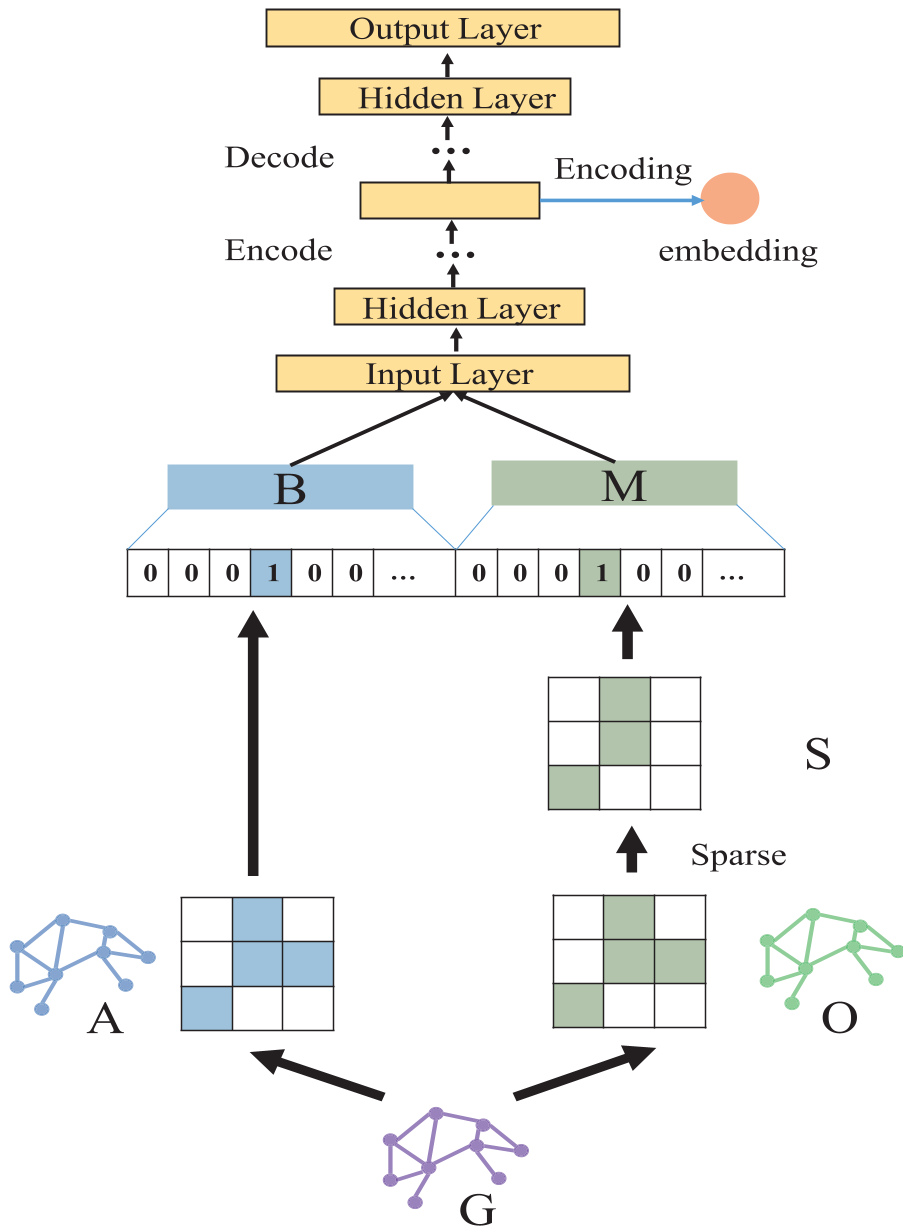
- Preparation: Generate the Modularity matrix (topology) and the Markov matrix (content).
- Concatenation: Create a mixed spectral matrix .
- Deep Learning: Feed into a Stacked Auto-Encoder. This allows the model to learn a unified, deep embedding that captures interactions between link structures and attributes.
Methodology: Why It Works
Unlike linear models, the DIR model's non-linear activation functions (like or ) allow it to discover latent community features that aren't visible through simple matrix factorization.
More importantly, the researchers found that the model is remarkably robust to the balance parameter. Whether you weight topology at 0.1 or 0.9, the final performance remains stable, suggesting that the deep architecture "automatically" learns the most salient features from whichever source is more informative for a specific node.
Experimental Battleground
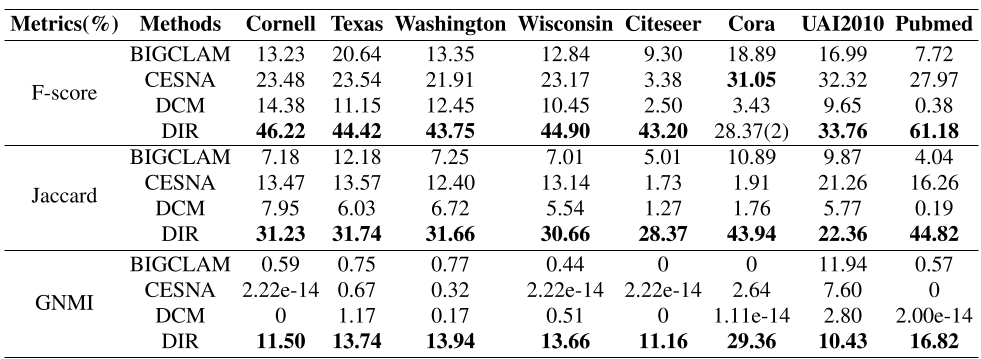
The model was tested against 9 state-of-the-art baselines, including SBM (Stochastic Blockmodels), BigCLAM, and CESNA.
Performance Highlights:
- NMI (Normalized Mutual Information): On the Cora dataset, DIR achieved an NMI of 40.30%, nearly doubling many baselines.
- Overlapping Communities: In metrics like GNMI and Jaccard, DIR showed a "definite superiority," consistently achieving the highest scores across 7 out of 8 datasets.
Critical Perspective
While DIR is a powerhouse for static networks, it faces two main challenges for future research:
- Complexity: Although nearly linear in relations to nodes/links, training deep auto-encoders is computationally heavier than simple spectral decomposition.
- Data Sparsity: As mentioned by the authors, in very small networks, "going too deep" can lead to information loss, suggesting that the depth of the network should be proportional to the data scale.
Conclusion
By treating community detection as a deep reconstruction task, DIR effectively retires the need for manual parameter tuning in multi-view graph analysis. It sets a new standard for how we should approach the fusion of heterogeneous information in complex social systems.
Keep up with the latest in AI and Social Network Analysis. For the full implementation, visit the authors' repository mentioned in the paper.