
Follow the Sound: Revolutionizing Pediatric Heart Disease Diagnosis with Lightweight AI
13258_Follow the Sound of Children's Heart A Deep-Learning-Based Computer-Aided Pediatric CHDs Diagnosis System.
This paper presents a lightweight, deep-learning-based computer-aided diagnosis (CAD) system for pediatric Congenital Heart Diseases (CHDs) using 1-D Convolutional Neural Networks (CNNs). The authors introduce a novel large-scale pediatric heart sound dataset and two specialized architectures (Dense Block and Clique Block based) that achieve SOTA performance with significantly reduced parameter counts.
TL;DR
Researchers have developed a breakthrough deep-learning system specifically for children's heart health. By creating the first large-scale pediatric heart sound dataset and designing ultra-lean 1-D CNN architectures, they've achieved 96.7% diagnostic accuracy with a model 100x smaller than standard AI benchmarks. This paves the way for reliable CHD screening on everyday smartphones and IoT wearables.
Background: Why Pediatric Auscultation is a Hard Problem
Auscultation (listening to the heart) is the oldest and cheapest tool in a cardiologist's kit. However, identifying Congenital Heart Diseases (CHDs) in newborns is far more complex than in adults. Kids have faster heart rates, unavoidable noise from crying or movement, and unique physiological sounds that would be considered "abnormal" in an adult but are perfectly healthy for a child.
Prior works failed because:
- Data Scarcity: Most public datasets are adult-centric.
- Complexity: Standard CNNs treat heart sounds like images (MFCCs), requiring massive compute power.
- Expertise Gap: Low-income regions lack the trained cardiologists needed to interpret these subtle auditory patterns.
Methodology: Leaner, Faster, Smarter
The authors opted for a 1-D End-to-End approach. Instead of converting heart sounds into images (spectrograms), the model "listens" to the raw waveform directly.
1. The Power of Feature Reuse
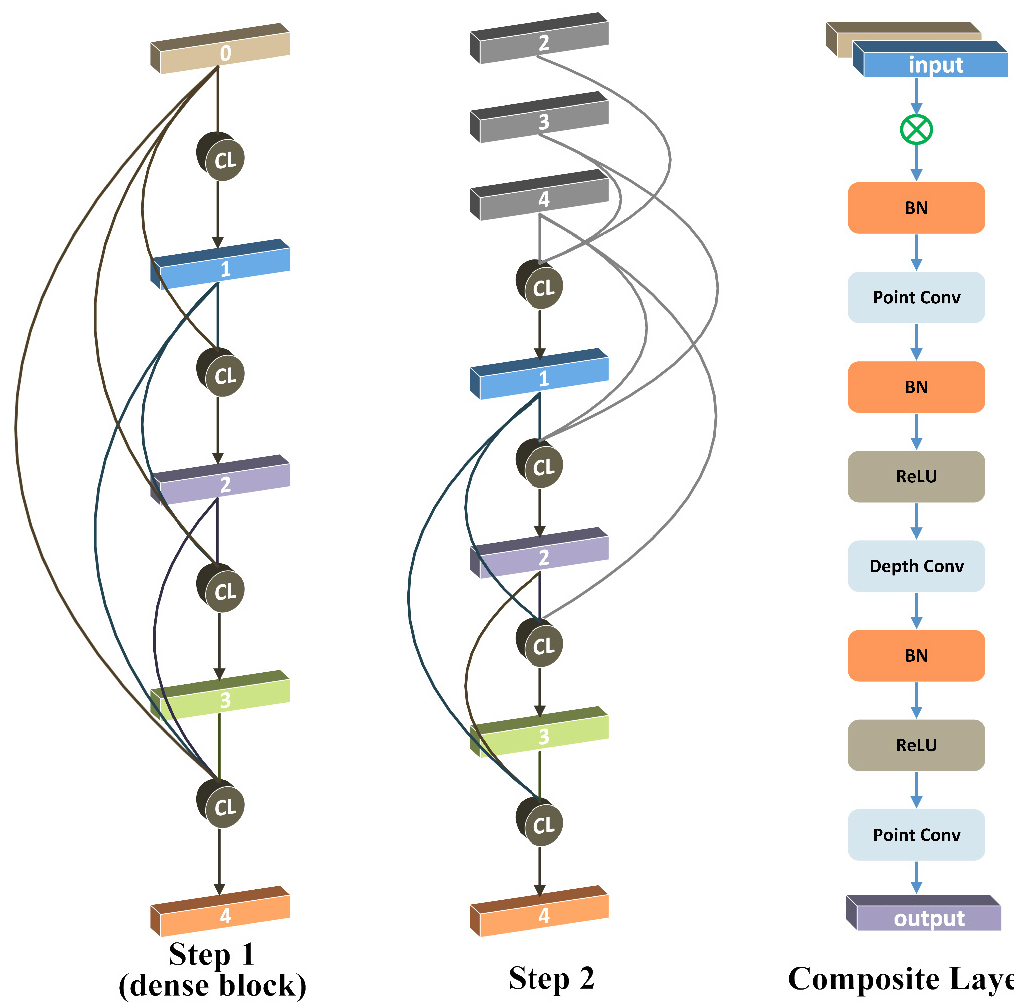
The system utilizes two specific types of blocks:
- Dense Blocks: Every layer is connected to every other layer within the block, ensuring that "knowledge" (features) from the first layer isn't lost by the time it reaches the last.
- Clique Blocks: These go a step further with bidirectional connections, allowing the network to refine earlier features based on information discovered later in the block.
2. Squeeze-and-Excitation (Attention)
The researchers added a "Transition Block" equipped with an Attention Mechanism. This allows the AI to "focus" on the specific parts of the heart cycle (like the S1/S2 lub-dub) that contain the most diagnostic information, while ignoring background noise like a child's cough.
Experimental Results: SOTA Performance at a Fraction of the Cost
The team tested their models on their newly collected dataset of 528 recordings. The results were staggering:
- Efficiency: The Dense-based model uses only 0.11 Million parameters. Compare this to the 12.41 Million parameters used by MFCC-CNNs.
- Accuracy: In a binary Normal vs. Abnormal task, the model achieved a sensitivity of 95.36% and a specificity of 98.08%.
- Real-world speed: On a standard smartphone, the inference takes just a fraction of a second, making it viable for "Tele-Auscultation" in rural clinics.

Seeing what the AI Hears: Interpretability
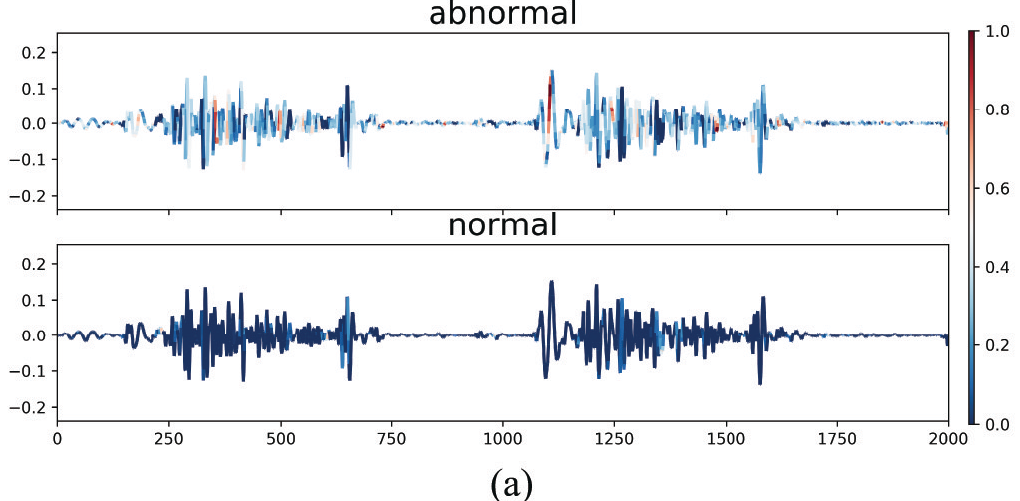
One of the biggest hurdles in medical AI is the "Black Box" problem. The authors used Class Activation Maps (CAM) to visualize what the model was listening to. As shown below, the model correctly focuses its attention on systolic murmurs or specific heart valves, which aligns with how human doctors perform diagnosis.
Critical Insight & Future Outlook
This paper shifts the paradigm from "bigger is better" to "smarter architecture is better." By using 1-D convolutions and specific feature-reuse blocks, the authors bypassed the need for expensive GPUs.
Limitations: The current dataset, while "large" for the field (528 recordings), is still small for deep learning standards. Future work will need to expand the diversity of diseases (e.g., distinguishing ASD from VSD specifically) to provide even more granular clinical guidance.
The Takeaway: We are entering an era where a $50 digital stethoscope and a smartphone can provide the same level of preliminary screening as a high-end cardiac center.