
Local Patches, Global Impact: Navigating COVID-19 Diagnosis with Limited Data
Deep learning COVID-19 features on CXR using limited training data sets
This paper introduces a patch-based convolutional neural network (CNN) for COVID-19 diagnosis using Chest X-Ray (CXR) images. By utilizing a ResNet-18 backbone with random patch cropping and majority voting, the method achieves state-of-the-art sensitive detection (92.5%) even with limited training data, outperforming complex models like COVID-Net.
TL;DR
In the face of the COVID-19 pandemic, data scarcity became the primary bottleneck for AI diagnostics. This paper presents a patch-based CNN approach that flips the script: instead of looking at the whole X-ray, the model learns from randomized local patches. This strategy effectively augments the data, prevents overfitting, and achieves 92.5% sensitivity with only 10% of the parameters required by previous SOTA models.
Academic Positioning: This work sits at the intersection of medical imaging and efficient deep learning, acting as a "quality-over-quantity" refinement for computer-aided diagnosis (CAD).
The Bottleneck: Why Global Models Fail in a Crisis
When a new disease like COVID-19 emerges, we don't have millions of labeled images. Standard architectures (like COVID-Net) are massive, often exceeding 100 million parameters. In a low-data regime, these models "memorize" the background or specific dataset biases rather than learning true pathology—a classic case of overfitting.
The authors identified that COVID-19 biomarkers—such as Ground-Glass Opacities (GGO) and bilateral consolidation—are localized and multifocal. A "global" approach that resizes the whole image often washes out these fine-grained local textures.
Methodology: The Local Patch Philosophy
The proposed framework moves away from the "whole image" classification. Here is the architectural breakdown:
1. Unified Preprocessing & Segmentation
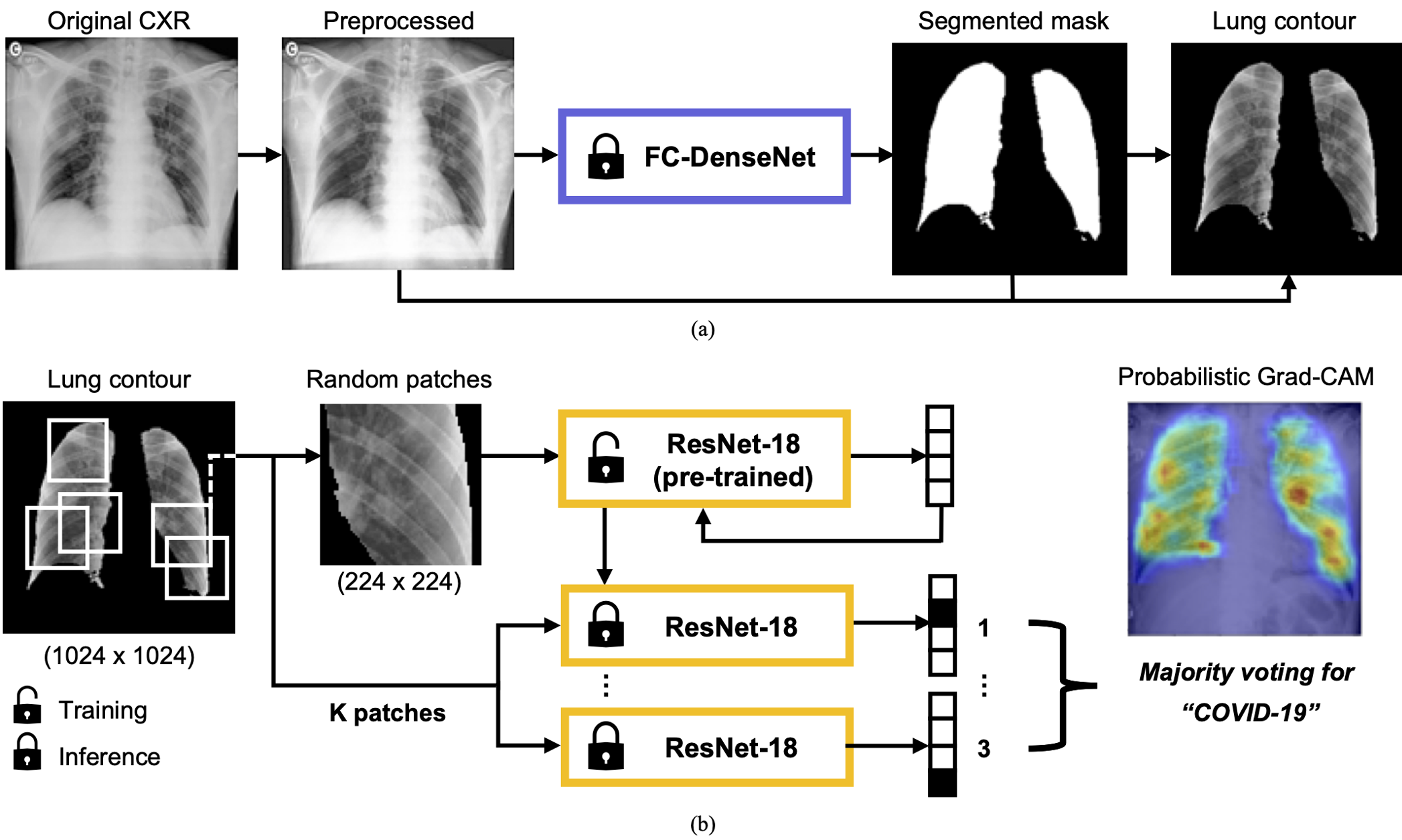
Medical images are notoriously heterogeneous (varying bit depths, sizes, and protocols). The authors use a universal pipeline (Gamma correction, Histogram Equalization) and an FC-DenseNet103 to extract the lung area. This ensures the classifier doesn't "cheat" by looking at metadata or areas outside the lungs.
2. Random Patch Cropping & Majority Voting
Instead of resizing a 1024x1024 image down to 224x224 (losing detail), the model crops random 224x224 patches from the original high-resolution lung area.
- Training: This acts as a massive data augmentor. One image becomes hundreds of potential training samples.
- Inference: The model takes 100 random patches from a single CXR and uses majority voting to decide the final diagnosis.
3. Probabilistic Grad-CAM
Traditional Grad-CAM often highlights one large, blurry area. By weighting patch-wise Grad-CAM results with the softmax probability of the disease, the authors created Probabilistic Grad-CAM. This map accurately highlights multifocal lesions, matching the "scattered" nature of viral pneumonia.
Experiments: Efficiency Meets Accuracy
The results prove that "bigger isn't always better." The researchers compared their ResNet-18 patch-based model against the heavy-duty COVID-Net.
| Metric | COVID-Net (116.6M params) | Proposed (11.6M params) |
|---|---|---|
| Accuracy | 92.4% | 91.9% |
| COVID-19 Sensitivity | 80% | 100% |
| COVID-19 Precision | 88.9% | 76.9% |
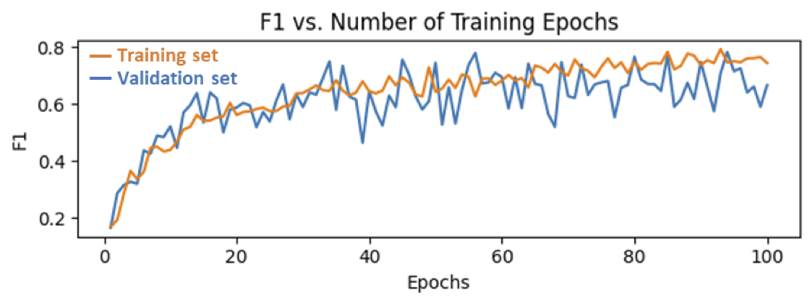
Key Insight: The patch-based model showed zero signs of overfitting in its training curves, unlike the global approach which saw a massive gap between training and validation accuracy.
Critical Analysis: A Triage Tool, Not a Replacement
The authors are realistic: CXR has lower sensitivity than CT or RT-PCR. However, they position this tool for triage.
- Why? Bacterial pneumonia and TB often involve different radiological patterns (like heart border deformation).
- The Value: By using AI to quickly rule out normal cases or bacterial infections, healthcare systems can reserve limited RT-PCR kits for those the model flags as "Viral/COVID-19."
Limitations: The model can still struggle with severe opacities that cause the segmentation network to fail ("under-segmentation"), though the authors argue these failures themselves can occasionally serve as a marker for severe infection.
Conclusion
The success of the patch-based approach underscores a vital lesson for medical AI: Domain-specific inductive bias (focusing on local biomarkers) is more powerful than raw model capacity. By mimicking how a radiologist zooms in on specific lung zones, this model achieves SOTA results with a fraction of the hardware requirements.
Future Work: Integrating this "patch-majority" logic into more modern Vision Transformers (ViTs) could further enhance the ability to capture long-range dependencies between different lung zones.