
ResNet-Forensics: Decoding the Digital Fingerprints of Facebook Images
A Deep Learning Based Digital Forensic Solution to Blind Source Identification of Facebook Images
The paper introduces a deep learning-based digital forensic solution specifically designed for Source Camera Identification (SCI) of images shared via Facebook. By adapting a ResNet50 architecture to handle heavily compressed social media imagery, the method achieves a state-of-the-art accuracy of 96% in attributing images to their originating camera models.
TL;DR
In the world of digital forensics, attributing an image to its source camera is a "Holy Grail" for legal evidence. However, Facebook's aggressive compression typically acts as a "forensic shredder," destroying traditional traces. This paper introduces a ResNet50-based approach that doesn't just survive Facebook's compression—it masters it, achieving a 96% identification accuracy where traditional methods stumble.
Background: The Forensic Blind Spot
Digital forensics often relies on Photo Response Non-Uniformity (PRNU)—a unique "noise" pattern left by every camera sensor. Think of it as a ballistic fingerprint for digital photos.
The problem? Online Social Networks (OSNs). When you upload a photo to Facebook, it is resized and compressed using proprietary algorithms. This process effectively wipes out the high-frequency PRNU noise. For forensic analysts, this creates a "blind spot" where an image downloaded from a suspect's Facebook profile can no longer be linked to their physical device using standard tools.
The Insight: Embracing the Artefacts
The authors from the National Institute of Technology, Rourkela, realized that instead of trying to "denoise" the image to find the original fingerprint, they should train a model to recognize the combined signature of the camera sensor plus the Facebook compression noise.
Methodology: ResNet50 to the Rescue
The team opted for a ResNet50 architecture. Unlike sequential CNNs, ResNet's "Skip Connections" (Identity Mappings) allow the network to learn residual functions. In a forensic context, this is crucial for capturing the subtle, low-level textures that differentiate a Nikon D200 from a Sony H50 after they've both been "mangled" by Facebook's encoders.
Key Technical Specs:
- Input: 512x512 image blocks.
- Optimizer: Adam with
ReduceLROnPlateaufor fine-tuned convergence. - Architecture: 50 layers deep, utilizing Global Average Pooling to keep the model size efficient (approx. 102MB).
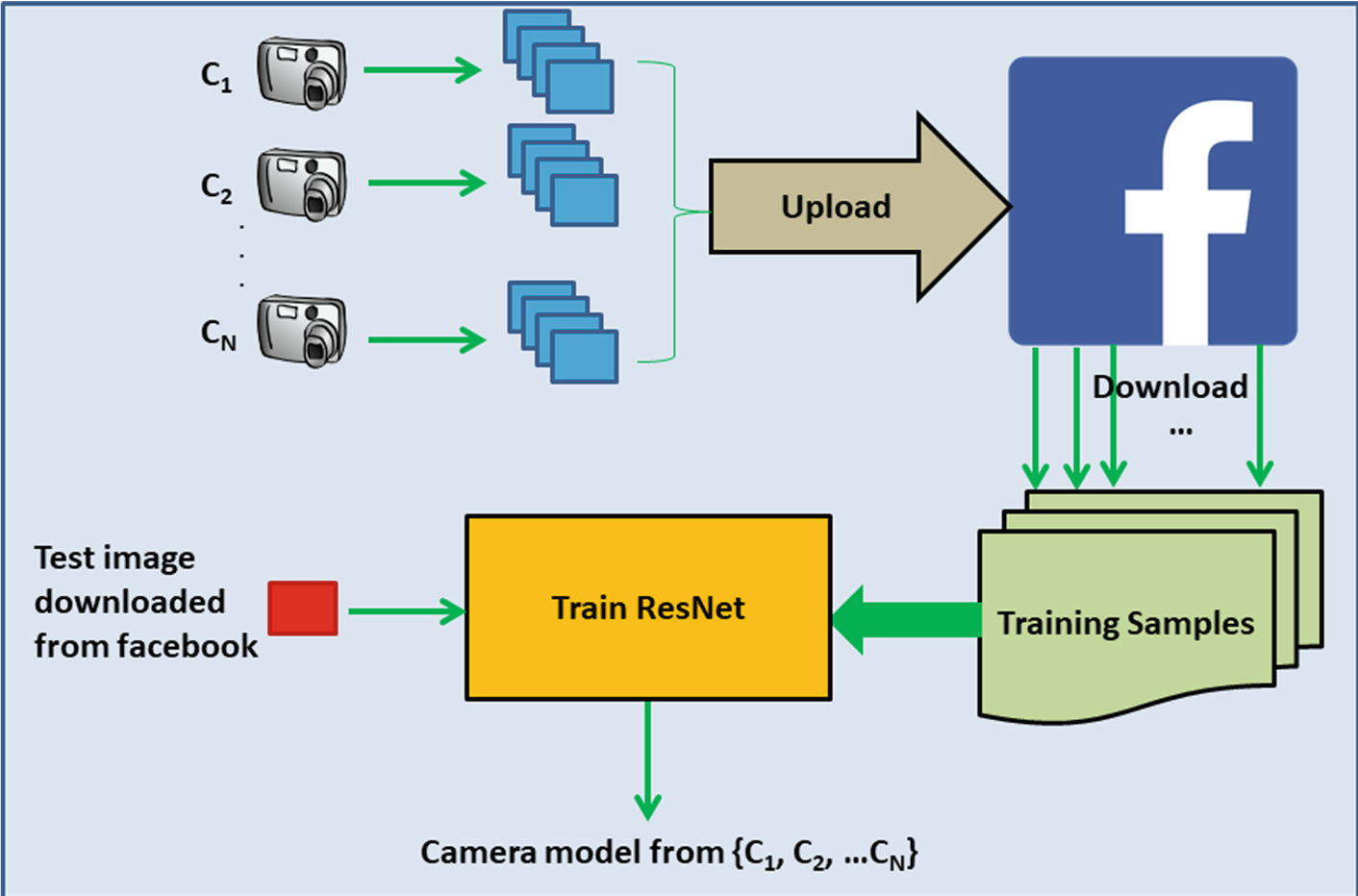 Figure 1: The training pipeline involves passing images through the Facebook OSN "black box" before training the ResNet model.
Experimental Showdown
The model was tested against the Dresden Image Database, a gold standard in forensics. The results were startling. While traditional methods struggled to break the 80% barrier, the ResNet approach hit 96%.
Comparative Performance:
| Method | Accuracy (%) |
|---|---|
| PRNU-based (Traditional) | 78.84% |
| IQM + HOWS Features | 82.20% |
| Proposed ResNet50 | 96.00% |
The confusion matrix revealed that most errors occurred between cameras with similar sensor characteristics, such as the Canon A640 and Sony H50, though these errors were minimal compared to previous benchmarks.
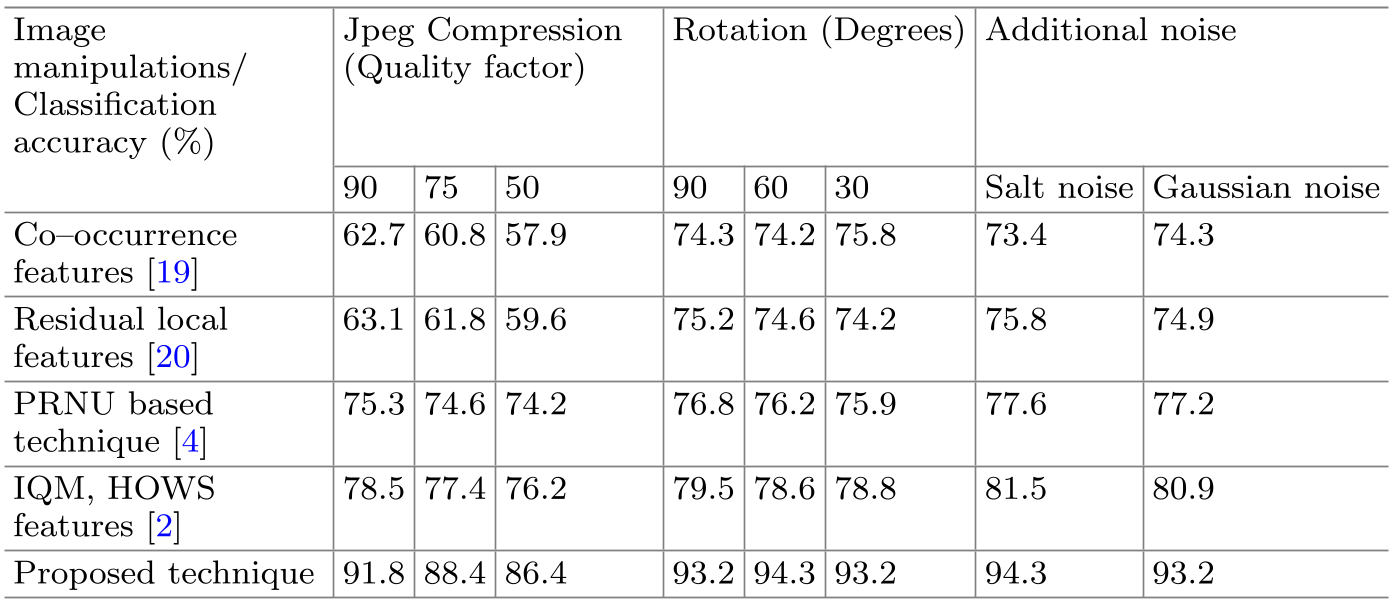 Figure 2: Robustness evaluation against JPEG compression, rotation, and noise.
Stress Testing: Is It Robust?
A forensic tool is useless if a criminal can bypass it by simply rotating the image or re-saving it. The authors tested the model against:
- Rotation (30°, 60°, 90°): Maintained >93% accuracy.
- Noise Addition: Salt & Pepper and Gaussian noise had negligible impact.
- Secondary Compression: Even when re-compressed at a low Quality Factor (QF=50), the model stayed above 86% accuracy, far outperforming any other method.
Critical Analysis & Conclusion
This paper marks a shift from hand-crafted features (like Wavelet statistics) to learned features. The primary strength is its pragmatic "black-box" approach: it doesn't need to know how Facebook compresses images; it only needs to see the results.
Limitations: The current study focuses on Camera Models, not individual serial numbers (Device Linking). While knowing a photo came from a "Nikon D70" is helpful, proving it came from the defendant's specific Nikon D70 is the next hurdle.
The Takeaway: For practitioners, this proves that deep learning can bridge the "OSN gap" in digital forensics. As social networks continue to evolve their compression, our forensic tools must move closer to the data-driven robustness displayed in this ResNet50 solution.