
Identifying Schizophrenia Risk in Children: A Deep Learning Approach to EEG
6504_Identification of Children at Risk of Schizophrenia via Deep Learning and EEG Responses.
This paper introduces an automated framework for identifying children at risk of schizophrenia (RSz) using raw EEG waveforms captured during a passive auditory oddball paradigm. The authors develop a hybrid 2D-CNN-LSTM architecture that extracts spatio-temporal features to outperform traditional ML methods, achieving a trial classification accuracy of approximately 72.5% in the initial assessment phase.
TL;DR
Researchers have developed a hybrid Deep Learning model (R-CNN) capable of identifying children at risk of schizophrenia by analyzing raw EEG responses to sound. By moving away from "hand-engineered" features and using raw waveforms, the model achieved nearly 70% accuracy in longitudinal tests, significantly outperforming traditional machine learning methods that struggled to handle the data's complexity.
Context & Motivation
Early intervention is the "holy grail" of psychiatric research. For schizophrenia, identifying vulnerability during the premorbid or prodromal phases (before full psychosis hits) can lead to treatments that mitigate disease progression.
The standard tool for this has been the passive auditory oddball paradigm—measuring how the brain reacts when a boring, repetitive sound is interrupted by something different. While experts have long looked at specific peaks like Mismatch Negativity (MMN), these markers are often too subtle in children to be reliable. Previous machine learning attempts failed because they relied on human-defined features that didn't capture the full picture.
The "How": A Hybrid R-CNN Architecture
The authors hypothesized that the "gold" is hidden in the raw, spatio-temporal dynamics of the EEG signal. They moved away from support vector machines and decision trees, opting for a custom-built 2D-CNN-LSTM network.
Why this works:
- 2D-Convolutional Layers: These act as automated feature extractors. Instead of looking for a specific peak, the CNN scans the 300ms window across 5 midline channels (Fz, FCz, Cz, CPz, Pz) to find morphological patterns humans might miss.
- LSTM Layers: EEG is a sequence. The Long Short-Term Memory units capture the "rhythm" of the brain's response over time.
- Efficiency: With only 1.3 million parameters, the model is "shallow" enough to avoid overfitting on small medical datasets—a common pitfall for massive models like ResNet.
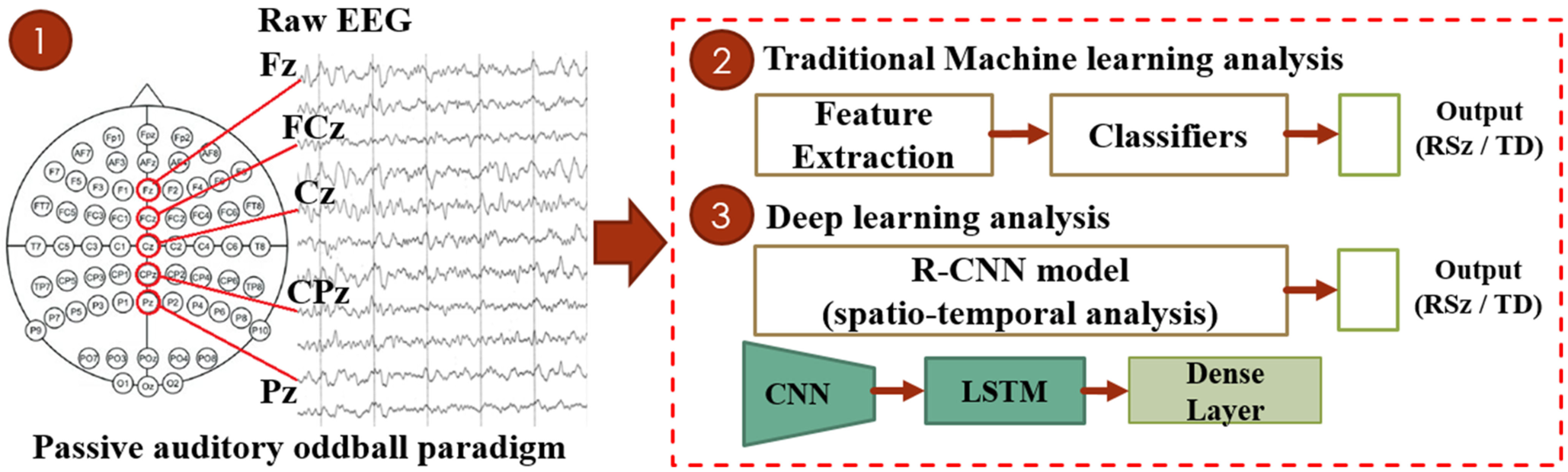 Figure 1: The dual-pathway approach comparing hand-crafted features (top) vs. the end-to-end Deep Learning pipeline (bottom).
Evidence of Success
The study followed children over 4 years (three assessment phases: A1, A2, and A3).
- The ML Failure: Traditional models like KNN and SVM achieved roughly 44% accuracy—worse than a coin flip in some contexts, proving that human-defined features (mean amplitudes) simply aren't enough to separate high-risk children from their peers.
- The DL Breakthrough: The R-CNN achieved 72.5% test accuracy in the first phase. Crucially, the model maintained its ability to identify risk as the children grew older (Phase A2 and A3), confirming that it had captured a stable, longitudinal biomarker.
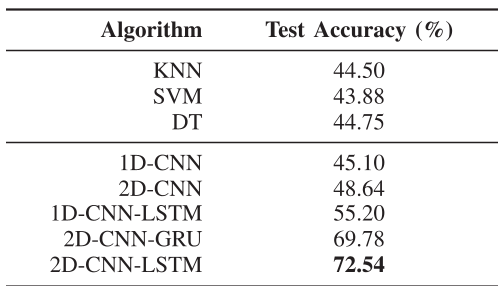 Table 2: Comparison of algorithms. Note the massive jump from 1D-CNN (45%) to the hybrid 2D-CNN-LSTM (72%).
Peeking Inside the Black Box
One of the most impressive parts of this research is the use of SHAP (SHapley Additive exPlanations). Often, deep learning is criticized for being a "black box." The authors proved their model was looking at clinically relevant data:
- Temporal Importance: The model focused heavily on the 200-225ms window.
- Spatial Importance: The CPz channel (center-parietal) was identified as the most discriminative electrode, specifically for identifying the "At-Risk" group.
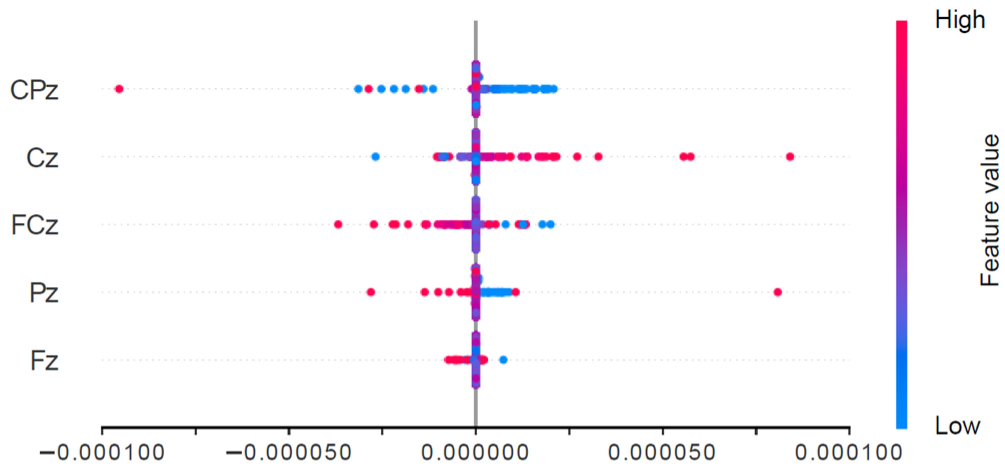 Figure 9: Impact of each channel. CPz shows the highest displacement, indicating its critical role in the model's decision-making.
Final Thoughts & Future Outlook
This paper is a significant milestone for Computational Psychiatry. It proves that the "noise" in raw EEG signals actually contains structured information about future mental health risks.
However, the authors acknowledge a hurdle: Heterogeneity. Every child’s brain is different, and the model’s performance varied across individuals. The next frontier? Memory-augmented networks or Attention mechanisms that can better handle individual variances and "learn" the unique fingerprint of a single child's brain over time.
The dream of a simple, automated EEG screen for childhood psychiatric health just got one step closer to reality.