
Beyond the Lab: Deep Hybrid Learning for Real-World Emotion Detection
Deep learning analysis of mobile physiological, environmental and location sensor data for emotion detection
This paper introduces a hybrid deep learning framework, MC-DCNN (Multi-Channels Deep Convolutional Neural Network) combined with LSTM, for real-world emotion detection. By fusing 20 channels of physiological, environmental, and location data from wearables and smartphones, the model achieves a SOTA average accuracy of 95% in "in the wild" settings.
TL;DR
Researchers have developed a hybrid CNN-LSTM model that can detect human emotions "in the wild" with 95% accuracy. Unlike previous methods that required tedious manual feature calculations, this approach processes raw data from smartphones and wristbands—combining heart rate, environmental noise, and GPS patterns—to understand how we feel as we navigate urban spaces.
Context: The "In the Wild" Challenge
Most emotion recognition research happens in a vacuum—literally. Participants sit in quiet labs watching curated videos while wired to medical-grade equipment. However, true human emotion is messy, influenced by environmental noise, location context, and physical movement.
The authors identifies a critical gap: Feature Engineering. Traditional machine learning (SVM, KNN) requires experts to decide which "features" (like mean heart rate or signal entropy) are important. This paper argues that deep learning can discover these "signatures" of emotion automatically, even in noisy, real-world environments.
Methodology: The Spatial-Temporal Powerhouse
The core innovation lies in the MC-DCNN (Multi-Channel Deep Convolutional Neural Network) + LSTM architecture.
- CNN (The Spatial Feature Extractor): The model treats 20 different sensor channels (from heart rate to UV levels) as a multi-channel input. Convolutional layers slide over this data to find local correlations between different sensors at specific moments.
- LSTM (The Temporal Memory): Emotions are not instantaneous; they have a "flow." The LSTM layer captures how these sensor patterns evolve over time, allowing the model to remember the "recent past" to predict the "current" emotional state.
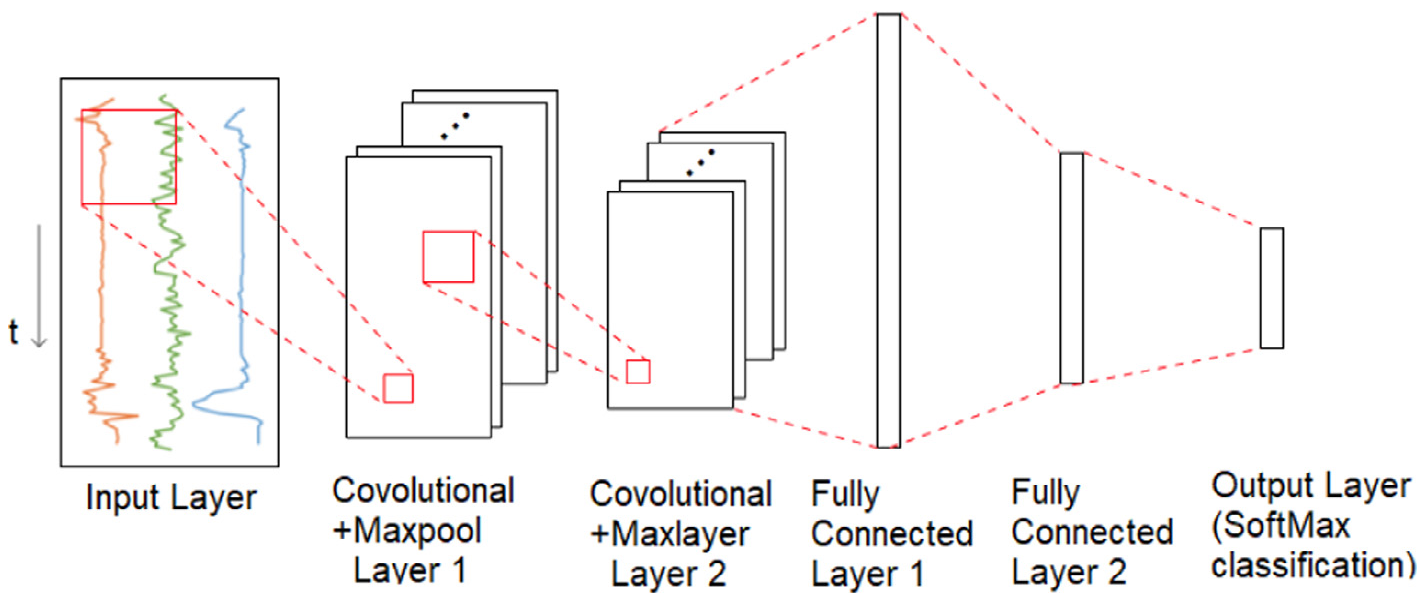 Figure 3: The CNN architecture used for extracting hierarchical features from multimodal sensor channels.
Data Fusion: Why One Sensor Isn't Enough
A unique contribution of this work is the EnvBodySens dataset. It tracks:
- On-Body: Heart Rate (HR), Galvanic Skin Response (GSR), Movement (Gyro/Accel).
- Environment: Noise levels, UV, Air Pressure.
- Location: GPS coordinates.
The study found that while On-Body data is the most robust, fusing all three modalities increased accuracy by roughly 7%. Environment and Location act as "contextual anchors" that help the model disambiguate physiological signals (e.g., differentiating between stress from a loud noise vs. physical exertion).
Results & Performance
The performance leap was substantial. By moving from a standard Multi-Layer Perceptron (MLP) to the hybrid CNN-LSTM, accuracy jumped from 73% to 95%.
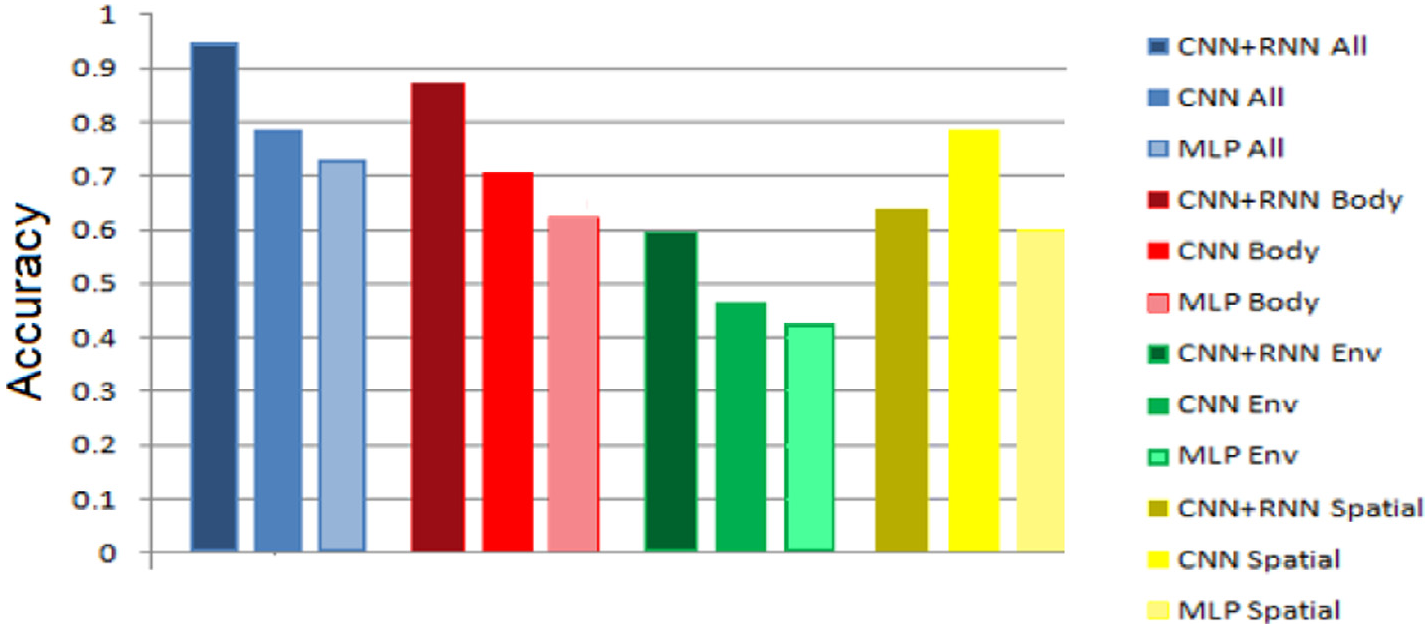 Figure 5: Comparison showing the hybrid CNN-LSTM model outperforming MLP and standard CNN across different sensor combinations.
The confusion matrices indicate that the model is particularly adept at distinguishing between neutral and high-arousal states, with the LSTM layer significantly reducing "confusion" between similar negative emotional states.
Critical Insight: The Subject Dependency Problem
Despite the high accuracy on a per-subject basis, the authors noted a significant drop (below 50%) when trying to create a "universal" model for all participants.
The Takeaway: Emotion is deeply personal. High-performing AI in this space must be personalized. Future systems will likely need "transfer learning"—starting with a general model and fine-tuning it to an individual's unique physiological "fingerprint."
Conclusion
This work marks a shift toward Naturalistic Affective Computing. By proving that deep hybrid models can handle the noise of a city walk, it opens doors for real-time mental health monitoring, personalized city planning, and human-robot interactions that actually understand how we feel in the real world.